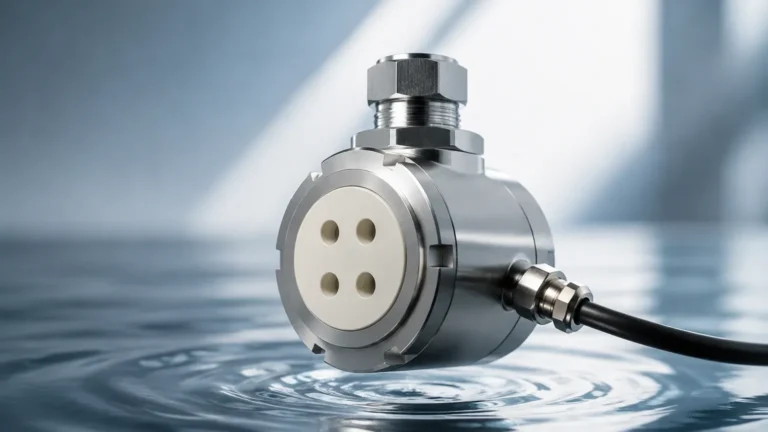
Vega Swing 63
Vega Swing 63
In the field of industrial process automation, point level detection serves as a critical safety and operational layer. The Vega Swing 63 (stylized as VEGASWING 63) is a prominent vibrating level switch designed for universal use in liquids. As a robust alternative to float switches or ultrasonic sensors for point-level applications, it utilizes the tuning fork principle to detect the presence or absence of a medium. This article provides a comprehensive engineering reference for the Vega Swing 63, its operating principles, technical specifications, and practical installation considerations for industrial environments.
Measurement Principle of Vibrating Level Switches
Before evaluating specific hardware like the Vega Swing 63, it is essential to understand the physics of vibration-based level detection. This technology, often referred to as a "tuning fork" sensor, relies on the mechanical resonance of a metal fork.
The Piezoelectric Drive
Inside the sensor housing, a piezoelectric crystal is energized to drive the tuning fork at its mechanical resonance frequency. In free air, the fork vibrates at a specific, high frequency (typically around 1,200 Hz). When the fork is immersed in a liquid medium, the density of the liquid dampens the vibration, causing a significant shift in the resonance frequency.
Frequency Detection and Switching
The integrated electronics continuously monitor the vibration frequency. Once the frequency drops below a predefined threshold due to immersion, the sensor recognizes the "covered" state. Conversely, when the liquid level falls and the fork is once again in the air, the frequency returns to its natural resonance, signaling the "uncovered" state. This change is then converted into a switching signal (e.g., relay, transistor, or NAMUR output) to trigger alarms, pumps, or valves.
Unlike float switches, which rely on mechanical movement and buoyancy, vibrating switches have no moving parts subject to wear or jamming. This makes them highly reliable for critical applications such as overfill protection or dry-run protection for pumps.
Technical Characteristics of the Vega Swing 63
The Vega Swing 63 is engineered for versatility, capable of handling extreme temperatures and pressures that would disable simpler sensors. It is often selected for processes where the chemical or physical properties of the liquid are demanding.
Material Construction and Durability
The wetted parts of the Vega Swing 63 are typically constructed from high-grade stainless steel (316L). For highly corrosive environments, exotic materials such as Hastelloy C22 are available. The sensor is designed to withstand process pressures ranging from vacuum up to 64 bar (928 psi) and process temperatures from -50 °C to +250 °C (-58 °F to +482 °F).
Application Versatility
One of the primary advantages of this specific model is its independence from the physical properties of the liquid. The switching point remains accurate regardless of:
* Dielectric Constant: Unlike capacitive sensors, it works in non-conductive oils and highly conductive acids alike.
* Density: While it requires a minimum density (standardly 0.7 g/cm³, with options for lower densities), it is largely unaffected by density fluctuations.
* Pressure and Temperature: The mechanical resonance is stable across a wide thermal and pressure envelope.
* Foam and Bubbles: The high-frequency vibration is generally not affected by surface foam or air bubbles within the liquid.
Practical Selection Criteria
When designing a level measurement system, engineers must compare vibrating switches with other technologies available on the Main Page of industrial instrumentation providers. The following table outlines the key evaluation criteria for the Vega Swing 63 compared to common alternatives.
| Feature | Vega Swing 63 (Vibrating) | Ultrasonic Point Level | Float Switch |
| :— | :— | :— | :— |
| Moving Parts | None | None | Mechanical Linkage |
| Build-up Resistance | High (Vibration sheds solids) | Medium | Low (Risk of jamming) |
| Maintenance | Minimal | Low | High |
| Pressure Range | Up to 64 bar | Typically low | Variable |
| Foam Sensitivity | Low | High | Low |
| Installation | Any orientation | Vertical preferred | Vertical preferred |
When to Choose the Vega Swing 63
This sensor is ideal for applications where high reliability is non-negotiable. It is frequently used as a redundant high-level alarm in chemical tanks to prevent environmental spills (compliant with WHG or SIL standards). It is also suitable for detecting the interface between liquid and gas in pipes to prevent pump cavitation.
Installation and Engineering Considerations
Proper installation is paramount to ensuring the longevity and accuracy of the Vega Swing 63. Engineers should follow specific guidelines regarding orientation and placement.
Mounting Orientation
The Vega Swing 63 can be mounted in any orientation—top-down, side-mounted, or even at an angle. However, the orientation of the fork blades matters in specific scenarios:
1. Horizontal Installation: In liquids that may leave deposits or build-up, the fork should be oriented so that the blades are vertical (standing on edge). This allows the liquid to drain more easily and prevents the "bridge" effect where material gets stuck between the blades.
2. Vertical Installation: When mounted from the top, the length of the sensor extension must be carefully calculated to reach the desired switching point. Extensions can range from a few centimeters to several meters.
Avoiding Turbulence and Flow
If the sensor is installed in a vessel with an agitator or near a high-velocity inlet, the mechanical forces on the fork can be significant. In such cases, a protective shield or a stilling well may be necessary to prevent mechanical fatigue or false switching caused by the force of the liquid flow.
Electrical Integration
The Vega Swing 63 offers several electronics options to match the control system architecture:
* Relay (DPDT): For direct switching of loads.
* Transistor (NPN/PNP): For high-speed switching and PLC integration.
* Two-wire (8/16mA): For loop-powered systems.
* NAMUR: For intrinsically safe applications in hazardous zones.

Limitations and Potential Risks
While the Vega Swing 63 is a highly capable instrument, it is not a "one-size-fits-all" solution. Understanding its limitations prevents costly specification errors.
High Viscosity and Clogging
In extremely viscous liquids (e.g., heavy bitumen or thick slurries), the vibration of the fork may be dampened even when the level has dropped. If the medium is so thick that it creates a permanent bridge between the fork tines, the sensor will remain in the "covered" state indefinitely. For such media, a displacement-based or radar-based solution found on the Main Page might be more appropriate.
Solids and Granulates
The Vega Swing 63 is specifically designed for liquids. While vibrating switches for solids (like the VEGAVIB or VEGAWAVE series) exist, they use different fork geometries and frequencies. Using a liquid-tuned fork in heavy bulk solids can lead to mechanical damage or failure to detect the material correctly.
Turbulence and Aeration
Extremely high levels of aeration (large gas bubbles) can occasionally cause the sensor to "see" air when it is actually submerged in a liquid-gas mixture. This is rare but should be considered in carbonated beverage production or high-speed aeration tanks.
Maintenance and Troubleshooting
One of the primary selling points of the Vega Swing 63 is its maintenance-free operation. However, periodic functional tests are required, especially in safety-instrumented systems (SIS).
Functional Testing (Proof Testing)
For SIL-rated applications, the sensor must undergo a proof test at regular intervals. This usually involves raising the liquid level to trigger the switch or using a test magnet (if equipped) to simulate the dampening effect. Modern electronics often include self-monitoring features that can detect damage to the piezo drive or the fork itself, reporting a fault via the output signal.
Troubleshooting Common Issues
* False Alarms: Often caused by heavy build-up or the fork touching the side of a narrow mounting nozzle. Ensure the fork has at least 10mm of clearance from the vessel walls.
* No Signal Change: Check the power supply and the switching threshold settings. In some cases, the density of the liquid may be lower than the factory default setting, requiring a simple adjustment via the integrated switches in the sensor head.
Frequently Asked Questions (FAQs)
Q: Can the Vega Swing 63 be used in food and beverage applications?
A: Yes, there are versions with hygienic process connections (like Tri-Clamp or SMS) and polished stainless steel finishes that meet FDA and 3-A requirements.
Q: How does the sensor handle coating or build-up?
A: The high-frequency vibration provides a self-cleaning effect for light coatings. However, if the coating is thick enough to bridge the tines, the sensor will malfunction. In these cases, regular cleaning or a different technology is required.
Q: Is it possible to shorten the sensor in the field?
A: Standard versions of the Vega Swing 63 are manufactured to a specific length and cannot be shortened. However, some tube-extended versions may offer limited adjustability depending on the specific configuration.
Q: Does the sensor require calibration?
A: No. The Vega Swing 63 is ready for operation immediately upon installation. It does not require a medium adjustment or calibration against a known level.
Conclusion
The Vega Swing 63 remains a benchmark for point level detection in the process industry. Its ability to operate in diverse conditions—from cryogenic storage to high-pressure reactors—makes it a staple for process engineers. By understanding the mechanical principles of the tuning fork and adhering to strict installation guidelines, facilities can ensure reliable overfill and dry-run protection. For those seeking a broader range of level measurement technologies, including radar, ultrasonic, and hydrostatic transmitters, exploring the comprehensive options on the Main Page is the recommended next step for project planning and procurement.