Alelo3
Alelo3
In the landscape of industrial bulk material handling, the measurement of Alelo3—commonly known in chemical and engineering contexts as Aluminum Oxide (Al₂O₃)—presents a unique set of challenges. As a primary raw material for aluminum smelting and a critical component in the production of refractories, ceramics, and abrasives, maintaining precise inventory control of Alelo3 is essential for operational efficiency. This guide examines the technical requirements for measuring Alelo3 levels in industrial silos and vessels, focusing on the physical properties of the material and the instrumentation technologies best suited for these environments.
Understanding Alelo3 in Industrial Level Measurement
Alelo3 is a white or translucent crystalline powder or granular material. From a level measurement perspective, its most significant characteristics are its dielectric constant, its abrasiveness, and its tendency to generate significant dust during pneumatic loading.
In bulk solid applications, the dielectric constant (εr) of Alelo3 typically ranges between 2.0 and 4.0, depending on its bulk density and moisture content. This relatively low dielectric value means that the material is a poor reflector of electromagnetic waves, which is a critical consideration when selecting radar-based measurement technologies. Furthermore, the high hardness of Alelo3 (9 on the Mohs scale) means that any contact-based sensors must be designed to withstand significant abrasive wear.
Effective level management of Alelo3 ensures that production lines remain fed without interruption while preventing silo overfills, which can lead to costly cleanup and equipment damage. To achieve this, engineers must understand the measurement principles that govern different sensor types.
Key Measurement Principles for Alelo3 Storage
Before selecting an instrument, it is necessary to understand how different physical principles interact with the properties of Alelo3.
Time-of-Flight (ToF) Principle
Most modern level transmitters for Alelo3 utilize the Time-of-Flight principle. The sensor emits a signal (either electromagnetic or ultrasonic) that travels to the material surface and reflects back to the transducer. The distance is calculated based on the time elapsed and the known speed of the signal. In Alelo3 silos, the accuracy of ToF depends on the strength of the return signal (the echo).
Guided Wave Radar (GWR)
Guided Wave Radar uses a physical probe (cable or rod) to guide low-power microwave pulses to the material surface. When the pulse hits the Alelo3, the change in dielectric constant causes a reflection. Because the energy is concentrated along the probe, GWR is highly effective for materials with low dielectric constants like Alelo3 powder, as it minimizes signal loss through the air.
Non-Contact Radar (Frequency Modulated Continuous Wave)
Non-contact radar, particularly those operating at high frequencies such as 80GHz, emits a continuous signal with a changing frequency. The difference in frequency between the emitted and received signal is proportional to the distance. High-frequency radar is preferred for Alelo3 because the narrow beam angle helps avoid internal silo obstructions and the high frequency provides better reflection from the fine powder surface.
Evaluating Level Sensor Technologies for Aluminum Oxide
When managing Alelo3, three primary technologies are typically considered: Radar, Ultrasonic, and Electromechanical systems.
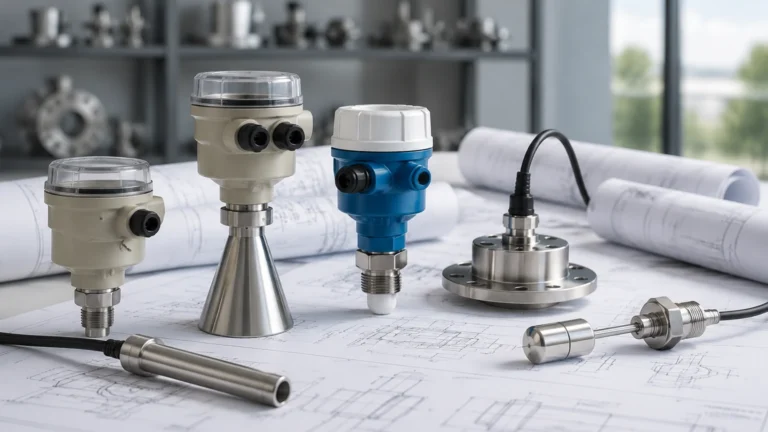
80GHz High-Frequency Radar
High-frequency radar has become the industry standard for Alelo3 measurement. The 80GHz technology allows for a very narrow beam angle (often as small as 3 degrees), which is vital in tall, narrow silos where internal bracing or ladders might otherwise cause false echoes.
* Advantages: Non-contact measurement means no wear from the abrasive Alelo3. It is largely unaffected by the heavy dust clouds generated during filling.
* Considerations: While 80GHz radar handles dust well, the low dielectric constant of Alelo3 requires a sensor with high sensitivity and advanced signal processing algorithms to distinguish the true material surface from background noise.
Guided Wave Radar (GWR)
GWR is often used in smaller bins or where the material surface is extremely turbulent.
* Advantages: It provides a very strong and reliable signal regardless of dust or air movement.
* Limitations: Because Alelo3 is highly abrasive and heavy, the downward pull (tensile load) on a GWR cable can be immense as the material settles. Engineers must ensure the silo roof and the sensor mounting can handle these forces, often exceeding several tons in large silos.
Ultrasonic Sensors
Ultrasonic sensors use sound waves to measure the distance to the Alelo3 surface.
* Advantages: Cost-effective for short-range applications.
* Limitations: Ultrasonic signals are significantly attenuated by dust. During the filling of an Alelo3 silo, the dust density is often high enough to completely block the ultrasonic signal, leading to "loss of echo" errors. Consequently, they are generally not recommended for primary Alelo3 silos.
Selection Criteria and Technical Comparison
Choosing the right instrument requires a comparison of technical specifications against the specific silo geometry and environmental conditions. The following table provides a general guideline for selecting Alelo3 level measurement solutions.
| Feature | 80GHz Non-Contact Radar | Guided Wave Radar (GWR) | Ultrasonic Sensor |
| :— | :— | :— | :— |
| Measurement Range | Up to 120m | Up to 75m | Up to 30m |
| Accuracy | ±2mm | ±2mm | ±0.25% of range |
| Dust Resistance | Excellent | Excellent | Poor |
| Abrasive Wear | None (Non-contact) | High (on probe) | None (Non-contact) |
| Dielectric Sensitivity | High | Very High | N/A (Sound based) |
| Installation Effort | Low | Moderate to High | Low |
For a comprehensive overview of available technologies and to find the best fit for your specific facility, you may Review product options and application support on our Main Page.

Installation Guidelines for Alelo3 Silos
Proper installation is as critical as technology selection. For Alelo3, several engineering factors must be addressed during the design phase.
Nozzle Positioning and Height
The mounting nozzle should be positioned such that the radar beam does not intersect the path of the incoming material flow. If the radar measures the falling stream of Alelo3 instead of the accumulated surface, the readings will be erratic. Additionally, the nozzle height should be kept as short as possible to prevent signal interference from the nozzle walls (ringing).
Angle of Repose
Alelo3, like most bulk solids, forms a cone when filled (angle of repose) and a depression when emptied. The sensor should ideally be mounted at approximately 1/3 of the radius from the silo wall to provide a measurement that represents the average volume of the material. In very large silos, multiple sensors or a 3D solids scanner may be required to map the surface accurately.
Dust Mitigation and Purging
While 80GHz radar is resistant to dust, a buildup of fine Alelo3 powder on the sensor lens can eventually attenuate the signal. Many sensors include an integrated air purge connection. Connecting a low-pressure dry air supply to the sensor flange helps keep the lens clean and ensures long-term maintenance-free operation.
Structural Tensile Loads
If using Guided Wave Radar, the tensile load calculation is mandatory. As Alelo3 settles, it exerts a downward force on the cable. For a 20-meter silo, these forces can reach 30-50 kN. The sensor must be specified with a reinforced cable, and the silo roof must be structurally reinforced at the mounting point.
Operational Limitations and Maintenance
Despite the robustness of modern level meters, certain limitations exist when measuring Alelo3:
1. Extreme Temperature: In some alumina production processes, the material may be stored at elevated temperatures. Standard sensors are typically rated to 80°C (176°F), but high-temperature versions with cooling fins or specialized seals are available for applications reaching up to 250°C (482°F).
2. Signal Absorption: Very fine Alelo3 powder can absorb signal energy. If the moisture content increases slightly, the material can become sticky, leading to "bridging" or "clinging" on the silo walls, which may interfere with GWR probes.
3. Vibration: Silos equipped with heavy-duty vibrators or air cannons to facilitate material flow can transmit mechanical noise to the sensor. High-quality instruments include vibration damping and software filters to mitigate this.
Maintenance requirements for non-contact radar are minimal, usually limited to a periodic visual inspection of the air purge system and the external housing. For GWR, the probe should be inspected annually for signs of excessive wear or deformation caused by material movement.
Frequently Asked Questions (FAQs)
Q: Can I use a pressure transmitter to measure Alelo3 levels?
A: Hydrostatic pressure transmitters are generally not suitable for dry bulk Alelo3 because the material does not behave like a fluid. It does not exert pressure equally in all directions, and the "bridging" effect can lead to highly inaccurate readings. Load cells (weighing) are an alternative, but they are significantly more expensive to retrofit than top-down level meters.
Q: How does the dielectric constant of Alelo3 affect the radar signal?
A: The dielectric constant (εr) determines how much energy is reflected back to the sensor. With Alelo3 having a low εr (2.0-4.0), only a small fraction of the radar energy is reflected. This is why high-sensitivity radar units with a high dynamic range are necessary to maintain a stable signal-to-noise ratio.
Q: Is 80GHz radar better than 26GHz radar for Alelo3?
A: Yes, in most cases. The 80GHz radar has a shorter wavelength, which reflects better from fine powders, and a narrower beam, which avoids the complex internal structures often found in industrial silos.
Q: What is the maximum height for measuring Alelo3?
A: Modern high-frequency radar units can measure bulk solids like Alelo3 at distances up to 120 meters (approx. 393 feet), provided the sensor is correctly aligned and the dust levels are within the instrument's operating parameters.
For engineers and procurement specialists looking to optimize their Alelo3 storage systems, selecting a partner with a deep understanding of industrial level measurement is paramount. By considering the physical properties of the material and the specific constraints of the storage environment, it is possible to achieve reliable, accurate, and maintenance-free level control. For more information on specific models and customized solutions, visit our Main Page.