Tuning Fork Level Switch
Tuning Fork Level Switch
In the landscape of industrial automation and process control, the tuning fork level switch stands as one of the most reliable and versatile instruments for point level detection. Often referred to as a vibrating limit switch, this device is designed to detect the presence or absence of liquids or granulated solids within a vessel. Unlike traditional float switches that rely on mechanical movement or ultrasonic sensors that can be affected by foam and vapor, the tuning fork level switch utilizes high-frequency vibration to provide precise, repeatable level monitoring in demanding environments.
For engineers and procurement professionals seeking robust measurement solutions, understanding the nuances of this technology is essential for ensuring plant safety and operational efficiency. Manufacturers like Welk provide a range of these instruments tailored for diverse applications, from water treatment to volatile chemical processing. To explore specific product specifications and technical support, you may visit the Main Page of our industrial resource site.
Measurement Principle of Tuning Fork Level Switches
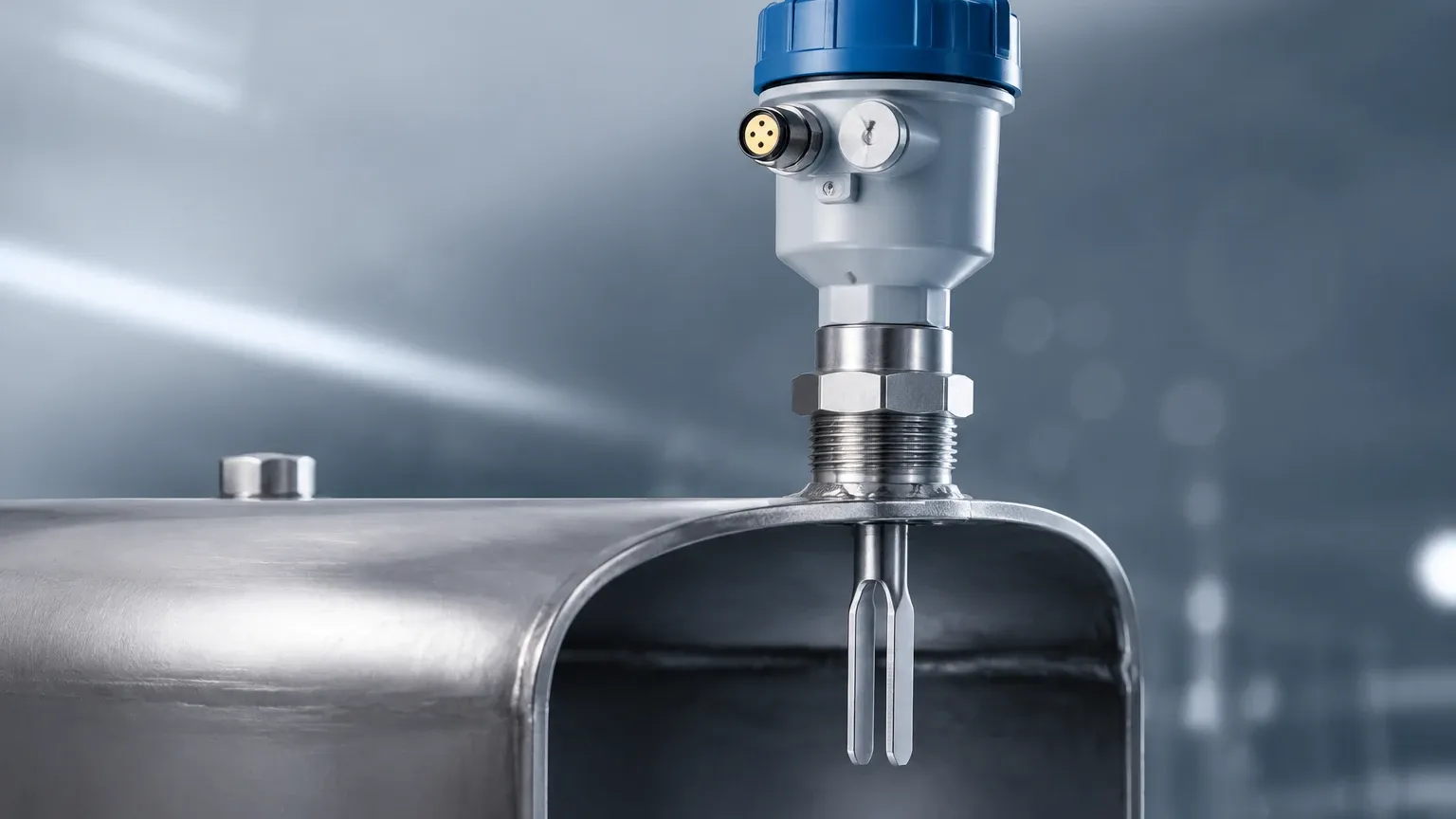
The fundamental operation of a tuning fork level switch is based on the principles of mechanical resonance and frequency shifting. The device consists of a sensor head with two tines (the "fork") and an internal electronic housing containing piezoelectric crystals.
The Vibrating Mechanism
One piezoelectric crystal is energized by an electrical signal, causing it to vibrate at its natural resonant frequency—typically around 1,200 Hz to 1,400 Hz for liquid switches and lower for solids. This vibration is transmitted to the fork tines. A second piezoelectric crystal acts as a receiver, monitoring the frequency and amplitude of the vibration.
The Detection Logic
When the fork is in the air (the "dry" state), it vibrates freely at its calibrated resonant frequency. As the process medium—whether a liquid or a powder—rises and makes contact with the tines, the vibration is damped. This contact causes a significant shift in the resonant frequency or a reduction in vibration amplitude. The internal electronics detect this change and convert it into a switching signal, such as a relay contact, a PNP/NPN transistor output, or a two-wire signal.
Because the switch relies on the physical damping of vibration rather than electrical properties like conductivity or dielectric constants, it is largely immune to changes in the medium's flow, turbulence, bubbles, foam, or vibration from external machinery.
Key Evaluation Criteria and Selection
Selecting the correct tuning fork level switch requires a detailed analysis of the process medium and the environmental conditions of the tank or pipe. The following table provides a general guideline for evaluating technical specifications during the procurement phase.
| Parameter | Liquid Applications | Solid/Granular Applications |
| :— | :— | :— |
| Minimum Density | Typically ≥ 0.7 g/cm³ (specialized ≥ 0.5 g/cm³) | Typically ≥ 0.1 g/cm³ (100 g/L) |
| Maximum Viscosity | Up to 10,000 mm²/s (cSt) | N/A (Flowability is key) |
| Pressure Range | Vacuum to 64 bar (6.4 MPa) | Vacuum to 25 bar (2.5 MPa) |
| Temperature Range | -50°C to +150°C (High-temp to 250°C) | -40°C to +150°C |
| Wetted Materials | 316L Stainless Steel, PFA Coating | 316L Stainless Steel, Alloy C |
| Output Options | Relay, PNP/NPN, 8/16mA, NAMUR | Relay, PNP/NPN |
Material Compatibility
For corrosive environments, such as those found in chemical processing or wastewater treatment, the wetted parts must be compatible with the medium. Standard 316L stainless steel is suitable for most applications, but for highly aggressive acids or bases, specialized coatings like PFA (Perfluoroalkoxy) or Halar are necessary to prevent premature sensor failure.
Sensitivity Adjustment
In applications involving light powders or aerated liquids, the ability to adjust the sensitivity of the switch is critical. High-quality tuning fork level switches allow users to calibrate the damping threshold to distinguish between the actual material level and incidental splashing or coating on the tines.
Industrial Applications
The versatility of the tuning fork level switch makes it a staple in various industries. Its lack of moving parts reduces maintenance requirements compared to mechanical switches.
1. Water and Wastewater Treatment
In water treatment plants, these switches are commonly used for pump protection (dry run prevention) and high-level alarms in chemical dosing tanks. Because they are unaffected by the presence of small debris or foam, they provide a more reliable signal than float-type sensors.
2. Chemical and Petrochemical Industry
Tuning fork switches are often deployed as overfill protection devices (High-High alarms) in storage tanks. Their ability to operate in high-pressure environments (up to 64 bar) and their availability with explosion-proof certifications (ATEX/IECEx) make them suitable for volatile hydrocarbons and solvents.
3. Food and Beverage Processing
For hygienic applications, tuning fork switches are designed with polished surfaces (Ra < 0.8 μm) and sanitary connections like Tri-Clamp. They are used to monitor the level of syrups, juices, and milk, where they must withstand Clean-in-Place (CIP) and Steam-in-Place (SIP) cycles at temperatures reaching 150°C.
4. Bulk Solids and Powder Handling
In silos containing plastic pellets, flour, or cement, the tuning fork level switch detects the presence of solids. It is particularly effective for low-density powders where a rotary paddle switch might fail due to mechanical resistance or motor burnout.
Installation Considerations and Best Practices
Proper installation is paramount to the longevity and accuracy of a tuning fork level switch. Incorrect orientation or placement can lead to false readings or physical damage to the sensor.
Orientation and Positioning
* Side Mounting: When installed horizontally, the tines should be oriented vertically (one above the other) to allow the medium to flow freely through the fork and prevent material buildup between the tines. This is especially important for viscous liquids or granulated solids.
* Top Mounting: For high-level detection from the top of a vessel, the switch should be installed away from the filling inlet to avoid false triggers caused by the incoming material stream.
* Pipe Mounting: In small-diameter pipes, ensure the fork is oriented parallel to the flow direction to minimize flow resistance and prevent the accumulation of solids.
Avoiding the "Bridge" Effect
In solid applications, material can sometimes bridge across the two tines, creating a false "full" signal even when the level has dropped. To prevent this, ensure the switch is not installed in a "dead zone" where material stagnates. For very sticky materials, a switch with wider tine spacing or a specialized coating may be required.
Electrical Wiring
Most industrial tuning fork switches offer a universal power supply (20-250V AC/DC). It is vital to ensure that the cable gland is tightened and points downward to prevent moisture from entering the housing through the conduit. Using shielded cables in environments with high electromagnetic interference (EMI) will also ensure signal integrity.
Limitations and Common Risks
While highly reliable, the tuning fork level switch is not a universal solution for every process. Engineers should be aware of the following limitations:
1. Heavy Build-up: While designed to ignore minor coating, extremely thick or sticky material that bridges the gap between the tines will cause a permanent switch state change. Regular cleaning or the use of a different technology (like a radio frequency admittance probe) may be necessary in these cases.
2. Large Particle Size: In solids handling, if the particle size is larger than the gap between the tines (typically around 15-20 mm), the particles can become wedged, leading to mechanical damage or false signals.
3. Extreme Turbulence: In tanks with high-speed agitators, the physical force of the liquid hitting the tines can cause mechanical fatigue. In such scenarios, a protective baffle should be installed to shield the sensor.
4. Air Bubbles in Liquids: While the switch is generally immune to small bubbles, a high concentration of entrained air (aeration) can lower the effective density of the liquid below the switch's detection threshold, leading to a failure to trigger.
Frequently Asked Questions (FAQ)
Q: Can a tuning fork level switch be used for interface detection?
A: Generally, no. Standard tuning fork switches are designed for point level detection (liquid vs. air). While some high-sensitivity models can detect the interface between two liquids of significantly different densities (e.g., oil and water), this is not their primary function.
Q: How do I test the switch without filling the tank?
A: Most modern switches include a magnetic test point on the housing. By placing a magnet against this point, you can simulate a "covered" state to test the relay and alarm circuits. Alternatively, simply touching the tines with your hand (if safe) will damp the vibration and trigger the switch.
Q: What is the typical lifespan of these sensors?
A: Because there are no moving parts to wear out, a tuning fork level switch can last 10-15 years in clean, non-corrosive environments. In abrasive or corrosive applications, the lifespan depends on the material selection and maintenance frequency.
Q: Does the switch require calibration for different liquids?
A: In most cases, no. As long as the liquid density is above the minimum threshold (usually 0.7 g/cm³), the switch will function without adjustment. Calibration is only typically required for extremely low-density fluids or solids.
Conclusion and Technical Support
The tuning fork level switch remains a cornerstone of modern industrial level measurement due to its reliability, lack of moving parts, and immunity to varying process conditions. By carefully considering the density, viscosity, and chemical compatibility of the medium, engineers can implement a solution that significantly reduces the risk of overfills or pump damage.
For technical documentation, detailed wiring diagrams, and a comprehensive catalog of level measurement instruments, including radar and ultrasonic sensors, please refer to the Main Page. Our team at Welk is committed to providing accurate and cost-effective measurement solutions tailored to your specific industrial automation needs.