Dielectric Constant of Ethyl Acetate
Dielectric Constant of Ethyl Acetate
In industrial process control, the accuracy of level measurement is often dictated by the physical and electrical properties of the medium being measured. For chemical engineers and instrumentation specialists working with solvents, the dielectric constant of ethyl acetate is a fundamental parameter. Understanding this value is not merely a matter of chemical record; it is the deciding factor in whether a radar level meter, a capacitance probe, or an ultrasonic sensor will provide reliable data in a storage tank or reactor.
Ethyl acetate ($CH_3COOCH_2CH_3$) is a widely used ester in the production of coatings, adhesives, and pharmaceuticals. From a measurement perspective, it presents a unique set of challenges. It is volatile, flammable, and possesses a moderate dielectric constant that sits between the highly reflective nature of water and the transparent nature of pure hydrocarbons. This article examines the dielectric properties of ethyl acetate and provides a technical framework for selecting and installing level measurement instrumentation.
The Role of Dielectric Constant in Level Measurement
Before selecting a sensor, it is essential to understand the measurement principles that rely on the dielectric constant (relative permittivity, $\varepsilon_r$). The dielectric constant is a measure of a material's ability to store electrical energy in an electric field. In the context of level instrumentation, it primarily affects two technologies: Radar (both non-contact and guided wave) and Capacitance.
Radar Measurement Principle
Radar level transmitters operate on the Time-of-Flight (ToF) principle. They emit electromagnetic pulses that travel through the vapor space and reflect off the surface of the liquid. The strength of this reflection is directly proportional to the dielectric constant of the liquid.
When a radar wave hits a boundary between two materials with different dielectric constants (e.g., air with $\varepsilon_r \approx 1$ and ethyl acetate with $\varepsilon_r \approx 6$), a portion of the energy is reflected. If the dielectric constant is very low (less than 1.5), the reflection is so weak that the sensor may "see through" the liquid to the tank bottom. With a dielectric constant of ethyl acetate hovering around 6.0, the reflection is generally sufficient for reliable detection, provided the correct antenna or probe configuration is used.
Capacitance Measurement Principle
Capacitance sensors treat the tank as a large capacitor. The sensor probe acts as one electrode, and the tank wall (if metallic) acts as the second electrode. The liquid between them acts as the dielectric material. As the level of ethyl acetate rises, it displaces air. Because the dielectric constant of ethyl acetate is significantly higher than that of air, the total capacitance of the system increases. The transmitter converts this change in capacitance into a level reading. For this technology, a stable dielectric constant is required for high accuracy.
Quantifying the Dielectric Constant of Ethyl Acetate
The dielectric constant of ethyl acetate is not a fixed number; it fluctuates based on environmental conditions, most notably temperature. For engineering calculations, the following values are typically used as benchmarks:
* At 20°C (68°F): $\varepsilon_r \approx 6.02$
* At 25°C (77°F): $\varepsilon_r \approx 5.9$ to $6.0$
* Temperature Coefficient: The dielectric constant generally decreases as the temperature increases. This occurs because increased thermal agitation prevents the molecular dipoles from aligning as easily with the applied electric field.
Compared to other common industrial fluids, ethyl acetate is considered a "medium" dielectric fluid. For comparison:
* Deionized Water: $\varepsilon_r \approx 80$
* Ethanol: $\varepsilon_r \approx 24$
* Ethyl Acetate: $\varepsilon_r \approx 6$
* Toluene: $\varepsilon_r \approx 2.4$
Because the value is approximately 6, ethyl acetate provides a much stronger radar return than oils or fuels, but it requires more sensitive signal processing than aqueous solutions.
Selecting Level Measurement Technology for Ethyl Acetate
Choosing the right instrument involves balancing the dielectric properties with the physical state of the process (pressure, temperature, and agitation). For comprehensive product specifications and application support, engineers should consult the Main Page of professional manufacturers like Welk to ensure the hardware meets the chemical compatibility requirements of esters.
1. Guided Wave Radar (GWR)
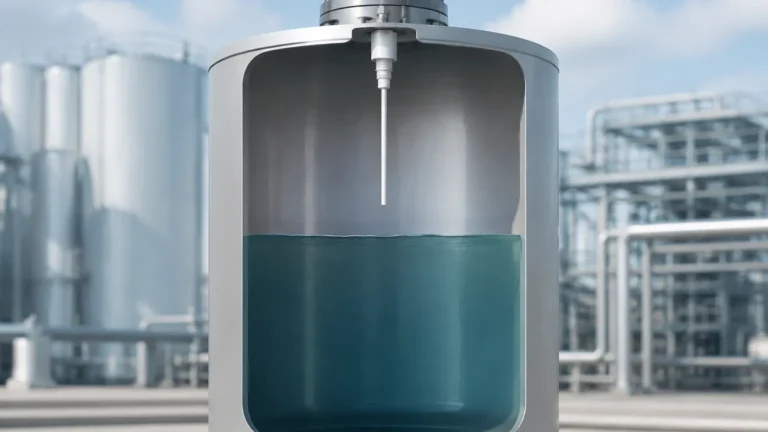
GWR is often the preferred choice for ethyl acetate. It uses a physical probe (waveguide) to direct the microwave pulse. This minimizes signal loss and is less affected by surface turbulence or foam. Since the dielectric constant of ethyl acetate is 6, a GWR sensor will produce a clear, unambiguous pulse reflection at the surface.
2. Non-Contact Radar
Non-contact radar is ideal for corrosive or hygienic applications where the sensor should not touch the medium. With a dielectric constant of 6, high-frequency radar (such as 26GHz or 80GHz) is highly effective. The narrower beam angles of high-frequency units help avoid internal tank obstructions, which is critical when the reflected signal is of moderate strength.
3. Ultrasonic Sensors
Ultrasonic sensors do not rely on the dielectric constant; they rely on sound waves. However, ethyl acetate is a volatile organic compound (VOC). In closed tanks, the vapor space will be saturated with ethyl acetate vapors. These vapors change the speed of sound compared to air, which can lead to significant measurement errors unless the sensor is equipped with temperature and vapor compensation. Generally, radar is preferred over ultrasonic for this specific solvent.
4. Hydrostatic Pressure Transmitters
Hydrostatic sensors measure the pressure exerted by the liquid column. This method is independent of the dielectric constant but depends on the density of the fluid. Ethyl acetate has a density of approximately 0.902 g/cm³ at 20°C. If the process temperature varies significantly, the density change must be accounted for to maintain accuracy.
Technical Selection Table
| Technology | Suitability for Ethyl Acetate | Dependency on $\varepsilon_r$ | Key Advantage |
| :— | :— | :— | :— |
| Guided Wave Radar | Excellent | High | Immune to vapor and turbulence. |
| Non-Contact Radar | Good | High | Non-invasive; low maintenance. |
| Capacitance | Fair | Absolute | Cost-effective for simple point level. |
| Ultrasonic | Poor to Fair | None | No contact, but vapor interference is high. |
| Hydrostatic | Good | None | Reliable if density is constant. |

Installation and Engineering Considerations
When installing a level meter in an ethyl acetate application, several practical factors must be addressed to ensure the dielectric constant of ethyl acetate does not lead to measurement failure.
Vapor Space and Condensation
Ethyl acetate has a relatively high vapor pressure. In outdoor tanks, temperature swings can cause condensation on the radar antenna or GWR probe. While a dielectric constant of 6 is high enough to be detected through thin films, heavy condensation can attenuate the signal. Using a PTFE-coated probe or an antenna with a dripping cone design can mitigate this risk.
Tank Geometry and Internal Obstructions
In vessels with agitators, heating coils, or baffles, the moderate reflection from the ethyl acetate surface may be competing with "noise" from these metal structures. It is critical to map the tank (False Echo Suppression) when the tank is empty to ensure the transmitter ignores these static reflections.
Hazardous Area Requirements
Ethyl acetate is a Class 1, Flammable Liquid. Any level measurement device must be appropriately rated (e.g., ATEX, IECEx, or UL/CSA hazardous area certifications). Intrinsically safe (Ex ia) or Explosion-proof (Ex d) housings are mandatory for safety compliance.
Material Compatibility
As an ester, ethyl acetate can degrade certain elastomers. When selecting a level meter, ensure that O-rings and seals are made of compatible materials such as PTFE (Teflon) or Kalrez. Standard Buna-N or EPDM seals may swell or dissolve when exposed to ethyl acetate.
Limitations and Potential Risks
While measuring ethyl acetate is common, engineers should be aware of the following limitations:
1. Low Dielectric Shifts: If ethyl acetate is mixed with other solvents (such as heptane or toluene), the effective dielectric constant of the mixture will drop. If the $\varepsilon_r$ falls below 2.0, standard non-contact radar may struggle without a high-gain antenna.
2. Boiling and Turbulence: If the ethyl acetate is at its boiling point, the surface will be turbulent and the vapor space dense. This scatters radar signals. In these scenarios, a GWR with a coaxial bypass chamber (stilling well) is the only reliable solution.
3. Coating and Buildup: If the ethyl acetate contains dissolved solids (like resins in a paint mixing application), these can coat the probe. While radar is resistant to some coating, extreme buildup will eventually affect the signal timing.
Frequently Asked Questions (FAQ)
Q: Can I use a standard float switch for ethyl acetate?
A: Yes, provided the materials of construction (stainless steel and compatible gaskets) are resistant to the solvent. However, float switches do not provide continuous level data and are prone to mechanical failure in viscous or dirty applications.
Q: How does the dielectric constant of ethyl acetate compare to water?
A: It is significantly lower. Water has a dielectric constant of about 80, making it a "perfect" target for radar. Ethyl acetate, at approximately 6, reflects only a fraction of the energy that water does, requiring more sensitive electronics.
Q: Is a stilling well necessary for radar measurement of ethyl acetate?
A: It is not strictly necessary if the surface is calm and the tank is free of obstructions. However, if there is heavy agitation or if the dielectric constant of the mixture might drop, a stilling well or a guided wave radar probe will significantly improve signal reliability.
Q: Does pressure affect the dielectric constant?
A: For liquids like ethyl acetate, pressure has a negligible effect on the dielectric constant. Temperature is the primary environmental variable that causes the $\varepsilon_r$ to shift.
Conclusion
The dielectric constant of ethyl acetate is a pivotal specification for any automated level control system. At a value of approximately 6.0, it allows for the successful use of advanced radar technologies, provided that engineers account for the solvent's volatility and flammability. By selecting high-quality instrumentation from established manufacturers like Welk and following rigorous installation standards, facilities can achieve precise, maintenance-free level monitoring. For further technical guidance on selecting the appropriate hardware for your specific process conditions, visit the Main Page for detailed product comparisons and engineering support.