What Does the Delta Pressure Method Mean
What Does the Delta Pressure Method Mean
In the field of industrial process control, accurate level measurement is fundamental to safety, efficiency, and inventory management. Among the various technologies available, the differential pressure (DP) method—often colloquially referred to as the "delta pressure" method—remains one of the most widely used and versatile techniques. But what does the delta pressure method mean in a practical engineering context, and how does it function across different industrial environments?
At its core, the delta pressure method is a technique used to determine the level of a liquid in a vessel by measuring the pressure difference between two distinct points. This method relies on the principles of hydrostatics and the physical relationship between fluid height, density, and gravity. By understanding these fundamentals, engineers can effectively specify, install, and maintain level measurement systems that offer high reliability and cost-effectiveness.
The Fundamental Measurement Principle
To answer the question of what does the delta pressure method mean, one must first look at the physics of hydrostatic pressure. According to Pascal's Law, the pressure exerted by a static liquid column is directly proportional to its height. The mathematical representation of this principle is:
P = ρ · g · h
Where:
* P is the hydrostatic pressure (typically measured in Pascals or bar).
* ρ (rho) is the density of the liquid (kg/m³).
* g is the acceleration due to gravity (approximately 9.81 m/s²).
* h is the height of the liquid column (meters).
In a level measurement application, gravity and density are usually treated as constants (though density variations due to temperature must be considered). Therefore, the pressure measured at the bottom of a tank is a direct indicator of the liquid level.
The term "delta pressure" (represented by the Greek letter Δ) refers to the subtraction of one pressure value from another. In level sensing, this is the difference between the total pressure at the bottom of the vessel and the pressure existing above the liquid surface. This subtraction is critical because it isolates the pressure generated solely by the liquid height, removing the influence of any overhead gas pressure or atmospheric fluctuations.
Open vs. Closed Tank Applications
The application of the delta pressure method varies significantly depending on whether the vessel is open to the atmosphere or pressurized.
Open (Atmospheric) Tanks
In an open tank, the surface of the liquid is exposed to the atmosphere. The pressure at the bottom of the tank is the sum of the atmospheric pressure plus the hydrostatic pressure of the liquid. To measure the level, a DP transmitter is used with its "High Side" (H) port connected to the bottom of the tank and its "Low Side" (L) port vented to the atmosphere. The transmitter calculates the difference (Delta P) between the tank bottom and the atmosphere, which equals the liquid's hydrostatic head.
Closed (Pressurized) Tanks
In closed vessels, such as boilers or chemical reactors, the space above the liquid is often filled with pressurized gas or vapor. If we only measured the pressure at the bottom, the reading would include both the liquid weight and the gas pressure, leading to a massive error.
In this scenario, the delta pressure method means connecting the High Side of the transmitter to the bottom of the vessel and the Low Side to the top of the vessel (the vapor space). The transmitter then subtracts the top pressure from the bottom pressure. The resulting "delta" is the pressure exerted only by the liquid column, regardless of how much the internal tank pressure fluctuates.
Key Components of a Delta Pressure System
A standard DP level measurement setup involves several critical components that ensure the signal is accurate and the instrument is protected:
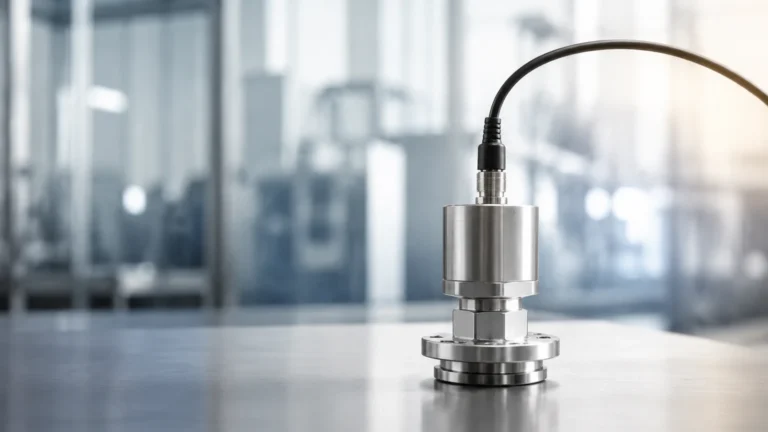
1. The DP Transmitter: The heart of the system, containing a sensing element (often a piezoresistive or capacitive sensor) that converts the physical pressure difference into an electrical signal, typically 4-20mA or a digital protocol like HART.
2. Impulse Lines: Small-diameter pipes that carry the pressure from the process vessel to the transmitter.
3. Manifolds: Usually a 3-valve or 5-valve assembly that allows for the isolation of the transmitter from the process for calibration or maintenance without shutting down the entire system.
4. Remote Seals (Capillaries): Used when the process fluid is corrosive, highly viscous, or prone to plugging impulse lines. These seals use a flexible diaphragm and a fill fluid (like silicone oil) to transmit the pressure to the sensor.
Selection Criteria for DP Level Measurement
When choosing a system, engineers must evaluate several factors to ensure the delta pressure method is appropriate for their specific application. For those reviewing various measurement technologies, the Main Page of Welk offers a broad overview of how DP transmitters compare to radar and ultrasonic alternatives.
| Selection Factor | Engineering Consideration |
| :— | :— |
| Fluid Density | Must be constant or compensated for; changes in density directly affect accuracy. |
| Chemical Compatibility | Diaphragm materials (316L SS, Hastelloy, Tantalum) must resist corrosion. |
| Temperature Range | High temperatures may require remote seals or cooling spacers to protect the electronics. |
| Pressure Rating | The transmitter must withstand the maximum static pressure of the vessel. |
| Accuracy Requirements | DP methods typically offer 0.075% to 0.1% accuracy of the calibrated span. |
Installation Considerations: Wet Legs vs. Dry Legs
One of the most complex aspects of what does the delta pressure method mean in pressurized tanks is the management of the "Low Side" impulse line. Depending on the nature of the gas in the vapor space, engineers must choose between a dry leg and a wet leg.
* Dry Leg: Used when the gas in the vapor space will not condense at ambient temperatures (e.g., dry nitrogen). The impulse line remains filled with gas, and no liquid accumulates. If condensation occurs, it will create a "liquid slug" that adds unintended pressure to the Low Side, causing a measurement error.
* Wet Leg: Used when the vapor is likely to condense (e.g., steam). The Low Side impulse line is intentionally filled with a known liquid (usually the process fluid or water). This creates a constant, predictable pressure on the Low Side. The transmitter is then calibrated to "zero out" this constant head, allowing it to measure the changing level on the High Side accurately.

Limitations and Risks of the Delta Pressure Method
While highly reliable, the delta pressure method is not without its limitations. Understanding these risks is essential for preventing process failures:
1. Density Sensitivity: Since the transmitter measures weight, not volume or actual distance, any change in the liquid's specific gravity (SG) will cause an error. For example, if a liquid expands due to heat, its density drops. The DP transmitter will sense less pressure and report a lower level, even though the actual volume has increased.
2. Impulse Line Clogging: In applications with slurries or solids, impulse lines can become blocked. This requires regular flushing or the use of flush-mounted remote seals.
3. Temperature Effects on Capillaries: In systems using remote seals with long capillary tubes, ambient temperature changes can cause the fill fluid to expand or contract. This "thermal shift" can introduce small errors in the delta pressure reading.
4. Mechanical Complexity: Compared to non-contact methods like radar, the DP method requires more mechanical connections (taps, valves, lines), which represent potential leak points.
Comparison with Other Technologies
In modern industrial automation, the delta pressure method is often weighed against non-contact technologies such as radar and ultrasonic sensors.
* Radar Level Meters: These are independent of density and are excellent for varying liquids. However, they can be more expensive and may struggle with heavy foam or internal tank obstructions.
* Ultrasonic Sensors: These are cost-effective for simple water applications but are sensitive to surface turbulence, dust, and vapor layers that can attenuate the sound wave.
* Delta Pressure: The primary advantage of DP is its ability to work in high-pressure, high-temperature environments where electronic components of non-contact sensors might fail. It is also the standard for measuring interface levels (the boundary between two immiscible liquids of different densities).
Frequently Asked Questions (FAQ)
Q: Can the delta pressure method be used for solids?
No, the DP method relies on hydrostatic pressure, which is a property of fluids. For powders or granules, radar or mechanical switches are preferred.
Q: How often should a DP transmitter be calibrated?
Calibration frequency depends on the criticality of the process and the stability of the instrument. Most modern transmitters have very low drift and are calibrated every 1 to 2 years.
Q: What happens if the tank is vacuum-rated?
The delta pressure method works perfectly in vacuum conditions, provided the transmitter is rated for absolute vacuum and the remote seal fill fluid is degassed to prevent boiling within the capillaries.
Q: Does tank shape affect the measurement?
The pressure at the bottom is determined only by the vertical height of the liquid, not the shape or width of the tank. However, if you need to convert that level into a volume reading (e.g., liters or gallons), the tank geometry must be programmed into the control system or the transmitter's strapping table.
Conclusion
Understanding what does the delta pressure method mean is a prerequisite for any engineer working in liquid processing. It is a robust, time-tested technology that converts the weight of a liquid into a precise level reading. While it requires careful consideration of fluid density and impulse line configuration, its reliability in pressurized environments makes it an indispensable tool in the industrial arsenal.
For those looking to implement these solutions, selecting the right hardware is the next step. From standard hydrostatic transmitters to advanced remote seal systems, choosing a partner with a deep understanding of application engineering is vital. To explore a full range of industrial measurement solutions, including radar and ultrasonic options, you can Review product options and application support to find the best fit for your specific process requirements.