Pressurized Hydrogen
Pressurized Hydrogen
As the global industrial landscape shifts toward decarbonization, pressurized hydrogen has emerged as a cornerstone of the new energy economy. Hydrogen, the most abundant element in the universe, offers a high energy content by mass but presents significant challenges due to its extremely low density at ambient conditions. To make hydrogen commercially viable for transport, storage, and industrial use, it must be compressed to high pressures or liquefied at cryogenic temperatures. For engineers and facility managers, managing pressurized hydrogen requires a deep understanding of fluid dynamics, material science, and precise level measurement technologies to ensure safety and operational efficiency.
In industrial applications, hydrogen is typically stored as a compressed gas in high-pressure tanks or as a cryogenic liquid. Each state requires specific instrumentation strategies. Accurate level and volume monitoring are essential not only for inventory management but also for preventing overfill conditions and ensuring the integrity of the storage vessel. This article explores the technical nuances of measuring and managing pressurized hydrogen in industrial environments.
The Role of Level Measurement in Pressurized Hydrogen Storage
Storing hydrogen under pressure introduces several physical variables that complicate standard measurement practices. Unlike water or heavy oils, hydrogen is highly diffusive and has a very low molecular weight. When stored as a liquid (LH2), it must be kept at temperatures below -253°C (-423°F). When stored as a compressed gas, pressures can range from 200 bar (2,900 psi) in industrial cylinders to 700 bar (10,150 psi) or more in automotive refueling stations.
Level measurement in these vessels serves as the primary data point for process control. In a pressurized tank, the "level" typically refers to the interface between the liquid phase and the gas phase (the ullage space). Because hydrogen systems are closed and highly pressurized, the instrumentation must be capable of withstanding extreme mechanical stress while maintaining high sensitivity. Furthermore, because hydrogen is highly flammable and has a wide range of explosive concentrations in air, all instrumentation must meet stringent hazardous area certifications, such as ATEX or IECEx.
Measurement Principles for Hydrogen Systems
Before selecting an instrument, it is critical to understand the physics of how different technologies interact with pressurized hydrogen. The following principles are the most commonly applied in modern industrial settings.
Radar Level Measurement (Non-Contact)
Radar level meters operate on the Time-of-Flight (ToF) principle. The device emits high-frequency electromagnetic pulses (typically in the GHz range) that travel through the gas space, reflect off the surface of the liquid hydrogen, and return to the sensor. The distance is calculated based on the time taken for the signal to return.
However, hydrogen presents a specific challenge for radar: its dielectric constant ($ε_r$) is extremely low, approximately 1.23 for liquid hydrogen. Most standard radar units require a higher dielectric constant to produce a strong reflection. To measure pressurized hydrogen effectively, high-sensitivity radar systems with advanced signal processing are required to distinguish the weak reflection from the liquid surface from background noise. Non-contact radar is preferred for high-pressure applications because it does not require a probe to be submerged in the medium, reducing the number of potential leak points.
Guided Wave Radar (GWR)
Guided Wave Radar also uses the ToF principle but directs the electromagnetic pulse along a physical probe (waveguide). This method is significantly more effective for low-dielectric media like pressurized hydrogen because the probe concentrates the energy, resulting in a stronger return signal. GWR is highly accurate and is not affected by changes in pressure or temperature within the tank. The primary consideration for GWR in hydrogen service is the mechanical integrity of the probe and the seals where the probe enters the pressurized vessel.
Differential Pressure (DP) Level Measurement
Hydrostatic level measurement relies on the principle that the pressure at the bottom of a vessel is proportional to the height of the liquid column multiplied by its density. In a pressurized hydrogen tank, a differential pressure transmitter is used. One side of the transmitter measures the total pressure (liquid head + gas pressure), while the other side measures only the gas pressure (top of the tank). The difference between the two provides the liquid level.
In pressurized hydrogen applications, DP measurement faces the challenge of hydrogen permeation. Hydrogen atoms are small enough to diffuse through the metal diaphragms of standard pressure sensors. To combat this, specialized diaphragms, often gold-plated, are used to provide a more effective barrier against atomic hydrogen diffusion.
Magnetic Level Gauges (MLG)
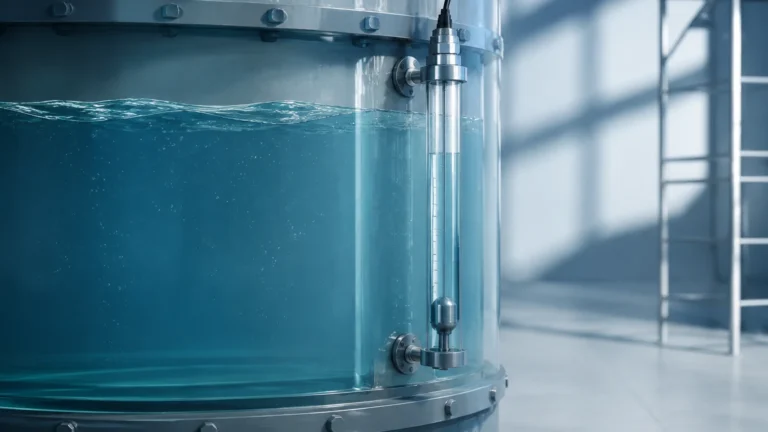
An MLG consists of a bypass chamber attached to the side of the tank. Inside the chamber, a float containing a high-intensity magnet moves up and down with the liquid level. Outside the chamber, a visual indicator or a transmitter tracks the position of the float. This is a robust, mechanical solution that provides a clear visual reference without requiring power. For pressurized hydrogen, the float must be engineered to withstand the high external pressure without collapsing while remaining buoyant enough to float in low-density liquid hydrogen.
Key Evaluation Criteria for Instrument Selection
When evaluating instrumentation for pressurized hydrogen, engineers must look beyond basic measurement accuracy. The unique properties of hydrogen demand specific material and safety considerations.
Material Compatibility and Hydrogen Embrittlement
Hydrogen embrittlement is a phenomenon where hydrogen atoms diffuse into the crystalline structure of metals, making them brittle and prone to cracking. This is especially dangerous in high-pressure systems. Instruments must be constructed from materials resistant to this effect. Austenitic stainless steels, such as 316L, are generally preferred. For higher-pressure applications, high-nickel alloys or specifically treated metals may be necessary. For more information on selecting compatible materials for level instrumentation, you can visit the Main Page of the Welk product catalog.
Pressure and Temperature Ratings
The instrument must be rated for the maximum allowable working pressure (MAWP) of the vessel. In hydrogen storage, thermal expansion can cause rapid pressure spikes. Furthermore, if the hydrogen is in a cryogenic state, the instrument must handle temperatures as low as 20 K. Thermal insulation and specialized mounting (such as standoff pipes) are often required to protect the electronic components from extreme cold.
Sealing Integrity and Leak Prevention
Hydrogen is the smallest molecule and will leak through seals that are perfectly adequate for other gases. Instrumentation for pressurized hydrogen often utilizes hermetic seals, welded connections, or specialized O-rings made of materials like PTFE or Viton, depending on the temperature. Minimizing the number of threaded connections and opting for flanged or welded interfaces is standard practice in high-pressure hydrogen engineering.
Selection Table for Hydrogen Level Instruments
The following table provides a comparison of common technologies used in pressurized hydrogen applications.
| Technology | Accuracy | Suitability for Low $ε_r$ | Pressure Limits | Key Advantage |
| :— | :— | :— | :— | :— |
| Non-Contact Radar | High (±2mm) | Moderate (Requires high sensitivity) | Up to 100+ bar | No contact with medium; low maintenance. |
| Guided Wave Radar | Very High (±1mm) | Excellent | Up to 400 bar | Strong signal even with low-density fluids. |
| Differential Pressure | Moderate | N/A (Density dependent) | Very High (600+ bar) | Proven technology; handles extreme pressures. |
| Magnetic Level Gauge | Moderate | N/A (Buoyancy dependent) | Up to 250 bar | Visual indication without power; highly robust. |
| Ultrasonic Sensors | Low | N/A | Low (Typically < 3 bar) | Not recommended for high-pressure hydrogen. |
Installation Considerations and Safety Protocols
Proper installation is as critical as instrument selection when dealing with pressurized hydrogen. Failure to follow best practices can lead to measurement errors or, in the worst case, catastrophic vessel failure.
1. Hazardous Area Compliance: Hydrogen is classified as a Group IIC gas (the most easily ignited). All electrical equipment must be certified as intrinsically safe (Ex i) or explosion-proof (Ex d). Ensure that the wiring and conduits also meet local electrical codes for explosive atmospheres.
2. Mounting Orientation: For radar and GWR, the sensor must be mounted perfectly vertical. Any tilt can cause the signal to reflect off the tank walls rather than the liquid surface. In pressurized vessels, internal obstructions like baffles or cooling coils must be mapped out during the commissioning phase to avoid false echoes.
3. Venting and Purging: Before installing or removing an instrument, the system must be depressurized and purged with an inert gas, typically nitrogen or helium. Hydrogen's low ignition energy means that even a small static spark during maintenance can be dangerous.
4. Calibration for Density: For DP transmitters, the accuracy of the level reading depends on the density of the fluid. Since the density of liquid hydrogen changes significantly with temperature and pressure, the control system should ideally include temperature compensation to adjust the level calculation in real-time.
Limitations and Common Risks
Despite advancements in technology, measuring pressurized hydrogen is not without risks. One of the primary limitations is signal attenuation. In high-pressure gas phases, the density of the hydrogen gas increases, which can slightly slow down the speed of radar pulses. While this effect is small, in high-precision applications, it must be accounted for.
Another risk is diaphragm fatigue in pressure-based sensors. Constant pressure cycling in a hydrogen refueling station can cause mechanical wear on the sensor diaphragms. Regular inspection intervals are necessary to detect signs of hydrogen-induced cracking before a leak occurs.
Finally, stratification in cryogenic storage can lead to inaccurate readings. If the liquid hydrogen is not uniform in temperature, density variations will occur, affecting both DP and float-based measurements. Utilizing multiple sensors or a multi-point temperature probe can help mitigate this risk.
Frequently Asked Questions (FAQ)
Q: Can I use a standard stainless steel level switch for pressurized hydrogen?
A: Not necessarily. While 316 stainless steel is generally resistant to hydrogen, the specific grade, welding quality, and pressure rating must be verified. Furthermore, the electrical components must be rated for Zone 0 or Zone 1 hydrogen environments.
Q: Why is gold plating used on pressure transmitter diaphragms?
A: Gold has a very dense atomic structure that acts as a superior barrier against hydrogen permeation. Standard stainless steel diaphragms allow hydrogen atoms to pass through over time, which can lead to the formation of hydrogen bubbles in the fill fluid of the transmitter, causing significant drift and eventual failure.
Q: How does the dielectric constant of hydrogen affect radar selection?
A: Because liquid hydrogen has a dielectric constant of approximately 1.23, it reflects very little radar energy. If using non-contact radar, you must select a unit with a high signal-to-noise ratio and potentially a larger antenna to capture enough reflected energy for a reliable reading.
Q: What is the maximum pressure for a magnetic level gauge in hydrogen service?
A: This depends on the float design. Standard floats might collapse at 50 bar (725 psi), but specialized high-pressure floats can be engineered for up to 250 bar (3,625 psi). Beyond this, DP transmitters or GWR are typically preferred.
Q: Is helium purging necessary for hydrogen instrumentation?
A: Yes, during maintenance or commissioning, purging with an inert gas is essential. Helium is often preferred over nitrogen for cryogenic hydrogen systems because nitrogen will freeze at liquid hydrogen temperatures, potentially clogging valves and ports.
For engineers seeking reliable level measurement solutions for pressurized hydrogen or other industrial gases, selecting the right technology is a balance of safety, accuracy, and long-term durability. By understanding the physical properties of hydrogen and the limitations of various measurement principles, operators can ensure the safe and efficient management of this critical energy carrier. For a comprehensive review of available hardware and technical support, please refer to the Main Page of our engineering resource center.