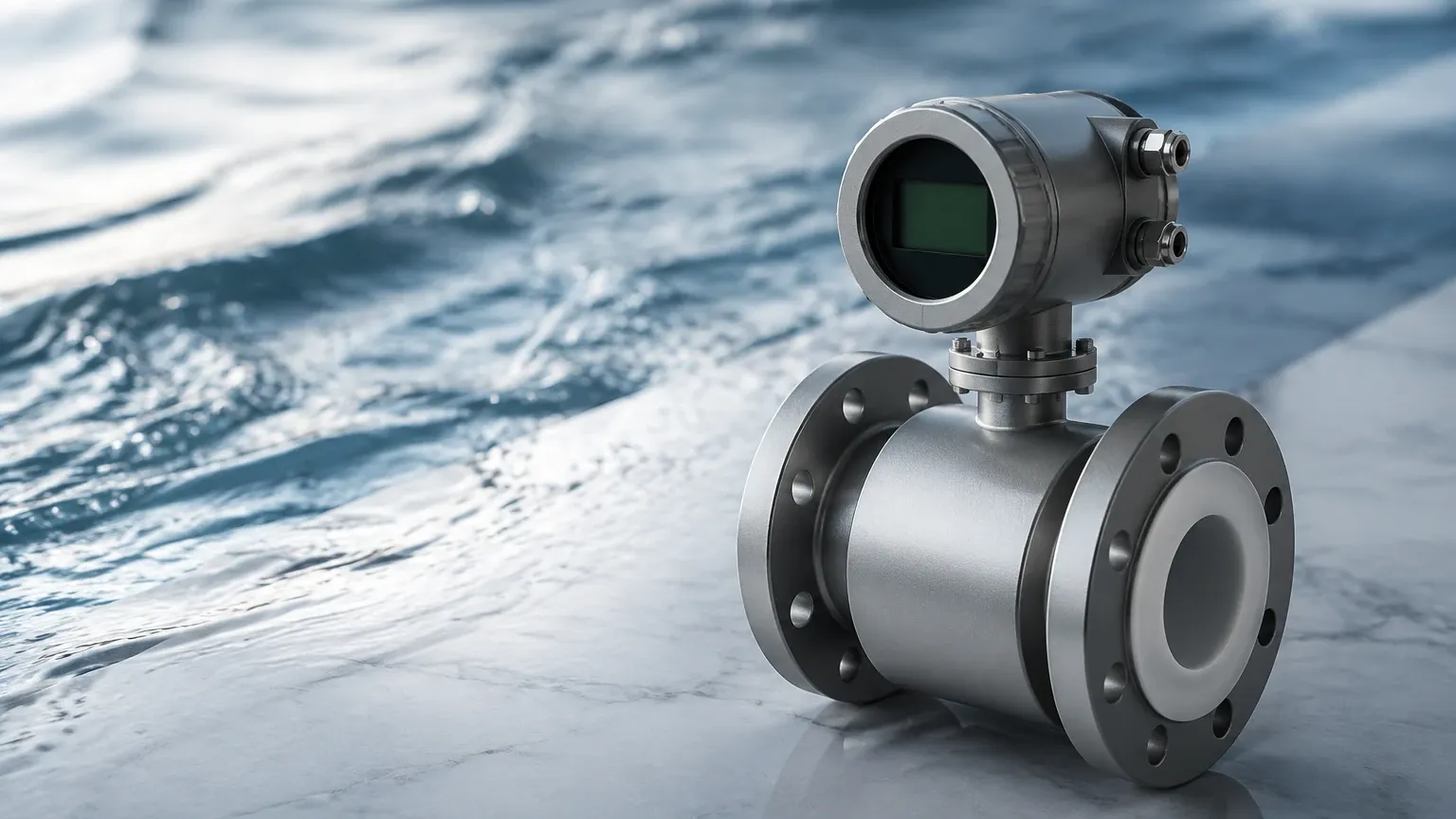
Picomag Electromagnetic Flowmeter
Picomag Electromagnetic Flowmeter
In the landscape of industrial automation, the precise measurement of liquid media is a fundamental requirement for process stability, safety, and efficiency. While level measurement instruments—such as those found on the Main Page—provide critical data regarding the volume and inventory of liquids in tanks and vessels, electromagnetic flowmeters like the Picomag offer the necessary insight into the dynamic movement of those liquids through piping systems. The Picomag electromagnetic flowmeter is specifically designed as a compact, cost-effective solution for utility applications and secondary loops where space is limited and ease of integration is paramount.
Understanding the Electromagnetic Measurement Principle
Before selecting a flowmeter for a specific application, it is essential to understand the physics governing its operation. Electromagnetic flowmeters, often referred to as "magmeters," operate based on Faraday’s Law of Induction. This principle states that a voltage is induced when a conductive fluid moves through a magnetic field.
The mathematical representation of this principle is expressed as:
U = B · v · d
Where:
- U is the induced voltage.
- B is the magnetic field strength.
- v is the average flow velocity of the liquid.
- d is the distance between the electrodes (the pipe diameter).
In a Picomag electromagnetic flowmeter, the device generates a constant magnetic field across the cross-section of the measuring pipe. As a conductive liquid (such as water or chemicals) flows through this field, it acts as a moving conductor, inducing a voltage. This voltage is picked up by two electrodes located on opposite sides of the pipe wall. Because the magnetic field strength (B) and the electrode distance (d) are constant, the induced voltage (U) is directly proportional to the flow velocity (v). The electronics within the meter then convert this velocity into a volumetric flow rate (e.g., liters per minute or cubic meters per hour).
It is important to note that for this principle to function, the medium must have a minimum electrical conductivity. Most electromagnetic flowmeters require the liquid to have a conductivity of at least 5 μS/cm to 20 μS/cm. This makes the technology ideal for water-based liquids but unsuitable for oils, hydrocarbons, or demineralized water with extremely low conductivity.
Key Evaluation Criteria for the Picomag Series
The Picomag is distinguished by its focus on the "plug-and-play" market. When evaluating this instrument against traditional, larger electromagnetic flowmeters, several criteria should be considered:
1. Compactness and Integration
Unlike traditional magmeters that often require significant installation space and separate transmitters, the Picomag integrates the sensor and transmitter into a single, compact housing. This makes it suitable for skid-mounted equipment and tight piping galleries where level sensors and flowmeters must coexist in close proximity.
2. Multi-Parameter Measurement
One of the primary advantages of the Picomag electromagnetic flowmeter is its ability to measure more than just flow. It simultaneously captures:
- Flow Rate: Volumetric flow of the medium.
- Temperature: Integrated temperature measurement for process monitoring.
- Conductivity: Real-time monitoring of the liquid's conductive properties, which is useful for detecting phase changes or fluid quality.
3. Digital Connectivity (IO-Link and Bluetooth)
In the era of Industry 4.0, the Picomag leverages IO-Link technology. This allows for seamless integration into existing automation architectures, providing digital data transmission that is immune to analog interference. Furthermore, Bluetooth connectivity allows technicians to configure the device via a smartphone or tablet, which is particularly useful in hard-to-reach locations.
Practical Selection Table
When specifying a Picomag electromagnetic flowmeter, engineers must match the device dimensions and flow ranges to the specific process requirements. The following table provides a general overview of the typical ranges available for this class of compact flowmeter.
| Nominal Diameter (DN) | Flow Range (Metric) | Flow Range (Imperial) | Max. Pressure Rating | Connection Type |
| :— | :— | :— | :— | :— |
| DN 15 (1/2") | 0.1 to 25 l/min | 0.026 to 6.6 gal/min | 16 bar (232 psi) | G Thread / NPT |
| DN 20 (3/4") | 0.2 to 50 l/min | 0.05 to 13.2 gal/min | 16 bar (232 psi) | G Thread / NPT |
| DN 25 (1") | 0.3 to 100 l/min | 0.08 to 26.4 gal/min | 16 bar (232 psi) | G Thread / NPT |
| DN 50 (2") | 1.5 to 750 l/min | 0.4 to 198 gal/min | 16 bar (232 psi) | G Thread / NPT |
Installation Considerations and Best Practices
To ensure the accuracy and longevity of a Picomag electromagnetic flowmeter, several installation rules must be followed. While magmeters are generally robust, they are sensitive to flow profiles and air entrapment.
Pipe Orientation and Filling
The measuring tube must always be completely full of liquid. If the pipe is only partially full, the meter will provide inaccurate readings or error codes. For this reason, vertical installation with an upward flow direction is the preferred orientation, as this ensures the pipe remains full and helps prevent the accumulation of air bubbles at the electrodes.
Straight Pipe Runs
To maintain a stable flow profile, it is recommended to have a straight inlet run of at least 5 x DN (five times the nominal diameter) before the meter and a straight outlet run of 2 x DN after the meter. If there are pumps or valves immediately upstream, these distances should be increased to minimize turbulence.
Grounding
Since the measurement principle relies on detecting millivolt-level signals, proper grounding is critical. The liquid medium, the sensor, and the transmitter must be at the same electrical potential to prevent stray currents from interfering with the measurement signal. In plastic piping systems, grounding rings are often required to establish this electrical connection with the fluid.
Limitations of the Technology
While the Picomag electromagnetic flowmeter is highly versatile, it is not a universal solution for every fluid. Engineers should be aware of the following limitations:
1. Conductivity Requirement: As mentioned, the meter cannot measure non-conductive fluids like oils, alcohols, or pure hydrocarbons. For these applications, ultrasonic or Coriolis flowmeters are required.
2. Solids Content: While magmeters can handle some suspended solids (slurries), highly abrasive particles can wear down the internal lining and electrodes over time, leading to drift or failure.
3. Temperature Limits: Compact meters like the Picomag typically have a maximum operating temperature around 70°C to 85°C. For high-temperature steam or thermal oil applications, specialized level and flow instruments from the Main Page or heavy-duty flow sensors must be used.
4. Magnetic Interference: Powerful motors or transformers located in the immediate vicinity of the meter can generate electromagnetic interference (EMI) that affects the internal magnetic field of the sensor.
Synergies Between Flow and Level Measurement
In most industrial processes, flow and level measurement are complementary. For example, in a water treatment plant, a Picomag electromagnetic flowmeter might measure the rate of chemical dosing into a tank, while a Welk ultrasonic level sensor or radar level meter monitors the total inventory within that tank.
By combining flow data (rate of change) with level data (current volume), plant operators can perform mass balance calculations to detect leaks, optimize pump performance, and ensure that chemical concentrations remain within specified limits. The integration of both measurement types into a centralized control system via IO-Link or 4-20mA signals provides a comprehensive view of the fluid's lifecycle within the facility.
Frequently Asked Questions (FAQ)
Q: Can the Picomag measure flow in both directions?
A: Yes, the Picomag electromagnetic flowmeter is capable of bidirectional measurement. It can distinguish between forward and reverse flow, which is useful in systems where backflow might occur or where pipes are used for both filling and emptying processes.
Q: Does the Picomag require regular recalibration?
A: Under normal operating conditions with clean liquids, the Picomag is very stable because it has no moving parts to wear out. However, in applications involving scaling or electrode coating, periodic verification or cleaning may be necessary to maintain accuracy. Many industries perform a calibration check every 1 to 3 years depending on internal quality standards.
Q: What happens if the liquid contains air bubbles?
A: Air bubbles are non-conductive. If they pass over the electrodes, they cause signal noise and can lead to significant measurement errors. If air entrainment is a persistent issue, an air eliminator should be installed upstream, or the meter should be relocated to a point in the system with higher pressure to keep the air in solution.
Q: Is the Bluetooth connection secure?
A: Yes, the Bluetooth interface used in modern industrial meters like the Picomag typically requires a specific pairing code and can be disabled via the hardware settings if the facility has strict wireless security protocols.
Q: How does the Picomag handle pressure drops?
A: Because the Picomag has a straight-through design with no obstructions in the flow path, the pressure drop across the device is negligible—essentially the same as a short length of standard pipe. This makes it highly energy-efficient compared to differential pressure or vortex flowmeters.
For engineers seeking to optimize their liquid management systems, the Picomag electromagnetic flowmeter represents a modern, digitally-ready solution for flow monitoring. When paired with reliable level measurement instruments from manufacturers like Welk, available on the Main Page, these devices ensure that every drop of process fluid is accounted for with precision and reliability.