Vortex Steam Flow Meter
Vortex Steam Flow Meter
In the realm of industrial process control, steam remains one of the most critical yet challenging fluids to measure. Whether used for power generation, heat exchange, or sterilization, the ability to accurately quantify steam flow is essential for energy efficiency, cost accounting, and safety. Among the various technologies available, the vortex steam flow meter has emerged as a preferred solution due to its lack of moving parts, high reliability, and wide rangeability. This article provides a technical overview of vortex shedding technology, selection criteria, and best practices for steam applications.
The Principle of Vortex Shedding in Steam Measurement
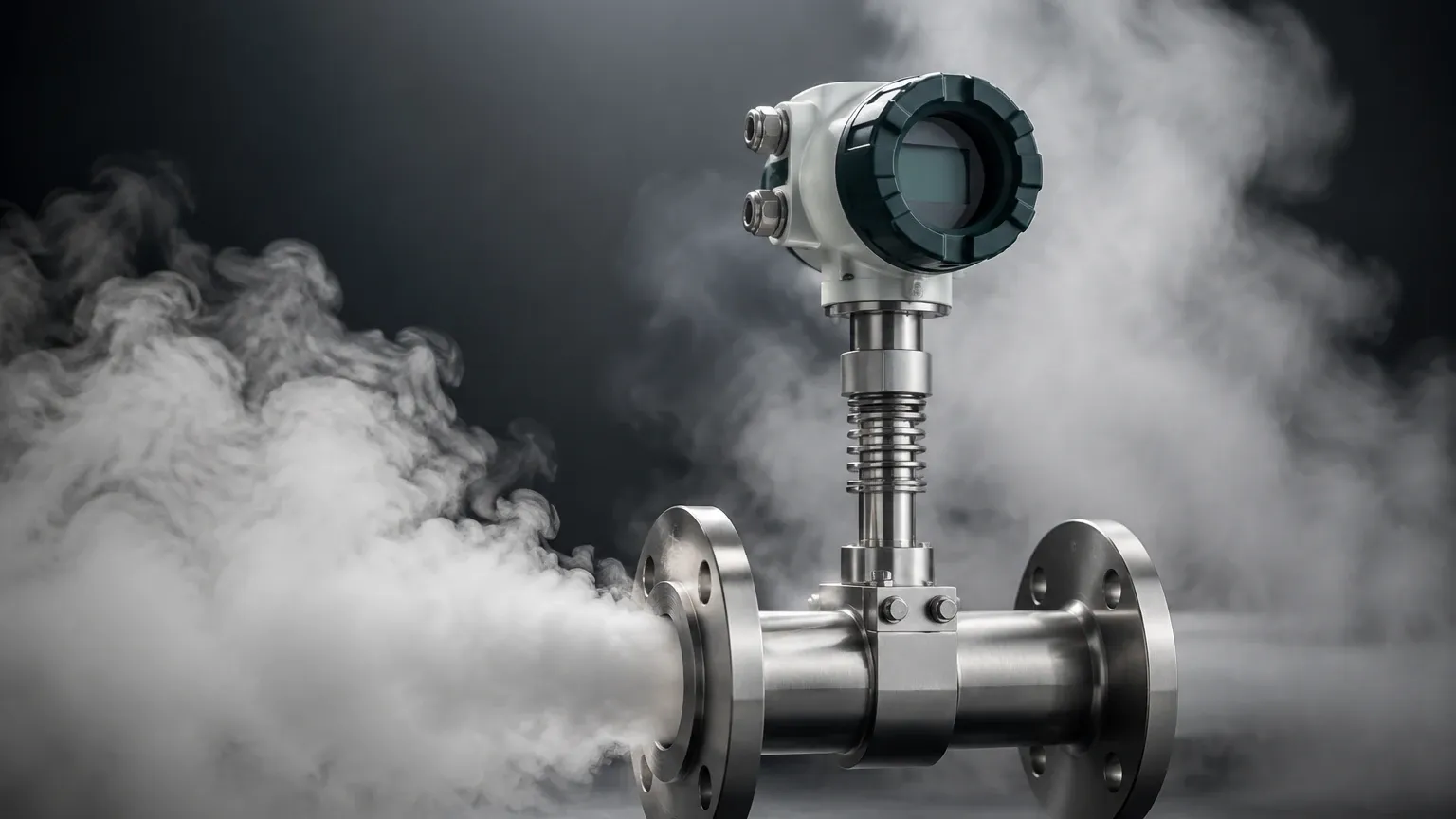
The operation of a vortex steam flow meter is based on the Von Kármán effect, a principle in fluid dynamics named after the physicist Theodore von Kármán. This principle describes the phenomenon that occurs when a fluid—in this case, steam—flows past an unstreamlined object, known as a bluff body or shedder bar.
As the steam encounters the bluff body, it cannot follow the contours of the object. This results in the formation of alternating vortices (swirls of fluid) on either side of the body. These vortices are shed at a specific frequency that is directly proportional to the velocity of the steam flow. The relationship is defined by the Strouhal equation:
f = (St × V) / d
Where:
* f is the frequency of vortex shedding.
* St is the Strouhal number (a dimensionless constant specific to the bluff body shape).
* V is the velocity of the fluid.
* d is the width of the bluff body.
Because the geometry of the bluff body and the pipe diameter are fixed, the meter can determine the volumetric flow rate by measuring the frequency of the vortices. These pressure pulses are typically detected by a piezoelectric crystal or a mechanical sensor embedded within or behind the bluff body, which converts the physical pulses into electrical signals for the transmitter to process.
Types of Vortex Meters for Steam Applications
Steam measurement is complicated by the fact that steam can exist in different states: saturated or superheated. Standard vortex meters measure volumetric flow, which is sufficient for some applications but often inadequate for steam because the density of steam changes significantly with pressure and temperature variations.
1. Volumetric Vortex Meters
These are the simplest versions, providing a raw volume measurement (e.g., cubic meters per hour). They are suitable for saturated steam applications where the pressure is constant and known. However, if the pressure fluctuates, the mass flow calculation will be inaccurate.
2. Multivariable Vortex Meters
To address the density issue, multivariable vortex steam flow meters integrate temperature and pressure sensors into a single device. By measuring the shedding frequency, the live pressure, and the live temperature, the meter’s internal computer can calculate the fluid density in real-time. This allows the device to output a highly accurate mass flow rate (e.g., kilograms per hour), which is the standard requirement for steam energy balancing.
Technical Selection Criteria and Evaluation
Selecting the correct vortex steam flow meter requires a deep understanding of the process conditions. Unlike level measurement instruments, which often deal with static or slow-moving surfaces, flow meters must handle dynamic forces and phase changes.
Reynolds Number Considerations
For a vortex meter to operate linearly and accurately, the flow must be turbulent. This is characterized by the Reynolds number (Re). Most vortex meters require a minimum Reynolds number of approximately 20,000 to maintain accuracy. Below this threshold, the vortex shedding becomes irregular, leading to a "low flow cut-off" where the meter cannot provide a reliable reading.
Selection Table: Vortex Meter Configurations
| Feature | Volumetric Vortex | Multivariable Vortex | External Compensation |
| :— | :— | :— | :— |
| Primary Output | Volume Flow | Mass Flow | Mass Flow |
| Integrated Sensors | None | P + T Sensors | None (uses external inputs) |
| Best For | Constant Pressure Saturated Steam | Superheated & Fluctuating Steam | Retrofit Systems |
| Installation Complexity | Low | Low | High (requires multiple taps) |
| Accuracy (Mass) | ±2.0% to 5.0% | ±1.0% to 1.5% | ±1.5% to 2.0% |
Material Compatibility
Steam applications involve high temperatures, often exceeding 250°C (482°F). The meter body must be constructed from robust materials, typically 316 Stainless Steel or Carbon Steel, to withstand thermal expansion and potential corrosion. Furthermore, the electronic components must be isolated from the heat of the process pipe through the use of cooling fins or extended neck designs.
Installation Guidelines for Optimal Accuracy
Poor installation is the most common cause of inaccuracy in vortex steam flow meters. To ensure the formation of a stable vortex street, the flow profile must be fully developed and free of turbulence caused by upstream obstructions.
Straight Pipe Requirements
A general rule of thumb for vortex meters is to provide a minimum of 10 diameters (10D) of straight, unobstructed pipe upstream of the meter and 5 diameters (5D) downstream. If the upstream piping includes multiple elbows in different planes, valves, or reducers, the required straight run may increase to 30D or 40D. If space is limited, flow conditioners or rectifiers can be installed to shorten these requirements.
Orientation and Support
Vortex meters can generally be installed in horizontal, vertical, or inclined pipes. However, for steam applications, horizontal installation is most common. It is vital to ensure the meter is not installed at a low point in the piping where condensate can collect. Water droplets hitting the bluff body at high velocity (water hammer) can damage the sensor and cause measurement spikes.
Insulation Considerations
While the pipe should be insulated to conserve energy, the transmitter head of the vortex meter should remain uninsulated. This allows ambient air to cool the electronics. Over-insulating the meter neck can lead to electronic failure due to heat soak from the steam line.
Limitations and Operational Challenges
While the vortex steam flow meter is a versatile tool, it is not universal. Engineers must be aware of its limitations:
1. Vibration Sensitivity: Because vortex meters detect pressure pulses, high levels of mechanical vibration in the piping can be misinterpreted as vortices. Modern meters use digital signal processing (DSP) to filter out common vibration frequencies, but extreme cases may still require pipe bracing.
2. Pressure Drop: The bluff body creates a permanent pressure drop in the line. While usually lower than that of an orifice plate, it must be accounted for in system design, especially in low-pressure steam systems.
3. Turndown Ratio: Vortex meters typically offer a turndown ratio of about 10:1 to 20:1. This is superior to orifice plates but inferior to some thermal or ultrasonic technologies. If the steam demand fluctuates from very high to very low (e.g., seasonal heating), a single vortex meter may not be able to capture the low-end flow.
4. Steam Quality: Vortex meters are designed for "dry" steam. If the steam has a high moisture content (low quality), the water droplets can interfere with vortex shedding and lead to an over-reading of the mass flow, as the meter assumes it is measuring a single-phase gas.
Integration with Industrial Automation Systems
In modern industrial facilities, flow data is rarely used in isolation. It is typically integrated into a broader control strategy that includes level, pressure, and temperature monitoring. For instance, in a boiler feed water system, the steam output measured by a vortex meter is balanced against the water input measured by level sensors in the deaerator and the boiler drum.
Welk provides a comprehensive range of instrumentation designed to work in tandem with these systems. For engineers looking to optimize their process loops, reviewing the full range of available technologies is essential. You can explore product options and application support by visiting the Main Page, which serves as a central hub for industrial measurement solutions including advanced level transmitters and flow monitoring equipment.
Frequently Asked Questions
Q: Can a vortex meter measure wet steam?
A: While a vortex meter will function in wet steam, its accuracy decreases. The meter measures the velocity of the vapor phase, but the presence of liquid droplets increases the actual mass flow without a proportional increase in vortex frequency. For accurate measurement, steam should be at least 95% dry, and steam traps should be installed upstream of the meter.
Q: How often does a vortex steam flow meter need calibration?
A: Because there are no moving parts to wear out, the "K-factor" (the relationship between pulses and volume) of a vortex meter is extremely stable. In many applications, a physical recalibration is only necessary every 3 to 5 years, though periodic electronic verification is recommended.
Q: What happens if the steam flow falls below the minimum velocity?
A: When the velocity is too low to shed vortices (below the Reynolds number threshold), the meter will output a zero flow signal. This is known as the "low-flow cut-off." If low-flow measurement is critical, a smaller diameter meter with reducers may be required to increase the fluid velocity at the point of measurement.
Q: Is a multivariable vortex meter better than using a separate pressure and temperature transmitter?
A: A multivariable meter is generally preferred because it reduces the number of pipe penetrations, lowering the risk of leaks and reducing installation costs. It also ensures that the pressure and temperature are measured at the exact same point as the flow, leading to a more accurate density compensation.
By following these engineering principles and selection guidelines, industrial operators can ensure that their vortex steam flow meter provides the reliable, accurate data necessary for efficient plant operation and energy management.