Level Sensor Omron
Level Sensor Omron
In the landscape of industrial automation, point level detection is a critical requirement for protecting pumps, preventing overflows, and managing batch processes. Among the various technologies available, the level sensor Omron range—specifically their conductive level controllers—has become a standard for water and wastewater applications. Understanding the engineering principles behind these devices, their selection criteria, and how they compare to other industrial Level Switches is essential for building reliable control systems.
This guide explores the technical foundations of conductive level sensing, the specific hardware configurations used in the Omron ecosystem, and practical considerations for deployment in process industries.
Measurement Principles of Conductive Level Sensors
The primary technology associated with a level sensor Omron is the conductive principle. Unlike float switches that rely on buoyancy or ultrasonic sensors that use sound waves, conductive sensors use the liquid itself as part of an electrical circuit.
The Conductive Logic
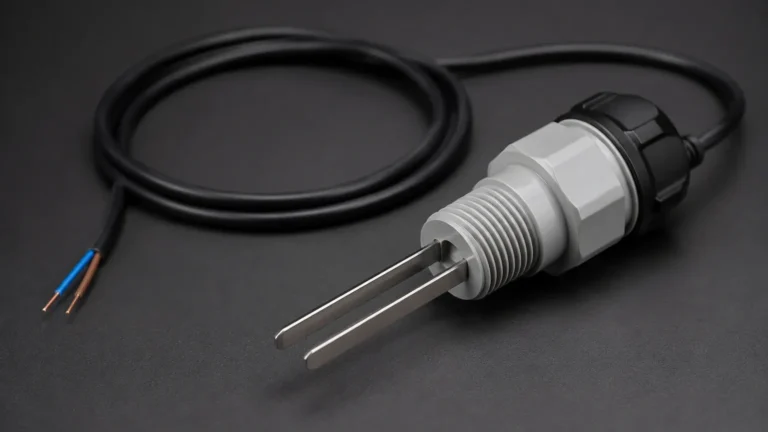
A conductive level system consists of a controller (the logic unit) and an electrode holder containing multiple stainless steel rods. The controller applies a low-voltage AC current (typically 8V or 24V AC) to the electrodes. When the liquid level rises and touches an electrode, the circuit to the common (ground) electrode is completed. This flow of current is detected by the controller, which then triggers an internal relay.
Using AC instead of DC is a critical engineering choice. DC current would cause electrolysis of the electrodes and the liquid, leading to rapid corrosion and buildup. AC prevents this electrochemical reaction, ensuring a longer service life for the sensing elements.
Multi-Point Detection
By using electrodes of different lengths, a single level sensor Omron setup can manage complex tasks:
- Two Electrodes: High or low alarm (Single point).
- Three Electrodes: Automatic supply or drainage control (Start/Stop logic with hysteresis).
- Five Electrodes: Combined supply control with high and low-level alarms.
Types of Level Sensors in the Omron Catalog
While conductive sensors are the most prominent, the term "level sensor Omron" also encompasses other technologies designed for specific environmental challenges.
1. Conductive Level Controllers (61F Series)
These are the "brains" of the system. They are typically DIN-rail or plug-in mounted inside a control panel. Models range from basic compact units to high-sensitivity versions for liquids with low conductivity (such as distilled water) and long-distance versions for remote reservoirs located up to 4 km (approx. 2.5 miles) away.
2. Electrode Holders and Electrodes (PS and BF Series)
These are the mechanical components that interface with the process. The PS-3S, PS-4S, and PS-5S series holders allow for multiple electrodes to be mounted in a single flange or threaded connection. Electrodes are usually made of SUS304 or SUS316 stainless steel, though specialized materials like titanium or Hastelloy are used for aggressive chemicals.
3. Photoelectric Level Sensors (E32 Series)
For applications where the liquid is non-conductive (like oils) or where a non-contact approach is needed in small tubes, photoelectric sensors are used. These detect the presence of liquid based on the change in the refractive index between the air and the liquid medium.
4. Ultrasonic Level Sensors
For continuous measurement rather than point switching, ultrasonic sensors emit high-frequency sound pulses. These are used when the sensor cannot touch the medium, such as in highly corrosive acids or where hygiene is a primary concern.
Engineering Selection Criteria
Selecting a level sensor Omron requires a detailed analysis of the liquid properties and the vessel environment. Engineers must confirm the following parameters before procurement:
Liquid Conductivity
Conductive sensors only work with liquids that conduct electricity.
- Suitable: Tap water, seawater, sewage, milk, beer, acids, and alkalis.
- Unsuitable: Pure water (distilled), oils, fats, alcohols, and dry solids.
For low-conductivity liquids, high-sensitivity controllers (e.g., the 61F-GP-NH) must be specified.
Temperature and Pressure
Standard electrode holders are often rated for atmospheric pressure and temperatures up to 70°C (158°F). In high-pressure boilers or high-temperature chemical reactors, specialized ceramic-insulated electrode holders are required to prevent steam leakage and electrical insulation failure.
Electrode Length and Spacing
Electrode rods are typically supplied in 1-meter (approx. 3.3 ft) segments that can be connected using nuts and sleeves. In deep tanks, spacers must be used every 1 meter to prevent the electrodes from touching each other due to liquid turbulence, which would cause a false trigger.
Comparison: Conductive vs. Other Level Switches
It is helpful to compare the conductive level sensor Omron approach with other common industrial Level Switches to determine the best fit for a project.
| Feature | Conductive (Omron 61F) | Tuning Fork (Vibratory) | Float Switch | Ultrasonic Switch |
| :— | :— | :— | :— | :— |
| Moving Parts | None | Minimal (Vibration) | Yes | None |
| Media Type | Conductive liquids only | Most liquids/solids | Most liquids | Most liquids |
| Coating Sensitivity | High (can cause bridging) | Low (self-cleaning) | Moderate | Moderate |
| Installation | Top-down electrodes | Side or Top mount | Side or Top mount | Top-down |
| Maintenance | Electrode cleaning | Low | High (moving parts) | Low |
| Cost | Low to Moderate | Moderate to High | Low | Moderate |

Installation and Wiring Considerations
Proper installation is the difference between a reliable system and one prone to "ghost" switching or failure.
1. Wiring Separation: Electrode signal lines should never be run in the same conduit as high-voltage power lines. Induced voltage from motors or pumps can interfere with the low-voltage AC signal of the controller.
2. Common Electrode (E3): The common electrode must always be the longest rod and should be positioned lower than the lowest control point. In metal tanks, the tank wall can sometimes act as the common, but a dedicated electrode is always preferred for reliability.
3. Sensitivity Adjustment: Most Omron controllers feature a sensitivity knob. This should be adjusted so the relay triggers reliably when the liquid touches the electrode but releases immediately when the level drops, even if the electrode remains damp.
4. Electrode Cutting: When cutting electrodes to length, ensure the ends are clean. For the 61F-G series, the difference in length between the "Start" (E1) and "Stop" (E2) electrodes defines the deadband (hysteresis), preventing the pump from cycling too frequently.
Limitations and Risks
While robust, the level sensor Omron conductive series has specific limitations:
* Scaling and Fouling: In hard water or wastewater, calcium or grease can build up on the electrodes. This coating acts as an insulator, preventing the circuit from closing. Regular mechanical cleaning is necessary.
* Vapor and Condensation: In closed tanks with high humidity, condensation can form on the electrode holder. If a water bridge forms between the electrode terminals at the head, the controller may "see" a high level even when the tank is empty.
* Turbulence: In tanks with heavy agitation, the liquid surface may fluctuate wildly. This can cause "chattering" of the relay. Using a controller with a built-in time delay or installing a stilling well (a pipe around the electrodes) can mitigate this.
Frequently Asked Questions (FAQ)
Q: Can I use a level sensor Omron for oil level detection?
A: No, standard conductive sensors will not work with oil because oil is non-conductive. For oil, you should use a float switch, a photoelectric sensor, or a capacitive level switch.
Q: How do I extend the electrodes beyond 1 meter?
A: You can use electrode connecting nuts and lock nuts to join multiple 1-meter rods. It is recommended to use an electrode spacer at each joint to maintain alignment.
Q: My pump won't stop even when the water is below the electrode. Why?
A: This is often caused by "leakage current." If the electrodes are dirty or the cable run is too long with high capacitance, the controller may think the circuit is still closed. Try reducing the sensitivity on the controller or cleaning the electrode insulators.
Q: What is the difference between the 61F-GP-N and the 61F-G?
A: The "GP" versions are typically plug-in models (8-pin or 11-pin bases), making them easier to replace in the field. The "G" versions are often larger, base-mounted units that may offer more complex control logic (like dual-pump alternation).
Conclusion
The level sensor Omron conductive series remains a foundational tool for industrial water management due to its lack of moving parts and straightforward logic. However, for applications involving non-conductive fluids, high-pressure environments, or the need for non-contact sensing, engineers should explore the wider range of Level Switches available in the market. By matching the specific conductivity and physical properties of the media to the correct sensing technology, facilities can ensure long-term operational stability and safety.