Level Switch D 74706
Level Switch D 74706
In industrial process automation, the accuracy of point-level detection is critical for preventing tank overfills, protecting pumps from dry running, and managing inventory levels. The term "Level Switch D 74706" is frequently encountered by procurement specialists and plant engineers sourcing high-quality instrumentation that adheres to the rigorous standards of German industrial manufacturing. D 74706 refers to the postal code of Ebhausen, Germany, a region synonymous with precision engineering and the production of world-class level measurement technology.
When selecting industrial Level Switches, it is essential to understand that the designation often points toward a specific level of reliability and certification required in demanding sectors such as chemical processing, water treatment, and oil and gas. This article provides a comprehensive technical guide to the principles, selection, and installation of level switches that meet these high-performance benchmarks.
Measurement Principles of Industrial Level Switches
Before selecting a specific model, engineers must evaluate the physical properties of the medium and the environmental conditions of the vessel. Different measurement principles offer distinct advantages depending on the application.
1. Vibrating Fork (Tuning Fork) Principle
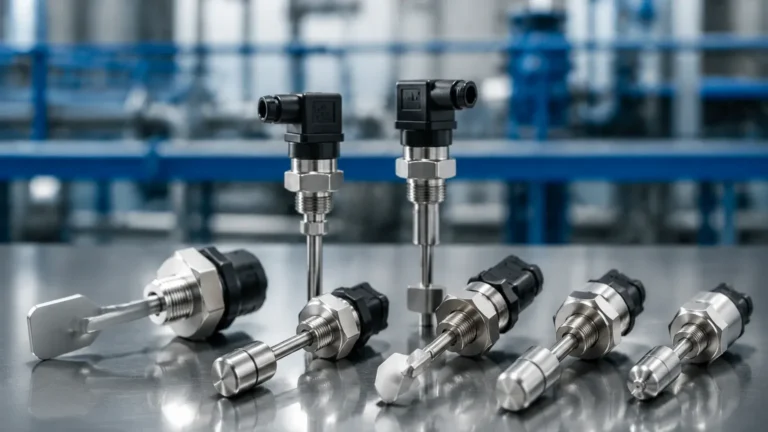
The vibrating fork level switch utilizes a piezoelectric crystal to energize a tuning fork at its natural resonance frequency. This frequency is typically around 1200 Hz to 1400 Hz. When the fork is immersed in a liquid or solid, the frequency shifts due to the change in density and mass loading.
* Detection: An internal electronic circuit monitors the frequency shift. If the shift exceeds a predefined threshold, the switch changes its output state (e.g., from NPN to PNP or opening a relay).
* Advantages: It is largely unaffected by flow, turbulence, bubbles, foam, or vibration. It is a "fit and forget" solution for most clean liquids.
2. Float and Magnetic Level Switches
This is one of the most established technologies. A float containing a permanent magnet moves with the liquid level along a guide tube. Inside the tube are reed switches or Hall-effect sensors.
* Detection: As the float passes the reed switch, the magnetic field closes (or opens) the contact.
* Advantages: Simple, low-cost, and requires no auxiliary power for the basic switch mechanism. However, it is susceptible to mechanical jamming if the medium contains high solids or is highly viscous.
3. Conductive Level Switches
Conductive switches are used for conductive liquids (typically water-based). They consist of one or more electrodes. When the liquid reaches the electrode, it completes an electrical circuit between the probe and the tank wall (if metal) or a reference electrode.
* Detection: The low-voltage AC current flow is detected by an amplifier, triggering the switch.
* Advantages: No moving parts and highly cost-effective for simple water/wastewater applications.
4. Capacitance Level Switches
These switches treat the probe and the vessel wall as two plates of a capacitor. The medium acts as the dielectric material. As the level rises, the capacitance changes.
* Detection: The change in capacitance is converted into a switching signal.
* Advantages: Excellent for detecting interfaces between different liquids (e.g., oil and water) and for powders or granules.
Technical Specifications for High-Precision Level Switches
Instruments associated with the D 74706 manufacturing standards are designed for longevity and extreme conditions. When reviewing technical data sheets, pay close attention to the following parameters:
Material Compatibility
For corrosive environments, 316L stainless steel is the standard. For aggressive acids, coatings such as PFA (Perfluoroalkoxy) or materials like Hastelloy C are required. The process connection (threads or flanges) must match the pressure rating of the vessel.
Electrical Output Options
* Relay (SPDT/DPDT): Ideal for direct control of pumps or valves.
* Transistor (PNP/NPN): Used for high-speed switching and direct PLC integration.
* NAMUR: A 2-wire current signal (typically 1mA vs 3mA) designed for intrinsically safe (Ex) zones.
* Two-wire AC/DC: Simplifies wiring by using the same leads for power and signal.
Temperature and Pressure Ratings
Industrial switches must operate reliably from -40°C to +150°C (-40°F to 302°F) in standard configurations, with specialized high-temperature versions reaching +250°C (482°F). Pressure ratings typically range from vacuum to 64 bar (928 psi), depending on the housing and process connection.
Selection Criteria and Application Matrix
Choosing the right level switch requires a systematic approach. Use the following table as a preliminary guide for technology selection based on common industrial media.
| Medium Type | Recommended Technology | Key Consideration |
| :— | :— | :— |
| Clean Water | Float or Vibrating Fork | Cost-effectiveness vs. longevity. |
| Wastewater/Sludge | Vibrating Fork (Heavy Duty) | Avoid floats due to clogging risks. |
| Aggressive Chemicals | Capacitance (PTFE Coated) | Chemical resistance is the priority. |
| Foamy Liquids | Vibrating Fork | Tuning forks ignore foam and detect liquid. |
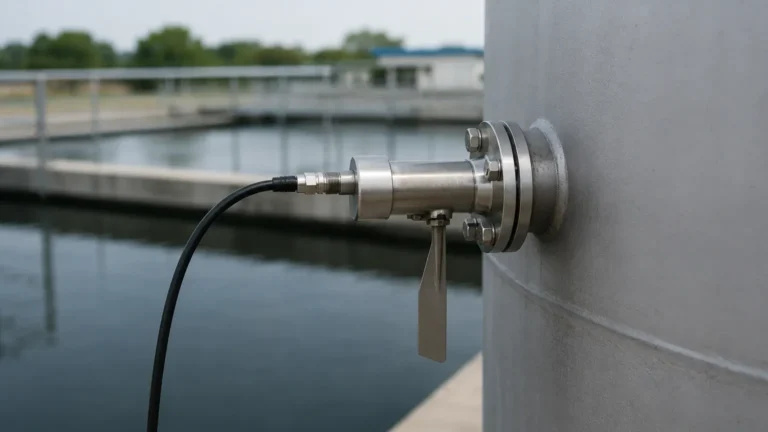
| Granular Solids | Rotating Paddle or Fork | Mechanical strength to resist lateral loads. |
| High-Pressure Steam | Magnetic Level Gauge Switch | High temperature and pressure tolerance. |
Evaluation Checklist
1. Density: Does the medium meet the minimum density requirement (e.g., >0.5 g/cm³ for vibrating forks)?
2. Viscosity: Will the medium stick to the probe and cause a "false positive"? (Maximum viscosity for forks is usually 10,000 mm²/s).
3. Hazardous Areas: Does the installation require ATEX, IECEx, or UL/CSA explosion-proof certification?
4. Hygienic Requirements: For food or pharma, are 3-A or EHEDG certified connections required?
Installation and Engineering Best Practices
Correct installation is as important as the technology itself. Failure to follow engineering guidelines can lead to premature failure or inaccurate switching.
Orientation and Positioning
* Horizontal Mounting: Most vibrating forks should be installed horizontally with the tines oriented vertically (one above the other) to allow liquid to drain easily and prevent build-up.
* Vertical Mounting: Often used for high-level alarms at the top of a tank. Ensure the probe length is correctly calculated to account for the switching point distance from the process connection.
Avoiding Interference
* Inflow Streams: Never install a level switch directly in the path of an incoming liquid stream. The force can cause mechanical damage or false triggers. Use a baffle plate if necessary.
* Agitators: Ensure there is sufficient clearance between the probe and any moving parts like mixers or agitators. Lateral forces from fluid movement must be calculated, especially for longer probes.
Cable Entry and Sealing
Always point the cable entry downwards to prevent moisture from entering the housing via the cable. Use a "drip loop" in the wiring. For outdoor installations, ensure the IP rating (typically IP66/IP67) is maintained by using the correct cable glands.
Operational Limitations and Maintenance
While modern Level Switches are designed for low maintenance, they are not immune to all process conditions.
Common Limitations
* Build-up: In highly viscous or crystallizing media, material can bridge the gap between tuning fork tines or coat a capacitance probe. While some electronics offer "build-up compensation," heavy accumulation will eventually cause failure.
* Turbulence: Extreme turbulence in a tank can cause "chatter" (rapid cycling of the switch). This can be mitigated by using electronics with a programmable switching delay (e.g., 0.5 to 3 seconds).
* Dielectric Constant: Capacitance switches require a stable dielectric constant. If the moisture content of a solid or the composition of a liquid changes significantly, the switch may need recalibration.
Maintenance Routine
* Visual Inspection: Check for corrosion on the process connection and integrity of the housing cover seal.
* Function Test: Most high-end switches include a test magnet or a button on the electronics module to simulate a covered state. This should be performed during scheduled shutdowns.
* Cleaning: If the medium is prone to scaling, the probe should be cleaned periodically using a solvent compatible with the probe material.
Frequently Asked Questions (FAQ)
Q: Can a vibrating fork switch be used for solids?
A: Yes, but you must select a version specifically designed for solids. These usually have larger tines and more robust electronics to handle the higher mechanical resistance and lower density of powders.
Q: What is the difference between a PNP and NPN output?
A: This refers to the polarity of the transistor switch. PNP (Source) switches the positive load, while NPN (Sink) switches the negative load. PNP is the standard in most European (D 74706 compliant) and North American PLC systems.
Q: How do I handle a level switch in a tank with a vacuum?
A: Ensure the switch is rated for vacuum service. The main concern is the seal at the process connection and the potential for "outgassing" to affect certain measurement types like ultrasonic gap switches.
Q: Is it possible to use a level switch for continuous measurement?
A: No. A level switch provides a discrete (On/Off) signal at a specific point. For continuous tracking (e.g., 0-100% volume), you would require a radar or ultrasonic level transmitter.
By adhering to these technical guidelines and understanding the engineering rigor associated with the D 74706 manufacturing region, plant operators can ensure their level measurement systems provide the reliability required for modern industrial safety and efficiency.