At What Pressure Does Natural Gas Liquefy
At What Pressure Does Natural Gas Liquefy
In the industrial processing and transport of energy resources, the transition of natural gas from a gaseous state to a liquid state—Liquefied Natural Gas (LNG)—is a fundamental operation. For engineers and facility managers, understanding the thermodynamic boundaries of this transition is critical for designing storage, transport, and measurement systems. A common question in the field is: at what pressure does natural gas liquefy?
The answer is not a single value but a relationship between pressure and temperature. This article explores the physical principles of natural gas liquefaction, the technical requirements for storage, and the specialized level measurement technologies required to monitor these high-pressure or cryogenic environments.
Understanding the Liquefaction Process of Natural Gas
Natural gas is primarily composed of methane ($CH_4$), typically making up 85% to 99% of the mixture. To understand at what pressure does natural gas liquefy, one must first look at the "critical point" of methane. The critical point is the temperature and pressure above which the distinction between liquid and gas disappears.
For pure methane, the critical temperature is approximately -82.6°C (-116.7°F), and the critical pressure is 45.96 bar (about 667 psi).
The Temperature-Pressure Relationship
There are two primary ways to liquefy natural gas for industrial use:
1. Cryogenic Liquefaction (Atmospheric Pressure): This is the most common method for large-scale transport (LNG tankers). The gas is cooled to approximately -162°C (-260°F). At this extreme cold, natural gas liquefies at standard atmospheric pressure (approximately 1 bar or 14.5 psi).
2. Pressurized Liquefaction: If the temperature is held above -162°C but below the critical temperature of -82.6°C, the gas can be liquefied by increasing the pressure. For example, at -100°C, a significantly higher pressure than atmospheric is required to maintain the liquid state.
Crucially, if the temperature of the natural gas is higher than -82.6°C, it is impossible to liquefy the gas regardless of how much pressure is applied. This is why natural gas cannot be liquefied at ambient temperatures (e.g., 25°C) simply by compression; it must always be cooled.
Level Measurement Principles in Liquefaction Systems
Monitoring the level of liquefied natural gas presents unique challenges due to the extreme temperatures and the pressurized nature of the vessels. Before selecting an instrument, it is essential to understand the measurement principles employed in these environments.
Radar Level Measurement (Non-Contact and Guided)
Radar technology is widely regarded as the gold standard for LNG level measurement. It operates on the Time-of-Flight (ToF) principle. The sensor emits a high-frequency electromagnetic pulse (typically in the 80GHz range for modern industrial applications). This pulse travels through the vapor space, reflects off the surface of the liquid, and returns to the sensor.
* Principle: The distance is calculated based on the time it takes for the signal to return ($D = c \times t / 2$).
* Advantages: Since radar waves do not require a medium to travel, they are unaffected by the high-pressure methane vapor or the cryogenic temperatures. 80GHz radar, in particular, offers a narrow beam angle, which is ideal for avoiding internal tank obstructions like cooling coils.
Hydrostatic Level Measurement
Hydrostatic sensors measure the pressure exerted by the liquid column. In a pressurized LNG tank, this requires a differential pressure (DP) approach.
* Principle: Two pressure sensors are used—one at the bottom of the tank and one in the vapor space at the top. The difference between these two pressures ($P_{bottom} – P_{top}$) represents the weight of the liquid column. By knowing the density of the LNG (which varies with temperature and composition), the level can be calculated ($h = \Delta P / (\rho \times g)$).
* Considerations: Because LNG density changes as "boil-off" occurs (methane evaporates, leaving behind heavier hydrocarbons like ethane), constant density compensation is required for accuracy.
Magnetic Level Gauges
Magnetic level gauges (MLGs) provide a robust, visual indication of the liquid level. They are often used as redundant systems on the side of a vessel.
* Principle: A float containing a permanent magnet resides inside a bypass chamber connected to the tank. As the liquid level rises and falls, the float moves accordingly. Outside the chamber, a series of magnetic flags or a follower indicates the level.
* Application: For high-pressure liquefaction processes, MLGs must be engineered with high-pressure ratings and cryogenic insulation (vacuum jackets) to prevent the liquid from boiling within the gauge.
Practical Selection for LNG and Pressurized Gas Storage
Choosing the right instrumentation depends on where in the process the measurement occurs. The following table provides a comparison of technologies based on the conditions found in natural gas liquefaction and storage.
Selection Table: Level Measurement for Liquefied Gas
| Technology | Temperature Range | Pressure Range | Accuracy | Best Use Case |
| :— | :— | :— | :— | :— |
| 80GHz Radar | -196°C to +450°C | Up to 160 bar | ±1 mm | Large LNG storage tanks, high-pressure separators. |
| Guided Wave Radar | -196°C to +400°C | Up to 400 bar | ±2 mm | Small process vessels with heavy turbulence or foam. |
| Hydrostatic (DP) | -100°C to +200°C | Up to 400 bar | ±0.1% FS | High-pressure buffer tanks where density is constant. |
| Magnetic Gauge | -196°C to +400°C | Up to 320 bar | ±5 mm | Visual local indication and redundant safety monitoring. |
| Ultrasonic | -40°C to +100°C | Up to 3 bar | ±0.25% | Low-pressure water treatment or non-critical chemical storage. |
*Note: Ultrasonic sensors are generally not recommended for LNG or high-pressure natural gas because the high density of the gas phase and the extreme cold significantly alter the speed of sound, leading to massive errors.*
For a comprehensive look at available hardware for these applications, you can Review product options and application support on our Main Page.
Installation Considerations for High-Pressure/Cryogenic Environments
When installing level meters in systems where natural gas is liquefied under pressure, several engineering factors must be addressed to ensure safety and longevity.
1. Material Compatibility
At cryogenic temperatures (-162°C), standard carbon steel becomes brittle and can shatter. All wetted parts, including flanges, probes, and chambers, must be constructed from 316/316L stainless steel or specialized alloys like Hastelloy. Gaskets must be made of PTFE or graphite designed for cryogenic service.
2. Pressure Ratings and Flanges
In pressurized liquefaction cycles, the vessel may operate at 50 bar or higher. Ensure that the instrument's process connection (flange) matches the vessel's rating (e.g., ASME Class 300 or 600). For radar installations, the antenna window (often ceramic or specialized glass) must be capable of withstanding the full design pressure of the tank.
3. Vapor Space Management
In LNG storage, the space above the liquid is filled with cold methane vapor. This vapor can condense on the lens of a radar sensor. Using a radar with a "drip-off" antenna design or a PTFE cover helps prevent droplets from clinging to the sensor face, which ensures a clear signal return.
4. Insulation and Heat Leakage
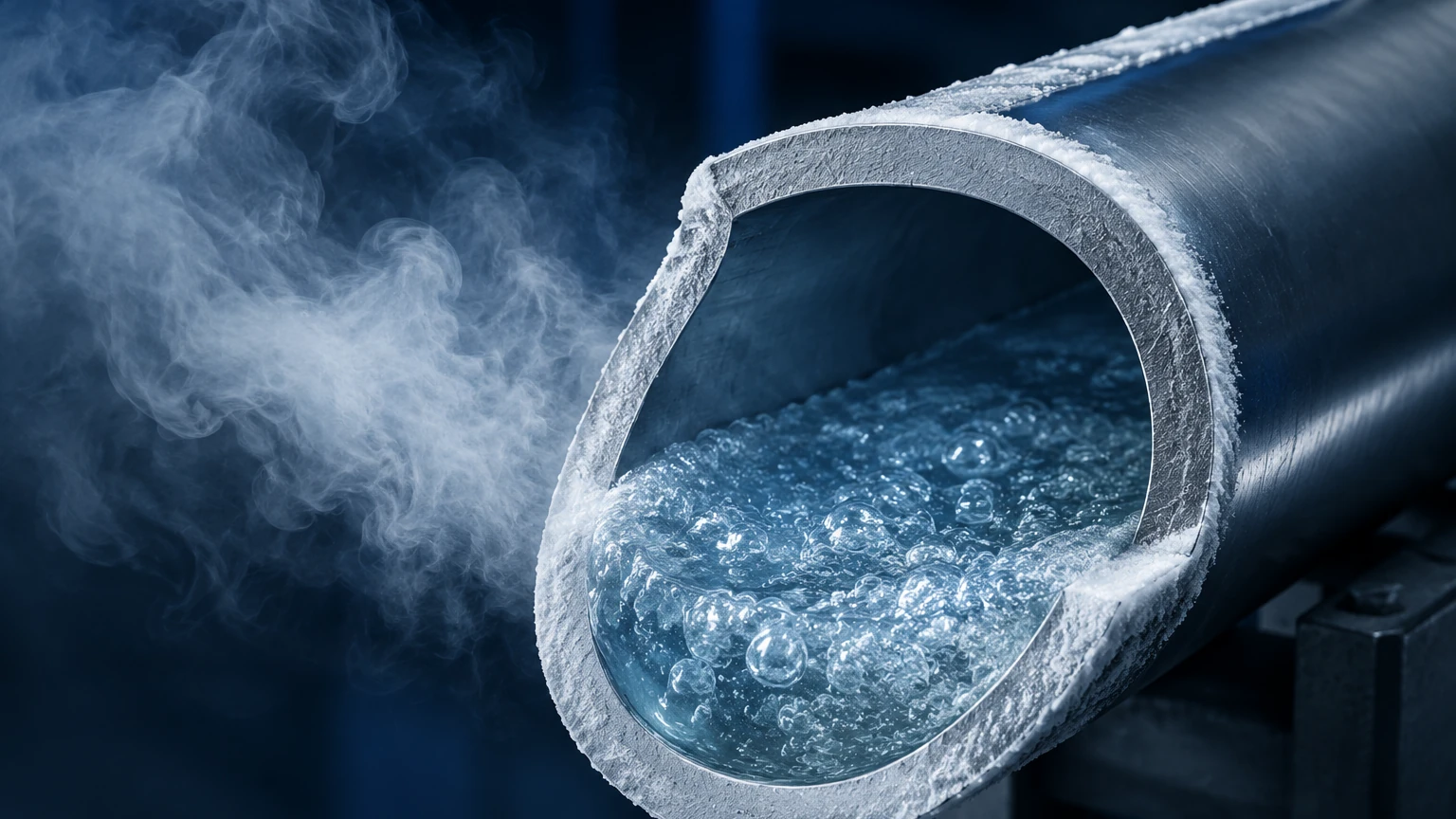
For hydrostatic or magnetic level gauges mounted externally (bypass), the chamber must be vacuum-jacketed or heavily insulated. Without proper insulation, heat from the ambient environment will cause the LNG inside the gauge to boil vigorously, creating bubbles that interfere with the float (in MLGs) or the pressure reading (in DP systems).
Limitations and Operational Risks
While modern instrumentation is highly capable, there are inherent limitations when dealing with the pressure at which natural gas liquefies.
* The Dielectric Constant (εr): Liquefied natural gas has a very low dielectric constant (approx. 1.7). This means it is a poor reflector of radar waves. To compensate, high-sensitivity radar or Guided Wave Radar (GWR) with a coaxial probe is often used to concentrate the signal energy.
* Boil-Off Gas (BOG): In any LNG system, a small amount of liquid is constantly turning back into gas. This creates a dynamic environment. If the pressure in the tank rises too high without a corresponding drop in temperature, the liquid may flash into gas, causing rapid level fluctuations.
* Stratification: In large storage tanks, different batches of LNG may have slightly different densities. This can lead to "rollover," a dangerous condition where a bottom layer becomes warmer than the top layer and suddenly rises, causing a massive release of boil-off gas. Level and temperature profiling are required to detect this risk.
Frequently Asked Questions (FAQ)
Q: Can you liquefy natural gas at room temperature?
A: No. The critical temperature of methane is -82.6°C. Above this temperature, natural gas remains a gas regardless of the pressure applied.
Q: What is the most common pressure for LNG storage?
A: Large-scale LNG is typically stored at near-atmospheric pressure (less than 0.5 bar gauge) at a temperature of -162°C. However, in small-scale peak-shaving plants or fuel tanks for trucks, it may be stored at pressures between 4 and 10 bar.
Q: Why is radar preferred over ultrasonic for LNG?
A: Ultrasonic sensors rely on sound waves, which change speed significantly based on gas temperature and density. In an LNG tank, the temperature gradient in the vapor space makes ultrasonic measurement highly inaccurate. Radar uses electromagnetic waves, which are unaffected by these factors.
Q: Does the composition of the gas affect the liquefaction pressure?
A: Yes. Natural gas with higher concentrations of ethane, propane, or butane will liquefy at higher temperatures and lower pressures than pure methane. This is why process plants must be tuned to the specific gas analysis of the wellhead.
Conclusion
Determining at what pressure does natural gas liquefy requires a dual understanding of thermodynamics and process engineering. While the physics dictates a critical temperature of -82.6°C, the practical application usually involves cooling the gas to -162°C to allow for low-pressure storage and transport.
For the engineers tasked with monitoring these fluids, the choice of level measurement is paramount. Whether utilizing 80GHz non-contact radar for large tanks or magnetic level gauges for pressurized process vessels, the equipment must be rated for both the extreme cold and the potential pressures involved. By adhering to strict installation guidelines and selecting the appropriate measurement principle, operators can ensure the safe and efficient handling of this vital energy resource.
For further technical specifications on industrial level transmitters and gauges designed for cryogenic and high-pressure service, visit our Main Page at https://www.level-meters.com/.