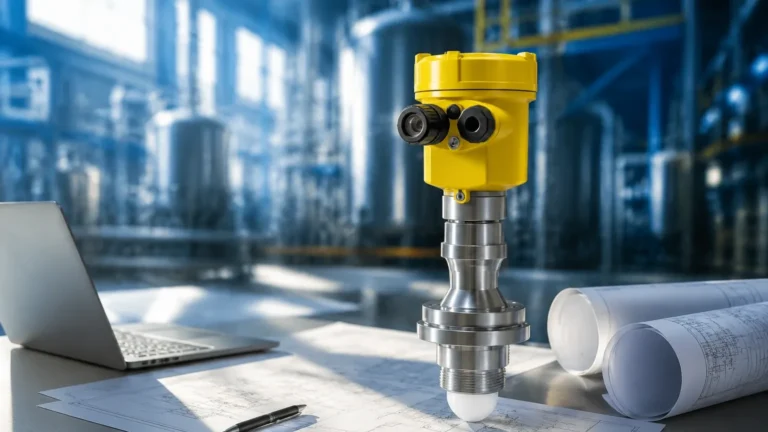
Best Vibration Sensor for Food and Beverage Facilities
Best Vibration Sensor for Food and Beverage Facilities
In the food and beverage (F&B) industry, precision and hygiene are the two pillars of successful production. Level measurement is a critical component of this process, ensuring that tanks do not overflow, pumps do not run dry, and recipes are followed with exacting detail. Among the various technologies available, the vibration level switch—often referred to as a tuning fork sensor—has emerged as a primary choice for point-level detection. Selecting the best vibration sensor for food and beverage facilities requires an understanding of both the mechanical principles of the device and the stringent sanitary requirements of the production environment.
Industrial level measurement instruments, such as those provided by Welk, must withstand aggressive cleaning cycles, high temperatures, and varying material viscosities. This guide explores why vibration sensors are often the optimal choice and how to select the right model for specific F&B applications.
Understanding the Measurement Principle
Before evaluating specific models, it is essential to understand how a vibration level sensor operates. These instruments utilize the physical properties of resonance to detect the presence or absence of a medium.
The Tuning Fork Mechanism
At the heart of the sensor is a sensing element shaped like a tuning fork. This fork is driven by internal piezoelectric crystals that cause it to vibrate at its natural resonance frequency in the air. For most industrial sensors, this frequency is typically around 1,200 Hz to 1,400 Hz.
Frequency Shift Detection
When the medium (liquid or solid) reaches the level of the fork and covers the tines, the frequency of the vibration changes. The density of the material dampens the vibration, causing a measurable drop in frequency. The internal electronics detect this shift and trigger an output signal, such as a relay or a transistor switch. Because the sensor relies on a change in frequency rather than electrical properties like conductivity or capacitance, it is remarkably stable across different types of fluids.
Why Vibration Sensors Suit Food and Beverage Applications
The food and beverage sector presents unique challenges that can interfere with other types of level sensors. The best vibration sensor for food and beverage facilities is one that can navigate these complexities without frequent recalibration or failure.
Immunity to Foam and Bubbles
Many food processes involve agitation, which creates foam on the surface of liquids like milk, beer, or fruit juices. Ultrasonic and radar sensors can sometimes struggle with foam, either absorbing the signal or providing a false high reading. Vibration sensors, however, are "foam-insensitive." They only trigger when the actual liquid density surrounds the tines, ignoring the light, airy structure of foam.
Handling Turbulence and Agitation
Mixing tanks are common in F&B facilities. The physical turbulence caused by impellers can disrupt the surface of the liquid, making continuous level measurement difficult. A vibration switch provides a reliable point-level check that is unaffected by surface ripples or waves, ensuring that the Main Page of your control system receives an accurate "tank full" or "tank empty" signal regardless of the internal dynamics.
CIP and SIP Compatibility
Clean-in-Place (CIP) and Steam-in-Place (SIP) processes are mandatory in food production to ensure sterilization. These processes involve high-pressure sprays of caustic chemicals and temperatures often exceeding 120°C (248°F). Vibration sensors designed for F&B are constructed from high-grade stainless steel (usually SS316L) and feature hermetically sealed electronics that can withstand these harsh cycles without losing calibration.
Key Evaluation Criteria for Selection
When searching for the best vibration sensor for food and beverage facilities, engineers must look beyond basic functionality. The following criteria are essential for maintaining food safety and operational efficiency.
1. Material and Surface Finish
In an F&B environment, every surface that comes into contact with the product must be non-reactive and easy to clean. The sensor tines should be made of 316L stainless steel. Furthermore, the surface roughness (Ra) is a critical metric. A surface finish of Ra < 0.8 μm is generally required to prevent bacterial growth in microscopic pits on the metal surface. Polished tines ensure that sticky substances, like chocolate or syrups, do not adhere to the sensor.
2. Process Connections
Standard threaded connections (like G1/2" or NPT) are often avoided in the food industry because the threads can trap food particles and harbor bacteria. Instead, "sanitary" connections are preferred. These include:
- Tri-Clamp (ISO 2852): The most common connection in North America and Europe, using a gasket and a clamp for a flush, gap-free seal.
- Varivent: A specialized hygienic flange system used extensively in dairy and brewery applications.
- SMS/DIN 11851: Threaded pipe couplings designed for easy manual cleaning.
3. Temperature and Pressure Ratings
While standard industrial sensors might handle up to 80°C (176°F), F&B sensors must often manage higher ranges for SIP cycles. A high-quality vibration sensor should be rated for at least 150°C (302°F) for short durations to accommodate steam sterilization. Pressure ratings typically need to cover 10 bar (145 psi) to 40 bar (580 psi) depending on the tank size and cleaning pressure.
Practical Selection Table
To assist in the decision-making process, the following table compares common configurations for vibration level switches in F&B environments.
| Feature | Standard Liquid Switch | High-Temperature Switch | Compact/Mini Switch |
| :— | :— | :— | :— |
| Primary Use | General storage tanks | SIP/CIP processes, hot oils | Small pipes, tight spaces |
| Max Temperature | 100°C (212°F) | 150°C – 250°C | 100°C (212°F) |
| Material | SS316L | SS316L / Inconel | SS316L |
| Surface Finish | Ra < 0.8 μm | Ra < 0.8 μm | Ra < 0.4 μm (Optional) |
| Output Options | Relay, PNP/NPN, 2-wire | Relay, 4-20mA loop | PNP/NPN, IO-Link |
| Typical Medium | Water, Juice, Milk | Steam, Hot Chocolate | Syrups, Additives |

Installation Considerations and Best Practices
Even the best vibration sensor for food and beverage facilities will underperform if installed incorrectly. Proper orientation and placement are vital for longevity and accuracy.
Orientation of the Tines
For liquid applications, the orientation of the fork tines is important. If the sensor is installed horizontally, the tines should be oriented vertically (one above the other). This allows the liquid to drain off the tines easily as the level drops, preventing "bridging" where a droplet of liquid stays trapped between the tines and causes a false positive reading.
Avoiding the Fill Stream
Never install a level switch directly in the path of the incoming product flow. The force of the falling liquid can damage the tines over time or cause intermittent switching. If the sensor must be near an inlet, a protective baffle should be installed to divert the flow.
Electrical Protection
F&B facilities are often wet environments due to frequent washdowns. Ensure that the sensor housing has an IP67 or IP69K rating. The IP69K rating specifically denotes protection against high-pressure, high-temperature water jets. Using high-quality cable glands and ensuring drip loops in the wiring will prevent moisture from entering the electronics housing.
Limitations of Vibration Sensors
While highly versatile, vibration sensors are not universal solutions. Engineers should be aware of specific limitations:
1. Extreme Viscosity: While they handle many thick liquids, extremely viscous substances (like cold peanut butter or heavy dough) may dampen the vibration so much that the sensor cannot restart once it is uncovered.
2. Solid Build-up: If a product dries and hardens on the tines (e.g., sugar crusting), the sensor may remain in the "covered" state even when the tank is empty. Regular cleaning or choosing a model with a "coating rejection" algorithm is necessary.
3. Grain Size: If used for dry solids (like flour or grain), the particle size must be small enough not to wedge between the tines. If the particles are too large, they can jam the fork and prevent vibration.
Frequently Asked Questions (FAQs)
Q: Can vibration sensors be used for dry powders in food plants?
A: Yes, specialized vibration switches with longer, more robust tines are designed for dry bulk solids like flour, sugar, and spices. They operate on the same principle but are tuned for lower-density materials.
Q: How often do these sensors need calibration?
A: One of the main advantages of vibration technology is that it is virtually maintenance-free. There are no moving parts to wear out, and the frequency shift is a physical constant. Calibration is generally not required after the initial setup unless the electronics are replaced.
Q: What is the difference between a standard industrial switch and a hygienic one?
A: The primary differences are the materials (SS316L), the surface polish (Ra < 0.8 μm), and the absence of gaps or threads in the process connection. Hygienic switches also carry certifications like EHEDG or 3-A.
Q: Does the color or transparency of the liquid affect the sensor?
A: No. Unlike optical or some ultrasonic sensors, vibration switches are completely unaffected by the color, transparency, or dielectric constant of the liquid.
Conclusion
Identifying the best vibration sensor for food and beverage facilities involves balancing technical specifications with regulatory compliance. By selecting a sensor with the correct surface finish, sanitary connections, and temperature resilience, facilities can ensure reliable point-level detection that survives the rigors of modern food production. For plant managers and engineers looking to upgrade their systems, it is advisable to Review product options and application support to find a solution tailored to specific chemical and physical process requirements. Investing in high-quality vibration technology not only prevents costly overflows and dry-run damage but also safeguards the most important asset of any food facility: consumer safety.
Download Best Vibration Sensor for Food and Beverage Facilities as a PDF