Coriolis Effect Mass Flow Meter
Coriolis Effect Mass Flow Meter
In the landscape of industrial process control, the ability to measure the mass of a moving fluid directly—rather than inferring it from volume—represents a significant leap in accuracy and reliability. The coriolis effect mass flow meter has emerged as the gold standard for high-precision applications across the chemical, pharmaceutical, and oil and gas industries. Unlike volumetric meters, which are sensitive to changes in temperature, pressure, and viscosity, Coriolis meters provide a direct measurement of mass, ensuring consistency in complex process environments.
The Fundamental Principle of Operation
To understand the coriolis effect mass flow meter, one must first understand the physics of the Coriolis force. In a classical physics context, the Coriolis effect is an inertial force that acts on objects in motion within a frame of reference that is rotating. In a flow meter, this rotation is replaced by high-frequency vibration.
The Vibrating Tube Mechanism
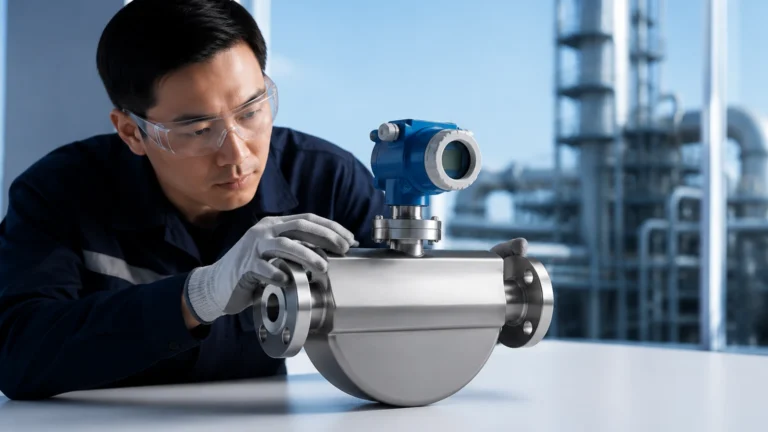
An industrial Coriolis meter typically consists of one or two measuring tubes. An internal electromagnetic drive coil causes these tubes to vibrate at their resonant frequency. When there is no fluid flowing, the tubes vibrate in a uniform, symmetrical manner. Both the inlet and outlet sides of the tube reach the peak of their oscillation cycle at the exact same time.
Introducing Fluid Flow and Phase Shift
When a fluid (liquid or gas) begins to flow through these vibrating tubes, the Coriolis effect is introduced. As the fluid moves toward the point of maximum vibration (the center of the tube), it resists being pushed upward and exerts a downward force on the tube. Conversely, as the fluid moves away from the center toward the outlet, it resists the slowing of its vertical motion and exerts an upward force.
This results in a "twisting" or a phase shift in the vibration of the tube. Sensors located at the inlet and outlet (pick-off coils) measure the time delay between the two points of the oscillation. This time delay, or phase shift, is directly proportional to the mass flow rate. Because the measurement relies on the inertia of the fluid's mass, it remains unaffected by the fluid's physical properties such as density or viscosity.
Simultaneous Density and Temperature Measurement
Beyond mass flow, these meters are multi-variable instruments. The resonant frequency at which the tube vibrates depends on the total mass of the tube and the fluid inside it. Since the volume of the tube is constant, the frequency of vibration can be used to calculate the fluid's density in real-time. Additionally, an internal RTD (Resistance Temperature Detector) monitors the tube temperature to compensate for changes in the tube's elasticity, providing an accurate temperature output for the process.
Key Advantages in Industrial Applications
The adoption of the coriolis effect mass flow meter is driven by several distinct advantages over traditional technologies like turbine, vortex, or differential pressure meters:
1. Direct Mass Measurement: Eliminates the need for external pressure and temperature compensation to calculate mass flow, reducing the number of instruments required in a loop.
2. High Accuracy: Modern Coriolis meters offer accuracies as high as ±0.05% for liquids and ±0.25% for gases, making them ideal for custody transfer and high-value chemical dosing.
3. Low Maintenance: With no moving parts in the fluid stream (such as bearings or gears), there is no mechanical wear and tear, leading to significantly lower maintenance costs over the instrument's lifecycle.
4. Bi-directional Flow: These meters can measure flow in both directions with equal precision, which is useful in loading and unloading applications.
5. Universal Fluid Compatibility: They can measure everything from cryogenic liquids to highly viscous resins and non-conductive fluids that electromagnetic meters cannot handle.
Technical Selection Criteria
Selecting the right coriolis effect mass flow meter requires a thorough analysis of the process conditions. Engineers should use the following table as a starting point for evaluating technical specifications.
| Parameter | Typical Specification Range | Engineering Consideration |
| :— | :— | :— |
| Accuracy (Liquid) | ±0.05% to ±0.1% of rate | Critical for custody transfer and batching. |
| Accuracy (Gas) | ±0.25% to ±0.5% of rate | Higher uncertainty due to lower fluid mass. |
| Repeatability | ±0.02% to ±0.05% | Essential for process consistency. |
| Turndown Ratio | 20:1 to 100:1 | Ability to measure low flows accurately. |
| Pressure Rating | Up to 350 bar (5,076 psi) | High-pressure designs available for CNG/hydrogen. |
| Temperature Range | -200°C to +400°C (-328°F to 752°F) | Covers cryogenic to high-heat applications. |
| Wetted Materials | 316L SS, Hastelloy, Tantalum | Must be compatible with corrosive fluids. |
When reviewing options for integrated process control, it is helpful to consult a comprehensive Main Page of industrial instrumentation to ensure the flow meter integrates seamlessly with existing level and pressure systems.
Installation Considerations and Best Practices
While Coriolis meters are robust, their accuracy depends heavily on proper installation. Because the measurement principle relies on detecting minute vibrations, external mechanical noise can interfere with the signal.
* Vibration Isolation: The meter should be installed on a rigid support. If the surrounding piping is subject to significant vibration (e.g., near a reciprocating pump), flexible connectors or dedicated mounting brackets should be used to isolate the sensor.
* Orientation: For liquid applications, the preferred orientation is with the tubes pointing downward (the "U" shape facing down) to prevent gas bubbles from becoming trapped. For gas applications, the tubes should point upward to prevent condensate buildup.
* Zero Calibration: After installation and under full-pipe, zero-flow conditions, a "zero trim" must be performed. This accounts for any stresses imposed on the meter by the piping and ensures the baseline for the phase shift is accurate.
* Straight Run Requirements: Unlike many other flow technologies, Coriolis meters generally do not require long straight runs of pipe upstream or downstream, as the measurement is independent of the flow profile (laminar or turbulent).
Limitations and Potential Risks
Despite their versatility, there are specific scenarios where a coriolis effect mass flow meter may face challenges:
* Entrained Gas: In liquid streams, the presence of large gas bubbles (slug flow) can dampen the tube's vibration, leading to measurement errors or "stalling" of the drive circuit. Advanced digital signal processing in modern transmitters has mitigated this, but it remains a consideration for aerated liquids.
* Pressure Drop: Because the fluid must often be diverted through two smaller tubes or a curved path, the pressure drop across a Coriolis meter can be higher than that of a full-bore electromagnetic or ultrasonic meter. This must be calculated during the sizing phase to ensure process requirements are met.
* Initial Cost: The capital expenditure for a Coriolis meter is typically higher than for volumetric meters. However, the total cost of ownership (TCO) is often lower due to reduced maintenance and increased process yield.
* Size Constraints: While available in sizes from 1 mm (1/25") to 400 mm (16"), the meters become extremely heavy and expensive at larger diameters, often making other technologies more practical for very large water mains.
Comparison with Other Technologies
To provide context for the coriolis effect mass flow meter, it is useful to compare it against other common industrial flow measurement methods.
| Feature | Coriolis | Electromagnetic (Mag) | Ultrasonic (Transit-Time) |
| :— | :— | :— | :— |
| Primary Measurement | Mass | Volume | Velocity |
| Fluid Conductivity | Irrelevant | Must be > 5 μS/cm | Irrelevant |
| Moving Parts | None | None | None |
| Straight Pipe Req. | Minimal | 5D Up / 2D Down | 10D-20D Up / 5D Down |
| Viscosity Effect | None | None | Significant |
| Relative Cost | High | Moderate | Moderate/High |
Frequently Asked Questions (FAQ)
Q: Can a Coriolis meter measure steam?
A: Yes, but with limitations. While they can measure the mass flow of saturated or superheated steam, the high velocities and low densities of steam often result in high pressure drops and reduced accuracy compared to liquid applications. Vortex meters are often a more cost-effective choice for steam unless mass accuracy is paramount.
Q: How does the meter handle high-viscosity fluids like molasses or crude oil?
A: Coriolis meters excel with high-viscosity fluids. Since the measurement is based on mass and inertia, the internal friction of the fluid does not affect the phase shift. However, high viscosity will increase the pressure drop, so the meter must be sized accordingly.
Q: Is recalibration necessary?
A: Because there is no mechanical wear, the "meter factor" (the relationship between phase shift and mass flow) is extremely stable. Recalibration is usually only required by regulatory standards (e.g., every 1–3 years for custody transfer) or if the meter has suffered significant corrosion or erosion of the internal tubes.
Q: What is the difference between a single-tube and dual-tube design?
A: Dual-tube designs are more common because they are naturally balanced and more resistant to external vibration. Single-tube designs are used in applications where hygiene is critical (easier to clean) or where very low pressure drop is required, though they may require more careful mounting to ensure stability.
Conclusion
The coriolis effect mass flow meter remains a cornerstone of modern industrial processing. By providing direct mass, density, and temperature readings in a single device, it simplifies system architecture and provides the high-fidelity data needed for advanced automation. While the initial investment is higher than some alternatives, the precision and reliability it offers make it an indispensable tool for engineers focused on optimizing process efficiency and product quality. For those looking to integrate these sensors into a broader measurement strategy, exploring the options available on the Main Page of specialized instrument providers is the recommended next step for technical evaluation and procurement.