Coriolis Flow Controller
Coriolis Flow Controller
In the landscape of industrial process automation, the ability to measure and control fluid flow with high precision is fundamental to maintaining product quality, safety, and operational efficiency. A Coriolis flow controller represents one of the most advanced solutions for mass flow management, integrating the high-accuracy measurement of a Coriolis meter with a dedicated control mechanism. Unlike volumetric flow meters, which are susceptible to errors caused by changes in temperature and pressure, Coriolis devices measure mass directly, making them indispensable in sectors such as chemical processing, oil and gas, and food production.
For engineers and procurement professionals, understanding the underlying physics and the integration requirements of these systems is the first step toward optimizing a production line. This guide examines the technical foundations, selection criteria, and practical implementation of Coriolis flow control technology.
Measurement Principles of Coriolis Technology
The operation of a Coriolis flow controller is based on the Coriolis effect—an inertial force described by Gustave-Gaspard Coriolis in the 19th century. In a practical industrial instrument, this principle is applied using vibrating tubes.
The Coriolis Effect in Practice
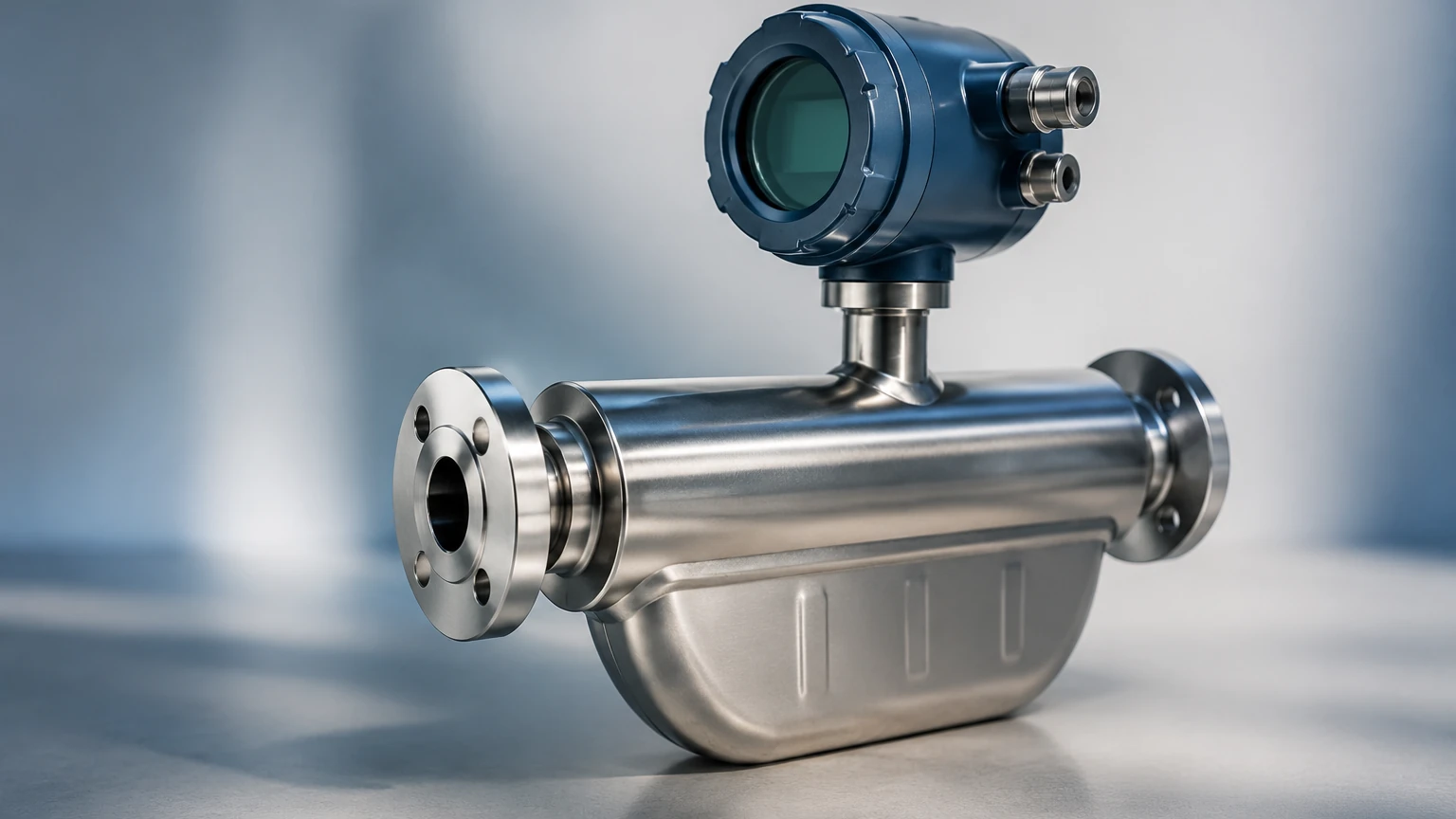
The device typically consists of one or two measuring tubes that are vibrated at their resonant frequency by an electromagnetic drive coil. When a fluid (liquid or gas) flows through these vibrating tubes, it is subjected to Coriolis forces. These forces act in opposite directions on the inlet and outlet sides of the tube, causing a slight mechanical twist or phase shift in the tube's vibration pattern.
Sensors located at the inlet and outlet detect this phase shift. The time delay (delta-T) between the two signals is directly proportional to the mass flow rate. Because mass is an intrinsic property that does not change with temperature or pressure, the measurement remains highly accurate regardless of the fluid’s physical state.
Simultaneous Density and Temperature Measurement
Beyond mass flow, Coriolis instruments are unique because they act as multivariable sensors. The resonant frequency at which the tubes vibrate is dependent on the total mass of the tube and the fluid inside it. By measuring this frequency, the device can calculate the fluid's density in real-time. Additionally, an internal temperature sensor is used to compensate for thermal expansion of the tubes, providing a third data point for the process controller.
Components of a Coriolis Flow Controller
A complete control system consists of three primary elements working in a closed-loop configuration:
1. The Sensor (Coriolis Meter): Provides high-precision mass flow, density, and temperature data.
2. The Transmitter/Controller: Processes the raw signals from the sensor and runs a PID (Proportional-Integral-Derivative) control algorithm. It compares the measured flow against a user-defined setpoint.
3. The Actuator: Typically a control valve or a variable-speed pump. Based on the output from the controller, the actuator adjusts the flow to match the setpoint.
This integrated approach allows for rapid response times, which is critical in batching applications where precise quantities must be dispensed in seconds.
Technical Selection Criteria
Selecting the correct Coriolis flow controller requires a detailed analysis of the process fluid and the environmental conditions. Engineers should use the following table as a baseline for evaluating potential hardware.
Selection Comparison Table
| Feature | Specification Range | Engineering Consideration |
| :— | :— | :— |
| Mass Flow Accuracy | ±0.1% to ±0.5% of rate | Critical for high-value chemical dosing. |
| Density Accuracy | ±0.5 kg/m³ to ±2.0 kg/m³ | Essential for concentration monitoring. |
| Nominal Diameter | DN1 (1mm) to DN400 (400mm) | Match to piping and flow velocity. |
| Pressure Rating | Up to 400 bar (40 MPa) | Must exceed maximum process surge pressure. |
| Temperature Range | -200°C to +350°C | Cryogenic and high-temp variants required. |
| Wetted Materials | 316L Stainless Steel, Hastelloy, Tantalum | Must be chemically compatible with the fluid. |
| Communication | Modbus, HART, Profibus, 4-20mA | Ensure compatibility with existing PLC/DCS. |
Practical Installation Considerations
While Coriolis meters are less sensitive to flow profiles than ultrasonic or electromagnetic meters, their performance is heavily influenced by mechanical installation. For those seeking comprehensive instrumentation options, reviewing the Main Page of a dedicated manufacturer can provide specific technical drawings for various mounting configurations.
Orientation and Support
* Liquid Service: The meter should ideally be installed in a vertical pipe with upward flow. This ensures the tubes remain full and prevents the entrapment of gas bubbles, which can cause measurement noise.
* Gas Service: For gas applications, the meter is often installed with the tubes pointing upward (in a "U" shape) to allow any condensed liquids to drain out.
* Mechanical Stress: The instrument should not be used to support the weight of the piping. Use robust pipe supports on both the inlet and outlet sides to prevent flange stress.
Vibration Isolation
Because the measurement principle relies on the vibration of internal tubes, external mechanical vibrations can interfere with the sensor. It is vital to avoid installing the controller near heavy machinery, such as large reciprocating pumps or compressors, without adequate dampening or flexible couplings.
Zero Point Calibration
After installation and once the system is filled with the process fluid at operating temperature and pressure, a "zero-point" calibration must be performed. This is done by stopping the flow completely (using valves) and allowing the transmitter to register the "zero" state. This compensates for any residual stresses introduced during the mounting process.
Limitations and Challenges
Despite their versatility, Coriolis flow controllers are not a universal solution for every application. Engineers must account for the following limitations:
* Initial Cost: The complexity of the sensor and the exotic materials often required (like Hastelloy) make these units more expensive than volumetric alternatives.
* Pressure Drop: The flow must pass through the narrowed measuring tubes, which can result in a significant pressure drop, especially with high-viscosity fluids.
* Entrained Air: Large amounts of air or gas bubbles in a liquid stream (slug flow) can dampen the tube vibration, leading to measurement errors or "fault" conditions. While modern digital signal processing (DSP) can handle some entrained air, it remains a challenge for high-precision control.
* Physical Size: For large pipe diameters (above DN200), the physical size and weight of a Coriolis meter become substantial, requiring significant structural support.
Frequently Asked Questions (FAQ)
Q: Can a Coriolis flow controller handle high-viscosity fluids like resins or syrups?
A: Yes. Since the measurement is based on mass, viscosity does not affect the accuracy. However, high-viscosity fluids will cause a higher pressure drop across the meter, which must be accounted for in the pump sizing.
Q: How often does the unit require recalibration?
A: In most stable processes, Coriolis meters are highly stable. Annual verification is common in regulated industries, but unless the internal tubes are eroded or corroded by the fluid, the factory calibration typically remains valid for several years.
Q: Is a straight run of pipe required before the meter?
A: Unlike many other flow technologies, Coriolis meters generally do not require long straight runs of pipe. However, it is still good practice to avoid placing valves or elbows immediately upstream to minimize turbulence and cavitation risks.
Q: Can it measure the flow of steam?
A: While theoretically possible, it is rarely practical. The low density of steam and the high velocities required often make other technologies, like vortex meters, more cost-effective for steam applications.
Conclusion and Next Steps
The integration of a Coriolis flow controller into a process loop offers unparalleled precision in mass flow and density management. By eliminating the variables of temperature and pressure from the flow equation, these devices provide the data integrity required for modern industrial automation.
Before finalizing a project specification, engineers should confirm the chemical compatibility of the wetted parts and ensure that the selected actuator (valve or pump) matches the response speed of the Coriolis transmitter. For a broader look at industrial measurement technologies, including level and flow solutions, you can Review product options and application support to find the right fit for your specific environmental constraints.