Coriolis Meter
Coriolis Meter
In the field of industrial process control, the Coriolis meter is recognized as one of the most versatile and accurate instruments for measuring fluid flow. Unlike volumetric flow meters, which measure the space a fluid occupies, the Coriolis meter measures the actual mass of the fluid passing through the system. This distinction is critical in industries such as chemical processing, oil and gas, and food production, where chemical reactions, custody transfer, and precise blending depend on mass rather than volume.
By providing direct mass flow, density, and temperature measurements in a single device, the Coriolis meter eliminates the need for external compensation calculations. This article provides a comprehensive engineering reference for understanding, selecting, and installing these instruments in industrial environments.
Measurement Principles
The operation of a Coriolis meter is based on the principles of classical mechanics, specifically the Coriolis effect. This effect describes the inertial force acting on an object that moves within a rotating frame of reference. In the context of a flow meter, the "rotating" frame is created by vibrating the measuring tubes at their resonant frequency.
The Coriolis Effect in Flow Tubes
When no fluid is flowing, the measuring tubes vibrate in a uniform, symmetrical manner. However, when a fluid (liquid or gas) flows through the vibrating tubes, the mass of the fluid is subjected to Coriolis acceleration. As the fluid moves toward the point of maximum vibration amplitude (the center of the tube), it resists being accelerated upward. Conversely, as the fluid moves away from the center toward the outlet, it resists being decelerated.
This resistance causes the tubes to twist. The inlet side of the tube lags behind the driving vibration, while the outlet side leads. This phenomenon is known as the phase shift. The magnitude of this phase shift is directly proportional to the mass flow rate of the fluid. Magnetic pick-off sensors located at the inlet and outlet sections of the tube detect this time difference (delta-T), which the transmitter then converts into a mass flow signal (e.g., kg/h or lb/min).
Density and Temperature Measurement
Beyond mass flow, the Coriolis meter is an exceptionally accurate densitometer. The tubes vibrate at their natural resonant frequency, which is influenced by the mass of the tubes and the mass of the fluid inside them. Since the volume of the tubes is constant, a change in the density of the fluid changes the total mass of the vibrating system, thereby shifting the resonant frequency. By measuring this frequency, the meter calculates the fluid's density in real-time.
Because the elasticity of the measuring tubes changes with temperature, a built-in Resistance Temperature Detector (RTD) monitors the tube temperature. This data is used to compensate for thermal expansion and changes in tube stiffness, ensuring accuracy across varying process conditions. This temperature data is also typically available as a secondary output for the process control system.
Key Components and Design Variations
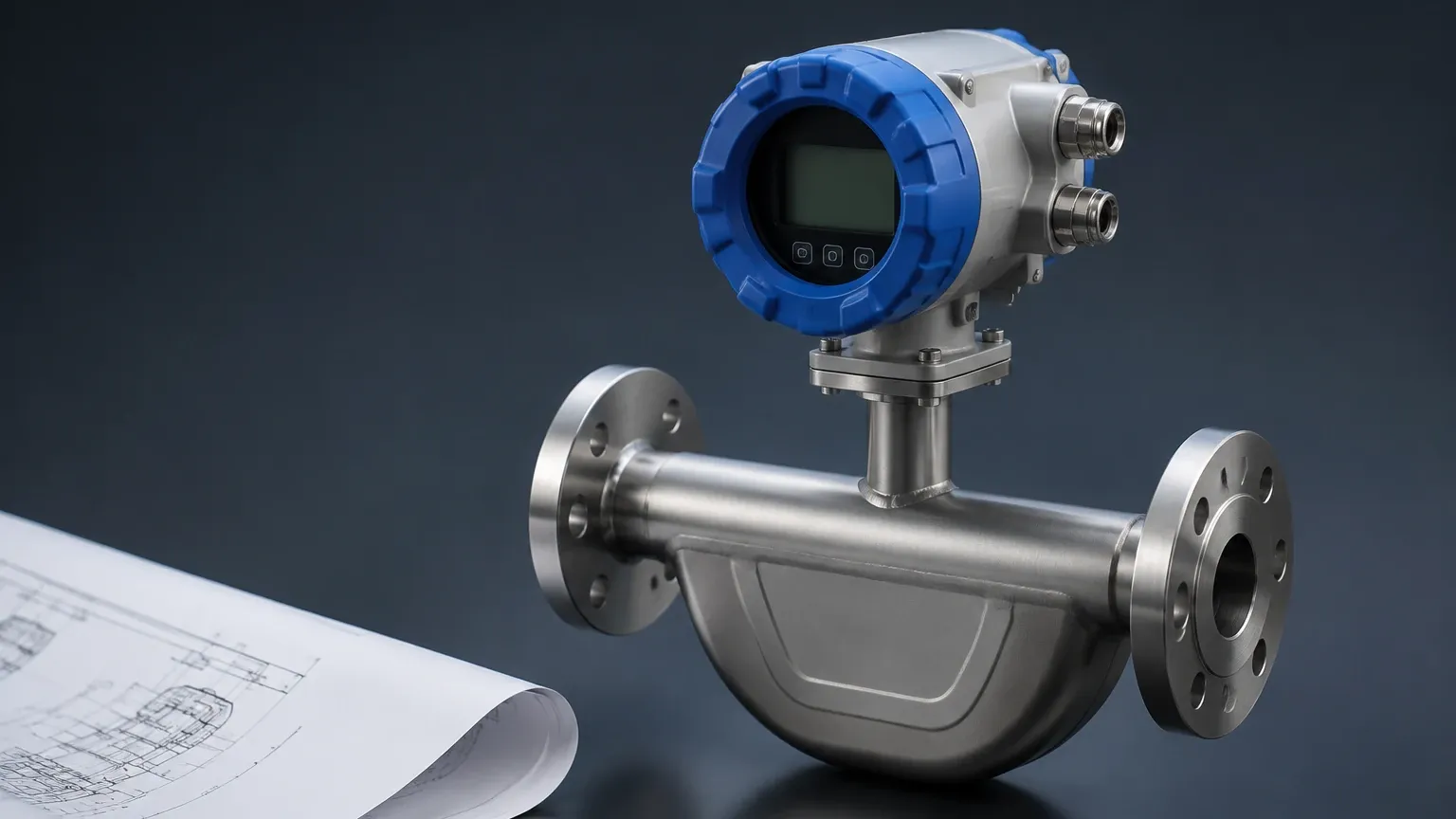
A Coriolis meter system consists of two primary parts: the sensor (the wetted part installed in the pipeline) and the transmitter (the electronic brain that processes the signals).
Sensor Tube Geometry
There are two primary tube configurations used in modern industrial applications:
1. U-Shaped Tubes: This is the most common design. The curved geometry allows for high sensitivity because the phase shift is more pronounced over the length of the curve. They are excellent for low-flow applications and offer high turndown ratios. However, they may require more space and can act as a trap for solids or air if not oriented correctly.
2. Straight Tubes: These meters are designed for applications where pressure drop must be minimized or where the fluid is highly viscous or contains solids. They are easier to clean (CIP/SIP compatible) and are less likely to clog. However, they are generally less sensitive than U-shaped designs and may be more susceptible to external mechanical vibration.
Transmitter Functions
The transmitter provides the power to drive the tube vibration and processes the low-level signals from the pick-off sensors. Modern transmitters offer multiple outputs, including 4-20mA (HART), Modbus RS485, and Foundation Fieldbus. They also perform diagnostic functions, such as "meter verification," which checks the structural integrity of the tubes without interrupting the process.
Technical Selection Criteria
Selecting the correct Coriolis meter requires a detailed understanding of the process fluid and the operational environment. Engineers must balance accuracy requirements against pressure drop and material compatibility.
| Parameter | U-Tube Design | Straight Tube Design |
| :— | :— | :— |
| Mass Flow Accuracy | Typically ±0.1% to ±0.05% | Typically ±0.1% to ±0.2% |
| Pressure Drop | Higher due to flow splitting/curves | Lower; similar to a straight pipe |
| Cleanability | Moderate (may retain fluid) | Excellent (self-draining) |
| Sensitivity | High; better for low flow rates | Moderate; requires higher velocities |
| Installation Footprint | Larger vertical or horizontal space | Compact; fits in-line |
| Solids Handling | Risk of accumulation in bends | Preferred for slurries and pastes |
Fluid Properties
* Viscosity: While Coriolis meters are relatively immune to viscosity changes, extremely high-viscosity fluids will result in a significant pressure drop.
* Corrosivity: Measuring tubes are typically manufactured from 316L Stainless Steel, but for highly aggressive chemicals, alloys like Hastelloy C-22 or Tantalum are required.
* Gas Content: Entrained air or gas bubbles can dampen the tube vibration, leading to measurement errors or "stalling" of the meter. Advanced digital signal processing in modern transmitters helps mitigate this, but it remains a critical selection factor.
Installation Best Practices
To achieve the high levels of accuracy specified by manufacturers, the Coriolis meter must be installed correctly. Unlike magnetic or ultrasonic meters, Coriolis meters do not require long straight pipe runs upstream or downstream, but they are sensitive to mechanical stress and vibration.
Orientation
* Liquids: The sensor should ideally be installed in a downward-facing "U" (flag position) or in a vertical pipe with upward flow. This ensures the tubes remain full and prevents air from becoming trapped.
* Gases: The sensor should be installed with the tubes facing upward to prevent condensate or liquids from accumulating in the measuring section.
* Slurries: Vertical installation with upward flow is preferred to prevent solids from settling in the tubes.
Support and Vibration Isolation
Coriolis meters operate by detecting minute vibrations. Therefore, external vibration from pumps, motors, or vibrating machinery can interfere with the measurement. The meter should be supported by the pipeline itself, and the piping should be rigidly anchored on both the inlet and outlet sides of the sensor. Flexible connectors are generally discouraged unless the meter is specifically isolated from the vibrating source.
Mechanical Stress
Thermal expansion or misalignment of the piping can exert torque or tension on the sensor body. This stress can distort the measuring tubes and cause a "zero shift," leading to measurement inaccuracies. It is essential to ensure that the piping is properly aligned before tightening the flange bolts.
Operational Limitations and Challenges
While the Coriolis meter is a powerful tool, it is not a universal solution for every application. Engineers should be aware of the following limitations:
1. Initial Cost: Coriolis meters are generally more expensive than volumetric meters (such as turbine or vortex meters) due to their complex construction and high-grade materials.
2. Size Constraints: As pipe diameters increase (above 250mm or 10 inches), Coriolis meters become extremely heavy, bulky, and prohibitively expensive. In large-diameter pipes, other technologies like ultrasonic or differential pressure may be more practical.
3. Pressure Drop: In U-tube designs, the fluid must be split into two tubes and forced around tight bends. At high flow rates, this can result in a significant pressure drop, which may require larger pumps or higher system pressures.
4. Zero Stability: Over time, or due to extreme temperature shifts, the "zero" point of the meter may drift. Regular zero-point calibration under no-flow conditions is necessary to maintain high accuracy.
Coriolis Meters in the Context of Inventory Management
In many industrial facilities, flow measurement and level measurement are used together to ensure total process visibility. While a Coriolis meter provides high-precision data on the mass entering or leaving a vessel, industrial level measurement instruments provide the necessary verification of the total volume stored.
For instance, in a chemical reactor, a Coriolis meter might control the precise mass of a catalyst being added, while a radar level meter or ultrasonic sensor monitors the total head-space and volume within the tank to prevent overfills. Integrating these technologies allows for a complete mass balance, which is essential for safety and efficiency. For more information on coordinating these measurement technologies, engineers often consult the Main Page of specialized instrumentation providers to review product options and application support.
Frequently Asked Questions (FAQs)
Q: Can a Coriolis meter measure the flow of gases?
A: Yes. Coriolis meters are highly effective for gas flow, provided the gas density is high enough to generate a detectable phase shift. They are frequently used in high-pressure natural gas applications and for measuring compressed air.
Q: Does the flow profile (laminar vs. turbulent) affect accuracy?
A: No. One of the greatest advantages of the Coriolis meter is that it is independent of the flow profile. This eliminates the need for flow straighteners or long straight piping runs, making them ideal for compact skids.
Q: How often does a Coriolis meter need to be calibrated?
A: Because there are no moving parts to wear out, Coriolis meters are very stable. However, for custody transfer or regulated industries (like pharma), annual calibration is standard. Many users rely on on-board "Smart Meter Verification" to extend the intervals between laboratory calibrations.
Q: What happens if the fluid contains air bubbles?
A: Entrained air can cause "slug flow," which disrupts the vibration of the tubes. While modern meters use high-speed digital processing to maintain measurement during brief periods of aeration, persistent air bubbles will reduce accuracy and may cause the meter to report an error.
Q: Can it measure bi-directional flow?
A: Yes, Coriolis meters can measure flow in both directions. The transmitter will indicate the direction of flow and can maintain separate totals for forward and reverse flow, which is useful in loading and unloading applications.
Conclusion
The Coriolis meter remains the gold standard for mass flow measurement in the B2B industrial sector. Its ability to provide simultaneous mass, density, and temperature readings with unmatched accuracy makes it an essential component of modern automation. By understanding the underlying physics and following strict installation guidelines regarding vibration and orientation, engineers can ensure long-term reliability and precision in even the most demanding process environments.