Water Treatment in Food Industry
Water Treatment in Food Industry
In the global food and beverage sector, water is more than just a utility; it is a critical raw material, a cleaning agent, and a heat transfer medium. Effective water treatment in food industry applications ensures that the final product meets stringent safety standards while maintaining operational efficiency and environmental compliance. From the purification of ingredient water to the management of complex wastewater streams, precise monitoring and control are the foundations of a successful treatment strategy.
Reliable level measurement is essential for automating these processes. Whether managing a storage silo for filtered water or a neutralization tank for effluent, selecting the correct instrumentation requires a deep understanding of both the treatment process and the underlying measurement physics.
Core Principles of Level Measurement in Water Systems
Before selecting instrumentation for water treatment, engineers must evaluate the physical principles that govern different measurement technologies. In the food industry, where hygiene and precision are paramount, three primary technologies are commonly deployed: Radar, Ultrasonic, and Hydrostatic measurement.
Radar Level Measurement (Non-Contact)
Radar level meters operate on the Time-of-Flight (ToF) principle. The device emits high-frequency electromagnetic waves (typically in the 26 GHz or 80 GHz range) toward the liquid surface. These waves are reflected back to the sensor. The distance is calculated based on the time it takes for the signal to travel to the surface and back.
In food-grade water treatment, radar is preferred because it is non-contact, meaning the sensor does not touch the medium. This reduces the risk of contamination and eliminates the need for frequent cleaning of the probe. Modern 80 GHz radar units offer narrow beam angles, which allow for accurate measurement even in narrow tanks with internal obstructions like agitators or spray balls.
Ultrasonic Level Measurement (Non-Contact)
Similar to radar, ultrasonic sensors use the ToF principle but rely on sound waves rather than electromagnetic waves. The sensor emits an ultrasonic pulse that reflects off the liquid surface.
Ultrasonic measurement is a cost-effective solution for many water treatment applications, particularly in open-air environments like sumps or large atmospheric tanks. However, because sound requires a medium (air) to travel, its accuracy can be affected by significant temperature fluctuations, heavy foam, or high-pressure vapors—conditions often found in food processing facilities.
Hydrostatic Level Measurement (Contact)
Hydrostatic transmitters measure the pressure exerted by the liquid column at the bottom of a tank. This pressure is directly proportional to the height of the liquid and its density. The formula used is $P = \rho \times g \times h$, where $P$ is pressure, $\rho$ is density, $g$ is gravity, and $h$ is the height of the liquid.
This technology is highly reliable for vented tanks where the density of the water remains constant. In the food industry, hydrostatic sensors are often designed with flush diaphragms to prevent bacterial growth in recesses, making them suitable for ingredient water storage.
The Role of Specialized Water Treatment in Food Industry
Water treatment in food industry plants is categorized by the water's intended use. Each stage requires specific level control strategies to maintain a continuous flow of high-quality water.
1. Raw Water Pre-treatment
Before water enters the production line, it must be treated to remove suspended solids, minerals, and organic matter. This often involves sedimentation tanks and sand filters. Level sensors here manage the intake pumps and signal when backwashing is required in filtration beds.
2. Ingredient Water Purification
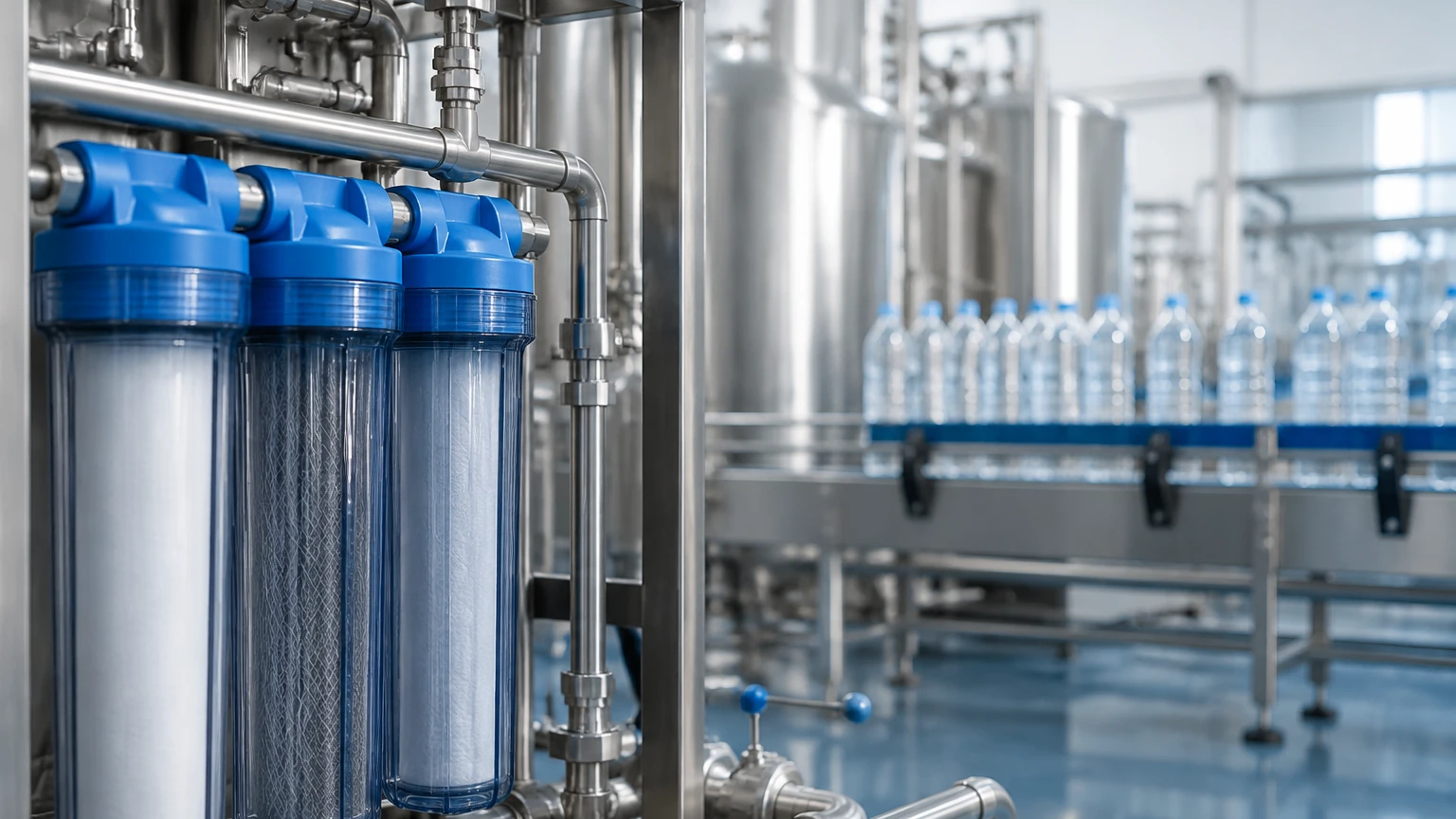
Water used as an ingredient must meet higher standards than potable water. Processes such as Reverse Osmosis (RO), Ultrafiltration (UF), and Deionization (DI) are common. Level measurement in RO permeate tanks ensures a constant buffer for the production line. Radar sensors are frequently used here to maintain high precision without introducing any metallic ions or contaminants into the purified water.
3. Clean-in-Place (CIP) Systems
CIP systems are vital for maintaining hygiene in food production. These systems use cycles of water, caustic chemicals, and acid to clean pipes and tanks. Level sensors in CIP tanks must withstand high temperatures (up to 90°C) and aggressive chemical concentrations. Radar level meters with PTFE-coated antennas are the industry standard for these demanding environments.
4. Wastewater and Effluent Management
Food processing generates significant wastewater containing fats, oils, greases (FOG), and organic solids. Treatment usually involves Dissolved Air Flotation (DAF) units or anaerobic digesters. Level control in these tanks is challenging due to surface foam and varying densities. Non-contact radar is often the only viable solution to prevent sensor fouling.
Selection Criteria for Level Instrumentation
Choosing the right instrument involves balancing technical requirements with budget constraints. The following table provides a general guide for selecting level technology based on common food industry water treatment applications.
| Application | Recommended Technology | Primary Benefit | Potential Limitation |
| :— | :— | :— | :— |
| Filtered Water Storage | Ultrasonic | Cost-effective, reliable | Sensitive to surface foam |
| Ingredient Water (RO) | 80 GHz Radar | High precision, sanitary | Higher initial investment |
| CIP Chemical Tanks | Radar (PTFE Coated) | Chemical resistance | Requires mounting clearance |
| Wastewater Sump | Hydrostatic | Simple installation | Sensitive to density changes |
| Open Channel Flow | Ultrasonic | Standardized for flumes | Affected by heavy wind/steam |
| Buffer Tanks | Hydrostatic | Continuous monitoring | Contacting measurement |
For engineers looking to integrate these technologies into a comprehensive facility management system, you can Review product options and application support on our Main Page to find specific models tailored to these environments.
Installation and Engineering Considerations
Proper installation is as critical as selecting the right technology. In the food industry, additional engineering constraints apply due to sanitary regulations.
1. Dead Zones and Blocking Distances: Every non-contact sensor has a "dead zone" near the sensor face where measurement is impossible. When designing a tank, ensure the maximum fill level does not enter this zone.
2. Mounting Position: Sensors should be mounted away from the tank wall to avoid false reflections and away from the fill inlet to prevent interference from turbulent liquid or splashing.
3. Sanitary Fittings: For any sensor contacting the medium (or even non-contact sensors in sterile environments), use Tri-Clamp or other hygienic fittings. Ensure the materials are FDA-compliant, such as 316L stainless steel or high-grade plastics like PEEK.
4. Venting and Condensation: In hot water applications, condensation can form on the sensor face. Some radar sensors feature specialized antenna designs or "drip-off" shapes that allow condensate to run off, preventing signal attenuation.
Operational Risks and Limitations
While modern instrumentation is robust, certain factors in food industry water treatment can compromise accuracy:
* Foam Accumulation: Heavy, dense foam can absorb ultrasonic and radar signals. In such cases, 80 GHz radar is often more effective at penetrating light foam, but extremely thick foam may still require a stilling well or a contact-based solution like a magnetic level gauge.
* Varying Density: Hydrostatic sensors assume a constant density. If the water treatment process involves mixing additives or significant temperature swings, the density will change, leading to level errors. In these scenarios, non-contact radar is a safer choice.
* Scaling and Buildup: In hard water or wastewater applications, minerals and solids can build up on contacting probes. This increases maintenance requirements and can lead to sensor failure. Non-contact measurement significantly mitigates this risk.
Frequently Asked Questions
Q: Can one sensor type be used for all water treatment stages in a food plant?
A: While radar is versatile enough to handle most stages, it may not be the most cost-effective for simple applications like raw water sumps where ultrasonic or hydrostatic sensors perform adequately. A hybrid approach is usually best for ROI.
Q: How does steam affect level measurement in hot water tanks?
A: Steam can significantly attenuate ultrasonic signals because the sound velocity changes with the gas composition. Radar is largely unaffected by steam, making it the preferred choice for boiler feed water or hot CIP rinse tanks.
Q: Are wireless level sensors suitable for water treatment?
A: Yes, wireless transmitters are increasingly used for remote water storage tanks or large-scale wastewater ponds where running cables is prohibitively expensive. However, ensure the data refresh rate is sufficient for your control logic.
Conclusion
Effective water treatment in food industry operations relies on the synergy between chemical processes and mechanical monitoring. By understanding the measurement principles of radar, ultrasonic, and hydrostatic technologies, engineers can specify solutions that ensure water purity, reduce waste, and protect downstream equipment. Always prioritize sanitary design and consider the specific environmental challenges—such as foam, steam, and chemical aggression—when selecting your instrumentation. For a deeper look at specific hardware configurations and technical data sheets, refer to the Main Page for a complete overview of industrial level measurement solutions.