Dielectric Constant of Silicon
Dielectric Constant of Silicon
In the field of industrial process control and automation, understanding the physical properties of the materials being measured is fundamental to achieving accuracy and reliability. One of the most critical parameters for level measurement—particularly when employing radar or capacitive technologies—is the dielectric constant (relative permittivity). When dealing with silicon in its various industrial forms, from crystalline semiconductor wafers to metallurgical powders and silica-based compounds, the dielectric constant of silicon plays a decisive role in instrument selection and configuration.
This guide provides a technical overview of the dielectric constant of silicon, explaining how it influences measurement principles and offering practical advice for engineers selecting level measurement solutions for silicon-related applications.
Understanding the Dielectric Constant (εr)
The dielectric constant, denoted by the Greek letter epsilon (εr), is a dimensionless measure of a material's ability to store electrical energy in an electric field compared to a vacuum. In a vacuum, the dielectric constant is defined as 1.0. Air is very close to this, with a value of approximately 1.0006.
In level measurement, the dielectric constant determines two primary factors:
1. Reflectivity: In radar level measurement (both non-contact and guided wave), the strength of the reflected signal (echo) is directly proportional to the difference between the dielectric constant of the medium and the air above it. Materials with a high dielectric constant reflect more energy back to the sensor.
2. Capacitance: In capacitive level sensors, the dielectric constant of the medium acts as the insulator between the probe and the tank wall. A change in the level of a material with a high dielectric constant results in a significant change in measured capacitance.
For silicon, the value of εr varies significantly depending on its physical state, purity, and temperature. This variation necessitates a deep understanding of the specific material form before selecting a measurement technology on the Main Page.
The Dielectric Constant of Silicon in Various Forms
Silicon is rarely found in its pure elemental form in bulk industrial storage; it is typically encountered as crystalline silicon, silicon metal powder, or as a compound like silicon dioxide (silica).
Crystalline Silicon
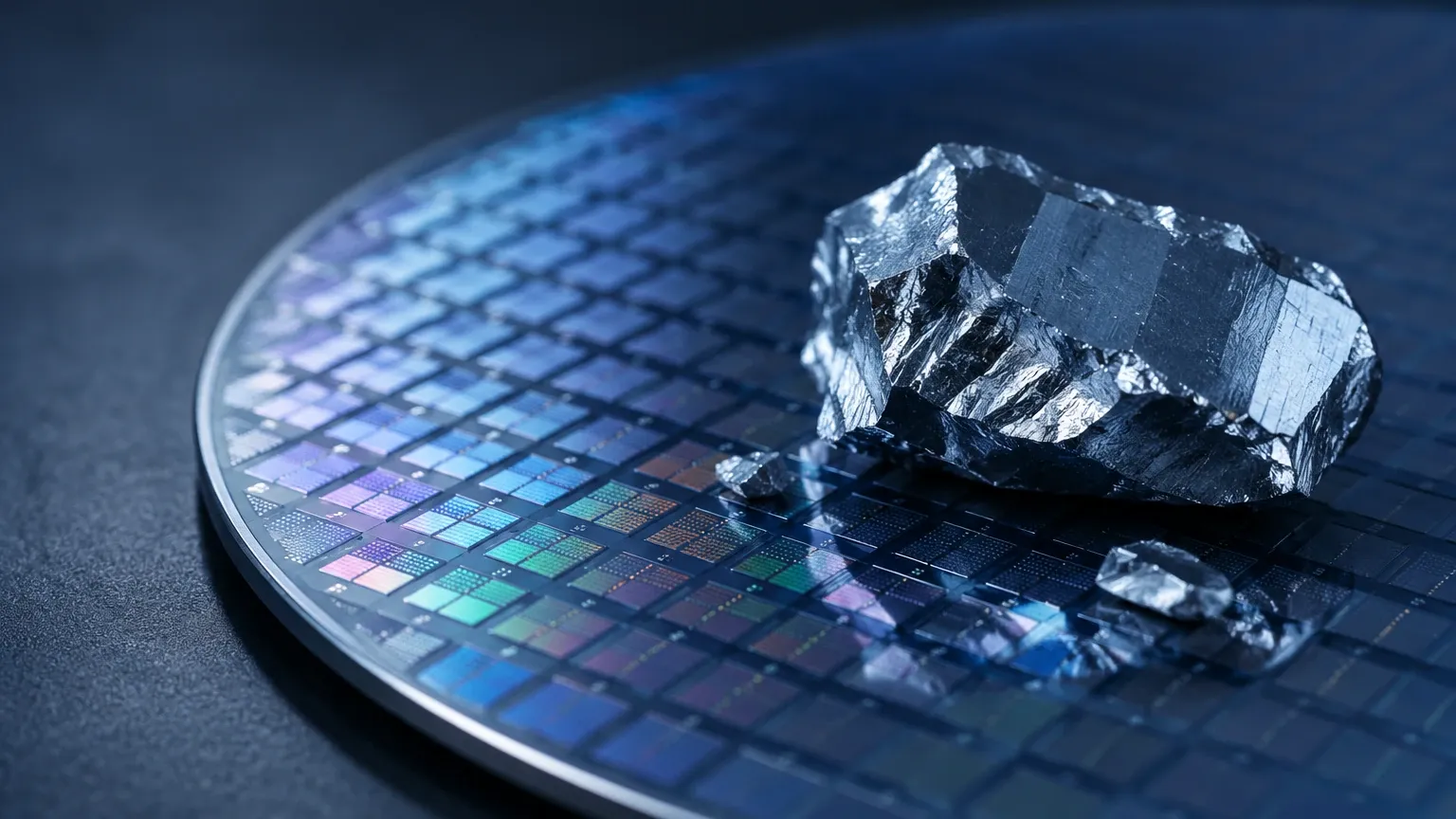
Pure crystalline silicon is a semiconductor. At room temperature (approx. 20°C / 68°F), the dielectric constant of silicon is approximately 11.7. This is considered a relatively high value for a non-metallic solid, meaning it provides an excellent reflection for radar signals. However, because silicon is a semiconductor, its conductivity can increase with temperature, which may affect signal penetration and surface reflection characteristics in high-temperature processing environments.
Silicon Dioxide (Silica/Sand)
Silicon dioxide (SiO2), commonly known as silica or quartz, is one of the most prevalent silicon compounds in industry. Its dielectric constant is significantly lower than that of pure silicon, typically ranging from 3.7 to 4.5. In the form of dry silica sand, the effective dielectric constant can drop further to between 2.5 and 3.5 due to the air gaps between the granules (bulk density effects).
Silicon Powders and Granules
In metallurgical and chemical applications, silicon is often stored as a powder. The "effective" dielectric constant of a powder is a mixture of the material's intrinsic εr and the εr of the air trapped between the particles. For silicon metal powder, the effective dielectric constant usually falls between 3.0 and 5.0. If the powder is extremely fine and aerated, the value may approach 1.5 to 2.0, presenting a challenge for standard radar transmitters.
Impact on Measurement Principles
Before recommending a specific instrument, it is essential to analyze how the dielectric constant of silicon interacts with different measurement physics.
Radar Level Measurement (Time of Flight)
Radar level meters emit high-frequency electromagnetic pulses. When these pulses hit the surface of the silicon, a portion of the energy is reflected. The reflection coefficient (Γ) can be simplified as:
Γ = (√εr – 1) / (√εr + 1)
For crystalline silicon (εr = 11.7), the reflection coefficient is approximately 0.55, meaning a very strong signal is returned. For silica sand (εr = 3.0), the coefficient drops to approximately 0.27. While this is still measurable, the signal is significantly weaker, requiring more sensitive electronics or high-gain antennas.
Guided Wave Radar (GWR)
Guided Wave Radar uses a physical probe (cable or rod) to guide the microwave pulse to the material surface. GWR is particularly effective for silicon powders with low dielectric constants because the probe concentrates the energy, reducing signal loss over distance. Even with a dielectric constant as low as 1.4, GWR can often provide a reliable level reading.
Capacitance Level Switches
Capacitance switches detect the presence of material at a specific point. When silicon (εr = 11.7) replaces air (εr = 1.0) around the probe, the capacitance increases. Because the dielectric constant of silicon is significantly higher than air, capacitive switches are highly reliable for high-level and low-level detection in silicon storage silos.
Practical Selection Table for Silicon Applications
The following table summarizes typical dielectric values and recommended measurement technologies for various silicon-based materials.
| Material State | Typical εr | Recommended Technology | Considerations |
| :— | :— | :— | :— |
| Crystalline Silicon (Solid) | 11.7 | Non-contact Radar (80GHz) | Excellent signal reflection. |
| Silicon Metal Powder | 3.0 – 5.0 | Guided Wave Radar (GWR) | Best for dusty environments. |
| Silica Sand (Dry) | 2.5 – 3.5 | 80GHz Radar / GWR | Requires high-sensitivity settings. |
| Silicon Carbide | 40.0+ | Non-contact Radar | Highly reflective; easy to measure. |
| Silicone Oil | 2.2 – 2.8 | Radar / Ultrasonic | Low dielectric; check for foam. |
| Silicon Tetrachloride (Liquid) | 2.4 | GWR / Pressure Transmitter | Corrosive; requires specialized materials. |
Installation Considerations for Silicon Storage
When installing level measurement instruments in silos containing silicon metal or silica, several engineering factors must be addressed to ensure the dielectric properties do not lead to measurement errors.
1. Angle of Repose and Signal Scattering
Silicon powders and granules form a cone (angle of repose) when loaded into a silo. Because the dielectric constant of silicon powders is relatively low, the radar signal may scatter away from the sensor if the surface is steeply angled. Using an 80GHz radar with a narrow beam angle (e.g., 3° to 6°) helps target the surface more effectively and reduces interference from silo walls.
2. Dust and Vapor Attenuation
While the dielectric constant of the silicon itself is the primary concern for reflection, the presence of dust in the headspace can attenuate the signal. High-frequency radar (80GHz) is generally better at penetrating dust than lower-frequency versions, but in extreme cases, a dust-purging system (using compressed air) may be required on the antenna lens.
3. Nozzle Geometry
For materials with a lower dielectric constant, such as silica sand, it is vital to minimize signal interference from the mounting nozzle. The nozzle should be as short as possible, and the antenna should extend slightly past the nozzle bottom to prevent "ringing" or internal reflections that could mask the weak return signal from the low-dielectric material.
4. Dielectric Variation due to Moisture
One of the most common risks in silicon level measurement is the presence of moisture. Water has a very high dielectric constant (εr ≈ 80). If silicon powder becomes damp, its effective dielectric constant will rise sharply. While this makes the surface easier to detect for radar, it can cause errors in Guided Wave Radar if the device is calibrated for a dry dielectric, as the propagation speed of the pulse along the probe changes.
Limitations and Challenges
Despite the advanced technology available on the Main Page, certain limitations exist when measuring silicon-based materials:
* Low Dielectric Thresholds: If the effective dielectric constant of a highly aerated silicon powder drops below 1.4, standard non-contact radar may struggle to distinguish the surface from background noise. In these instances, Guided Wave Radar with a coaxial probe or a high-gain parabolic antenna is mandatory.
* Signal Absorption: In some semiconductor-grade silicon processes, the material may exhibit conductive properties. Highly conductive materials do not allow radar signals to penetrate; they reflect almost all energy at the surface. While good for level measurement, it prevents the use of radar for interface measurement (e.g., measuring through one layer to another).
* Build-up on Probes: For GWR and capacitive sensors, silicon dust can build up on the probe. If the dust is dry, its low dielectric constant usually means the sensor can "see through" the build-up. However, if the build-up becomes moist or conductive, it may create a "virtual level," leading to false high readings.
Frequently Asked Questions (FAQs)
Q: Can I use ultrasonic sensors for silicon powder?
A: While ultrasonic sensors do not depend on the dielectric constant (they use sound waves), they are often unsuitable for silicon powders because the porous surface of the powder absorbs sound energy, and the heavy dust common in these silos scatters the acoustic signal. Radar is generally preferred.
Q: How does the dielectric constant of silicon change with temperature?
A: For pure silicon, the dielectric constant is relatively stable up to moderate temperatures, but as it approaches melting points in furnace applications, the increasing conductivity becomes the dominant factor in electromagnetic interaction.
Q: Do I need to re-calibrate my radar if I switch from silica sand to silicon metal?
A: Yes. Because the dielectric constant of silicon metal (εr ≈ 5.0) is higher than that of silica sand (εr ≈ 3.0), the reflection intensity will change. Most modern radar units can auto-gain, but it is best practice to verify the sensitivity settings to ensure the most reliable echo tracking.
Q: What is the best antenna for low-dielectric silicon materials?
A: A large-diameter lens antenna or a parabolic antenna is best. These designs focus the radar energy into a narrow beam, maximizing the amount of energy that returns to the receiver after reflecting off a low-dielectric surface.
Conclusion
The dielectric constant of silicon is a pivotal factor in designing a reliable level measurement system. Whether dealing with the high reflectivity of crystalline silicon or the more challenging, low-dielectric properties of silica powders, selecting the correct technology—such as 80GHz high-frequency radar or Guided Wave Radar—is essential. By considering the material's physical state, the potential for dust, and the silo's geometry, engineers can ensure long-term operational success. For detailed product specifications and application-specific support, users should consult the technical resources available on the Main Page.