Differential Pressure Level Transmitters
Differential Pressure Level Transmitters
Differential pressure (DP) level transmitters represent one of the most established and versatile technologies in the field of industrial process control. Used extensively across water treatment, chemical processing, and oil and gas industries, these instruments provide a reliable method for determining the liquid level in both open and closed vessels. By measuring the difference in pressure between two points, these transmitters infer the height of a liquid column based on the physical properties of the fluid and the laws of hydrostatics.
As a professional manufacturer, Welk provides a range of industrial level measurement instruments designed to meet the rigorous demands of modern automation. Understanding the engineering principles behind differential pressure level transmitters is essential for selecting the correct configuration for specific process conditions, ensuring long-term accuracy and minimal maintenance.
Understanding the Measurement Principle
The operation of differential pressure level transmitters is rooted in the hydrostatic pressure principle. This principle states that the pressure exerted by a static liquid column is directly proportional to its height and the density of the fluid. The mathematical representation is expressed as:
P = ρ × g × h
Where:
* P is the hydrostatic pressure (typically measured in Pascals or bar).
* ρ (rho) is the density of the liquid (kg/m³).
* g is the acceleration due to gravity (approximately 9.81 m/s²).
* h is the height of the liquid column (meters).
Open Tank Applications
In an atmospheric or open tank, the measurement is straightforward. The low-pressure side of the transmitter is vented to the atmosphere. The high-pressure side is connected to the bottom of the tank. Since the atmospheric pressure acts on both the surface of the liquid and the low-pressure port of the transmitter, it cancels out, leaving the transmitter to measure only the pressure exerted by the liquid height.
Closed Tank Applications
In pressurized or vacuum-sealed vessels, the pressure above the liquid (the headspace) must be accounted for. If only a single-port pressure sensor were used at the bottom, it would measure the sum of the liquid's hydrostatic pressure and the gas pressure in the headspace, leading to an incorrect level reading.
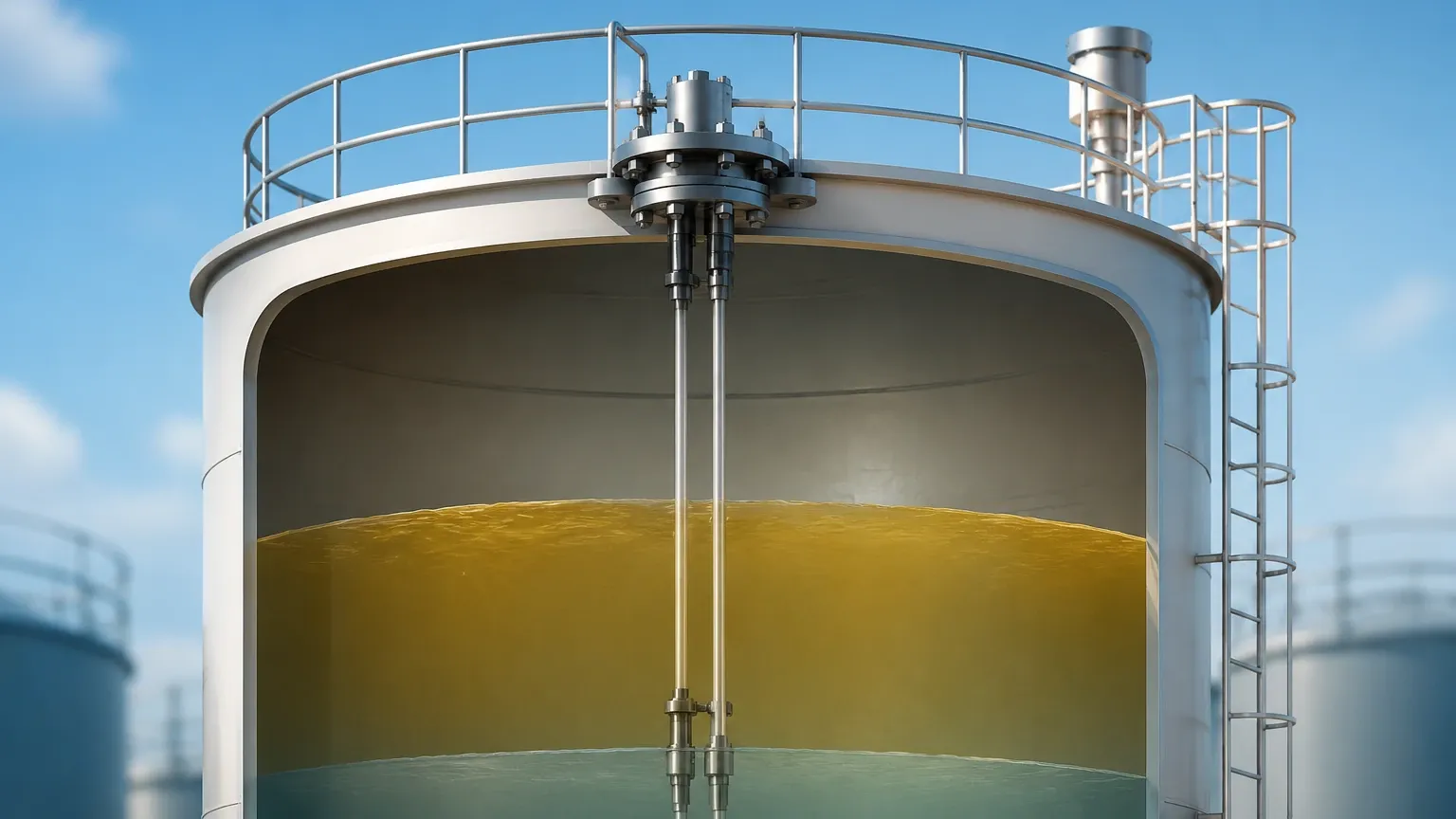
Differential pressure level transmitters solve this by connecting the high-pressure (HP) port to the bottom of the vessel and the low-pressure (LP) port to the top of the vessel (the gas space). The transmitter subtracts the headspace pressure from the total pressure at the bottom, isolating the pressure generated solely by the liquid column.
Types of Differential Pressure Level Transmitters
Depending on the process media and the physical layout of the plant, different transmitter configurations are required to ensure signal integrity and instrument longevity.
1. Direct Mount Transmitters
These are the most common and cost-effective units. The transmitter is mounted directly to the process flange or via short impulse piping. They are ideal for clean, non-corrosive liquids at moderate temperatures. Welk offers direct-mount solutions that integrate seamlessly into standard industrial piping architectures.
2. Remote Seal (Capillary) Systems
In many chemical and high-temperature applications, the process fluid cannot come into direct contact with the transmitter's sensing diaphragm. This may be due to the fluid being highly corrosive, viscous, prone to polymerization, or extremely hot.
Remote seal systems use a flexible diaphragm at the process connection, linked to the transmitter body via oil-filled capillary tubes. The pressure is transmitted through the fill fluid (such as silicone oil or high-temperature oil) to the sensor. While highly effective, these systems must be calibrated carefully to account for the weight of the fill fluid in the capillaries.
3. Submersible Hydrostatic Transmitters
While technically a subset of pressure measurement, submersible sensors are often used in deep wells or large open reservoirs. These units are lowered into the liquid, and the "differential" aspect is handled by a vent tube within the cable that references the sensor to atmospheric pressure.
Key Selection Criteria for Industrial Applications
Selecting the right differential pressure level transmitter requires a thorough analysis of the process environment. Engineers should evaluate the following criteria before procurement:
* Fluid Density: Since the transmitter measures weight to infer height, any change in density (often caused by temperature fluctuations) will result in a measurement error. If the density is not constant, compensation via a temperature sensor and a PLC/DCS algorithm may be necessary.
* Process Temperature: Standard transmitters have specific operating limits. For cryogenic or high-heat applications (above 120°C), remote seals with specialized fill fluids are mandatory to protect the electronics.
* Chemical Compatibility: The wetted parts, including the diaphragm and process flanges, must be compatible with the media. Common materials include 316L Stainless Steel, Hastelloy C, Tantalum, or Monel.
* Pressure Rating: The transmitter must be able to withstand the maximum static pressure of the vessel without shifting its zero point or damaging the sensor.
* Turndown Ratio: This refers to the range over which the transmitter can maintain its accuracy. A high turndown ratio allows a single transmitter model to be used across various tank heights in a facility.
Practical Selection Table for DP Level Measurement
The following table provides a general guideline for selecting transmitter configurations based on common industrial scenarios.
| Application Scenario | Recommended Transmitter Type | Key Consideration |
| :— | :— | :— |
| Clean water in an open reservoir | Direct mount / Submersible | Cost-effective, simple venting |
| Pressurized nitrogen-blanketed tank | Standard DP Transmitter | Use of a "dry leg" or "wet leg" |
| Corrosive acid storage | Remote Seal (Tantalum/Hastelloy) | Material compatibility is critical |
| High-viscosity polymers | Flush Diaphragm Remote Seal | Prevents clogging of impulse lines |
| Vacuum distillation column | Balanced Remote Seal System | Prevents boiling of fill fluid in capillaries |
| Food and Beverage (Sanitary) | Tri-Clamp Remote Seal | Ease of cleaning and CIP/SIP compliance |
Installation Considerations: Wet Leg vs. Dry Leg
One of the most critical aspects of installing differential pressure level transmitters in closed tanks is the management of the low-pressure (LP) impulse line.
The Dry Leg
If the gas in the headspace is non-condensable (such as dry nitrogen or air), a "dry leg" is used. The LP impulse line is filled only with gas. It is important to install a condensate trap at the bottom of the leg to prevent any stray moisture from accumulating and adding unwanted hydrostatic head to the LP side.
The Wet Leg
If the gas in the headspace is a vapor that can condense (such as steam), the LP impulse line will eventually fill with liquid. To prevent an unpredictable and fluctuating liquid level in the impulse line, the line is intentionally filled with a known liquid (usually the process fluid or a compatible stable liquid) to a fixed height. This is known as a "wet leg."
When using a wet leg, the transmitter must be calibrated with a "negative zero shift" or "suppressed zero" because the LP side will always see more pressure than the HP side when the tank is empty.
Limitations and Common Risks
While differential pressure level transmitters are robust, they are not suitable for every application. Engineers must be aware of the following limitations:
1. Density Sensitivity: If a tank stores different products with varying densities at different times, the DP transmitter will require recalibration for each product. It cannot "see" the top of the liquid; it only feels the weight.
2. Impulse Line Clogging: In applications with suspended solids or slurries, impulse lines can become plugged. This leads to "frozen" readings or significant lag in response. In these cases, a flush-mounted remote seal is a superior choice.
3. Ambient Temperature Effects: For remote seal systems, long capillary runs exposed to the sun or cold weather can cause the fill fluid to expand or contract, leading to measurement drift. Proper insulation or heat tracing of capillaries may be required.
4. Static Pressure Shifts: Very high static pressures can cause a slight shift in the diaphragm's zero position. High-quality transmitters from manufacturers like Welk are designed to minimize this effect, but it should be checked during commissioning.
Frequently Asked Questions (FAQ)
Q: Can a DP transmitter measure the level of an interface between two liquids?
A: Yes. If there are two immiscible liquids with different densities (e.g., oil and water), a DP transmitter can measure the interface level. The transmitter must be calibrated based on the density difference between the two fluids.
Q: How often should a differential pressure level transmitter be calibrated?
A: For most industrial applications, an annual calibration check is standard. However, in critical safety loops or highly corrosive environments, semi-annual checks may be necessary. Modern smart transmitters with HART or Foundation Fieldbus protocols offer self-diagnostics that can help determine when calibration is drifting.
Q: What is the advantage of using a DP transmitter over an ultrasonic or radar sensor?
A: DP transmitters are often preferred in applications with heavy foam, internal tank obstructions (like agitators or heating coils), or high-pressure steam, all of which can interfere with the signals of non-contact sensors like radar or ultrasonic meters.
Q: What units of measurement are typically used for DP level?
A: While the output is usually 4-20mA or a digital signal, the calibration units are typically mmH2O, mbar, or kPa. For example, a water tank that is 5 meters high would exert approximately 500 mbar (50 kPa) of pressure at the base.
Conclusion and Technical Support
Differential pressure level transmitters remain a cornerstone of industrial instrumentation due to their reliability and the fundamental physical principles they employ. By carefully considering fluid density, vessel pressure, and installation geometry, engineers can implement a measurement solution that provides years of accurate service.
For those seeking to optimize their process automation or requiring customized OEM/ODM services for level measurement, selecting a partner with deep technical expertise is vital. You can Review product options and application support on the Welk Main Page to find detailed specifications for radar, ultrasonic, and hydrostatic solutions tailored to your specific industry needs. Whether you are managing water treatment facilities or complex chemical reactors, the right instrumentation is the first step toward operational excellence.