Din Rail Conductivity Level Switches
Din Rail Conductivity Level Switches
In industrial automation and process control, the precise management of liquid levels is critical for operational efficiency and safety. Among the various technologies available, conductivity level switches represent one of the most reliable and cost-effective solutions for detecting the presence or absence of conductive liquids. When these controllers are designed for DIN rail mounting, they offer significant advantages in terms of control cabinet organization, ease of installation, and maintenance accessibility. This guide provides a comprehensive technical overview of din rail conductivity level switches, their operating principles, selection criteria, and practical application in modern industrial environments.
Measurement Principles of Conductivity Level Switches
Conductivity level switches operate on a relatively simple yet highly effective electrical principle. The system typically consists of a controller—often mounted on a standard 35mm DIN rail—and a set of electrodes (probes) that extend into the vessel or tank.
The Electrical Circuit
The fundamental principle relies on the electrical conductivity of the liquid being measured. The controller applies a low-voltage alternating current (AC) to the electrodes. When the liquid level rises and touches the probes, an electrical circuit is completed between the sensing electrode and a reference (earth) electrode or the conductive tank wall. This small current flow is detected by the DIN rail controller, which then triggers an internal relay to change state (e.g., from Open to Closed).
Why AC is Used
It is important to note that professional-grade din rail conductivity level switches use AC voltage rather than DC. Using direct current (DC) would lead to electrolysis, causing the rapid degradation of the electrodes and the potential buildup of gases or chemical changes in the liquid. High-frequency AC prevents these electrochemical reactions, ensuring long-term probe stability and measurement accuracy.
Sensitivity and Resistance
The "conductivity" of a liquid is the inverse of its electrical resistance. Different liquids have varying levels of conductivity; for instance, wastewater and acids are highly conductive, while purified water has very high resistance. Most DIN rail controllers feature an adjustable sensitivity potentiometer, allowing engineers to calibrate the device to the specific resistance (typically measured in kΩ) of the process medium. This ensures the switch does not trigger prematurely due to high humidity or foam, nor fail to trigger in low-conductivity fluids.
The Role of DIN Rail Mounting in Industrial Design
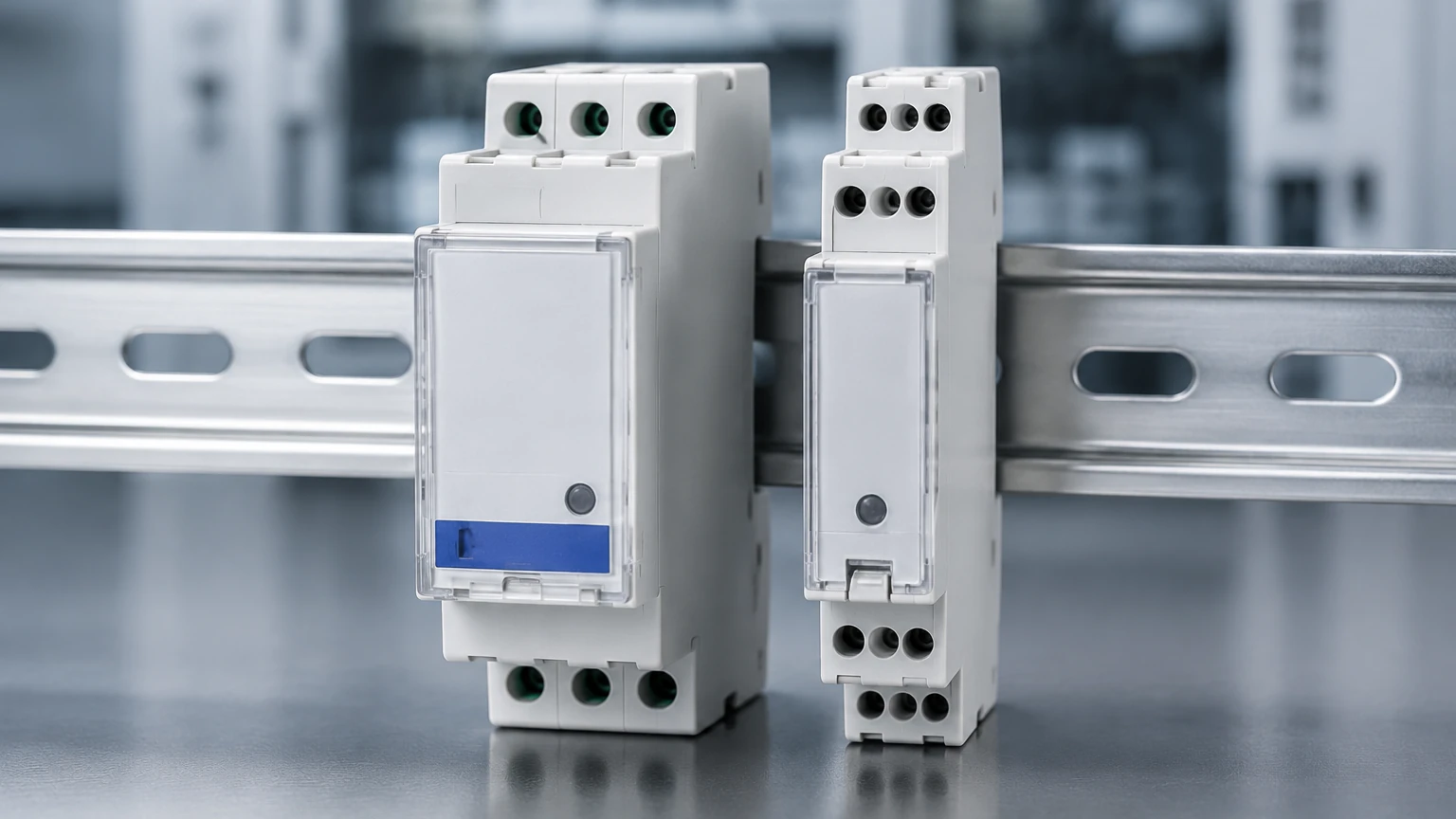
In the context of industrial level measurement, the physical housing of the controller is as important as the sensing technology itself. The DIN rail format is the global standard for mounting electrical components inside control panels.
1. Space Efficiency: Modern control cabinets are often crowded. DIN rail conductivity level switches are typically compact (ranging from 17.5mm to 35mm in width), allowing multiple units to be installed side-by-side to manage various tanks or multi-level detection points within a single enclosure.
2. Simplified Wiring: By centralizing the level control logic on the DIN rail, wiring from the field probes can be neatly routed to the cabinet. This setup separates the sensing environment (the tank) from the control environment (the cabinet), protecting the electronics from harsh process conditions.
3. Modular Maintenance: If a controller needs to be replaced or upgraded, the DIN rail clip mechanism allows for rapid removal without disturbing adjacent components. This minimizes downtime in critical processes like water treatment or chemical dosing.
For engineers seeking a diverse range of industrial instrumentation, reviewing the Main Page of specialized manufacturers like Welk can provide insights into how these switches integrate with broader automation ecosystems.
Key Evaluation Criteria for Selection
Selecting the right din rail conductivity level switches requires an understanding of both the liquid properties and the control logic required for the application. Use the following criteria to evaluate potential models.
Number of Levels and Control Logic
Controllers are generally categorized by the number of electrodes they support:
* Single Level (2 Probes): Used for basic high or low-level alarms. One probe is the reference, and the other is the trigger point.
* Dual Level (3 Probes): Used for pump control (filling or emptying). The probes define a "start" and "stop" level, creating a hysteresis zone to prevent the pump from rapid cycling (chattering).
* Multi-Level (4+ Probes): Used for complex sequences, such as low-level alarm, pump start, pump stop, and high-level overflow alarm.
Sensitivity Range
Ensure the controller's sensitivity range matches the liquid.
* Standard (5kΩ to 100kΩ): Suitable for most tap water, wastewater, and mild chemicals.
* High Sensitivity (up to 500kΩ or 1MΩ): Required for distilled water or liquids with very low ion content.
Relay Output and Power Supply
Check the contact rating of the internal relay. Most units provide a Changeover (SPDT) contact rated for 5A or 8A at 250VAC. Additionally, verify the supply voltage; industrial standards usually require 24VDC or universal AC/DC inputs (24V to 240V).
Selection Table: Conductivity Level Switch Configurations
| Feature | Standard Water Control | Chemical/Acid Processing | High-Purity Water |
| :— | :— | :— | :— |
| Sensitivity Range | 5kΩ – 50kΩ | 1kΩ – 20kΩ | 100kΩ – 1MΩ |
| Probe Material | 304/316 Stainless Steel | Hastelloy or Titanium | 316L (Electropolished) |
| Control Logic | Filling/Emptying | High/Low Alarms | High Sensitivity Detection |
| Mounting | 35mm DIN Rail | 35mm DIN Rail | 35mm DIN Rail |
| Typical Application | Sump pumps, storage tanks | Neutralization tanks | Pharmaceutical rinsing |
Installation Considerations and Best Practices
Proper installation is paramount to ensuring the reliability of din rail conductivity level switches. Errors in probe placement or wiring can lead to false triggers or system failure.
Probe Placement and Orientation
* Vertical vs. Horizontal: Probes are typically installed vertically from the top of the tank. If horizontal installation is necessary, the probes must be angled slightly downward to ensure liquid drains off them when the level drops, preventing "bridging" (where a film of liquid keeps the circuit closed).
* Turbulence: In tanks with high agitation or inflow, use a stilling well (a perforated pipe) to house the probes. This prevents the liquid surface from splashing against the electrodes and causing relay chatter.
* Distance between Probes: Maintain a minimum distance (typically 10mm to 20mm) between electrodes to prevent debris from getting stuck between them and creating a short circuit.
Wiring and Grounding
* Cable Length: While conductivity switches can support long cable runs, excessive length (over 100 meters) can introduce parasitic capacitance, which might be interpreted by the controller as conductivity. Use shielded cables for long distances.
* Reference Electrode: If the tank is made of a non-conductive material (like plastic or fiberglass), a dedicated reference electrode must be installed that reaches the lowest point of the measurement range. For metal tanks, the tank wall itself can often serve as the reference ground.
DIN Rail Controller Setup
* Time Delay: Many DIN rail units include an adjustable time delay (0.5 to 10 seconds). This is vital for applications where the liquid surface is wavy, as it prevents the relay from switching on and off rapidly due to surface ripples.
Limitations and Common Risks
While highly effective, conductivity level switches are not universal solutions. Engineers must be aware of the following limitations:
1. Non-Conductive Liquids: This technology cannot detect oils, fuels, hydrocarbons, or pure deionized water, as these substances do not conduct electricity.
2. Coating and Fouling: If the liquid is prone to leaving deposits (like heavy grease or calcium scale), the probes may become coated. A non-conductive coating will prevent the switch from detecting the liquid, while a conductive coating can cause the switch to stay "on" even when the tank is empty.
3. Vapor and Condensation: In high-temperature tanks, heavy condensation on the probe head or insulation can create a conductive path between electrodes, leading to false high-level signals. Using probes with moisture-resistant insulators is recommended.
Frequently Asked Questions (FAQs)
Q: Can I use din rail conductivity level switches for boiling water?
A: Yes, provided the probes are rated for the temperature. However, steam and bubbles can affect the consistency of the reading. A time delay on the controller is usually necessary.
Q: What happens if the probes touch the side of a metal tank?
A: If a sensing probe touches a conductive tank wall, it will complete the circuit and trigger a permanent "high" signal. Ensure probes are properly spaced and use spacers if necessary to keep them centered.
Q: How often should the probes be cleaned?
A: This depends entirely on the medium. For clean water, probes may last years without maintenance. In wastewater or chemical applications, monthly or quarterly inspections are advised to check for corrosion or buildup.
Q: Is it safe to touch the probes while the system is powered?
A: While the voltage used by most DIN rail controllers is low-voltage AC (typically <24V) and galvanically isolated from the mains, it is always best practice to de-energize the system before handling the probes to avoid any risk of electrical shock or accidental equipment triggering.
Conclusion
Din rail conductivity level switches remain a cornerstone of industrial liquid management due to their simplicity, reliability, and ease of integration. By understanding the electrical properties of the process fluid and adhering to strict installation guidelines regarding probe placement and sensitivity adjustment, facilities can achieve precise level control with minimal investment. For complex applications involving non-conductive fluids or high-pressure environments, other technologies such as radar or ultrasonic sensors may be required. However, for the vast majority of conductive liquid applications, the DIN rail conductivity switch offers an unbeatable balance of performance and practicality.