Distillation Column Pressure Drop
Distillation Column Pressure Drop
In the field of chemical engineering and industrial processing, monitoring distillation column pressure drop is one of the most critical diagnostic tools for ensuring operational efficiency and product purity. Pressure drop, often denoted as $\Delta P$, represents the difference in pressure between the bottom and the top of a distillation column. This parameter serves as a direct indicator of the internal hydraulic conditions, vapor-liquid contact efficiency, and the overall health of the column internals.
For engineers and plant operators, understanding the nuances of distillation column pressure drop is essential for optimizing throughput and preventing costly downtime. This guide examines the fundamental principles of pressure drop, the instrumentation used to monitor it, and practical considerations for hardware selection and installation.
Fundamental Principles of Pressure Drop
Pressure drop in a distillation column is generated by two primary factors: the mechanical resistance of the column internals and the hydrostatic head of the liquid retained on those internals. To manage these factors, it is necessary to distinguish between "dry" and "wet" pressure drop.
Dry Pressure Drop
Dry pressure drop occurs when vapor flows through the column internals (such as trays, packing, or distributors) without any liquid present. It is primarily a function of the vapor velocity, the density of the vapor, and the geometric configuration of the internals. As vapor passes through orifices in a tray or the interstitial spaces in packing, kinetic energy is lost due to friction and changes in flow direction.
Wet Pressure Drop and Liquid Holdup
In normal operation, the column is "wet." The total distillation column pressure drop is the sum of the dry pressure drop and the pressure required for the vapor to bubble through the liquid layer (on trays) or to pass through the narrowed channels caused by liquid film (in packed columns).
On a trayed column, the vapor must overcome the hydrostatic head of the liquid on the tray, which is determined by the weir height and the liquid crest over the weir. In packed columns, the liquid occupies a portion of the void space, increasing the actual vapor velocity and thus the frictional resistance. This additional resistance is known as liquid holdup.
Measurement Principles
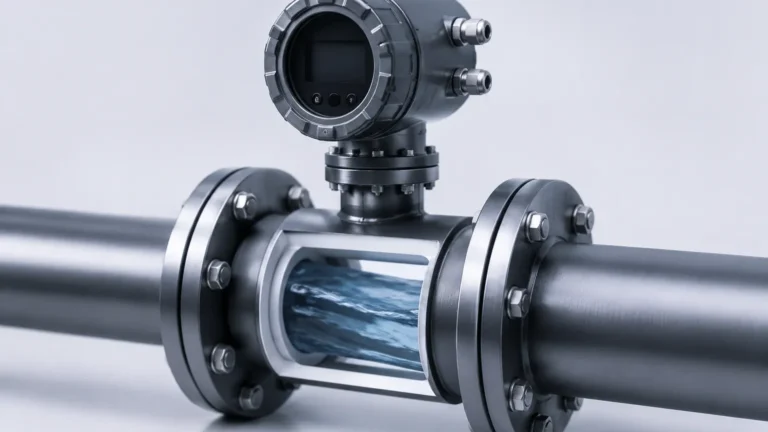
The most common method for measuring distillation column pressure drop is through Differential Pressure (DP) transmitters. These instruments utilize two sensing points—one at the bottom (high-pressure side) and one at the top (low-pressure side) of the column. The transmitter calculates the difference, providing a real-time $\Delta P$ reading. For high-accuracy requirements, especially in vacuum distillation where pressure drops are kept intentionally low, specialized low-range DP cells are employed.
The Relationship Between Pressure Drop and Column Performance
Monitoring distillation column pressure drop is not merely about recording data; it is about interpreting the "breathing" of the process. Every column has an optimal operating window, often illustrated by a capacity plot or "flood curve."
The Loading Point
As vapor velocity increases, the pressure drop increases gradually. Eventually, the column reaches the "loading point," where the vapor begins to hinder the downward flow of liquid significantly. At this stage, the liquid holdup increases rapidly, causing a sharper rise in the pressure drop curve. Operating near the loading point often yields the highest mass transfer efficiency because of the increased turbulence and contact area.
The Flooding Point
If vapor velocity continues to rise beyond the loading point, the column reaches "flooding." At this stage, the pressure drop increases exponentially. Liquid can no longer flow down against the upward vapor force, leading to liquid accumulation in the column. This results in a massive loss of separation efficiency, carryover of liquid into the overhead system (entrainment), and potential mechanical damage to internals. A sudden spike in distillation column pressure drop is the primary early warning sign of an impending flood.
Weeping and Dumping
Conversely, if the pressure drop is too low, it indicates that the vapor velocity is insufficient to support the liquid on the trays. This leads to "weeping," where liquid leaks through the tray perforations instead of flowing over the weir. In extreme cases, "dumping" occurs, where all liquid falls through the trays, effectively stopping the distillation process. Monitoring the lower limits of $\Delta P$ is therefore just as vital as monitoring the upper limits.
Instrumentation and Level Measurement Integration
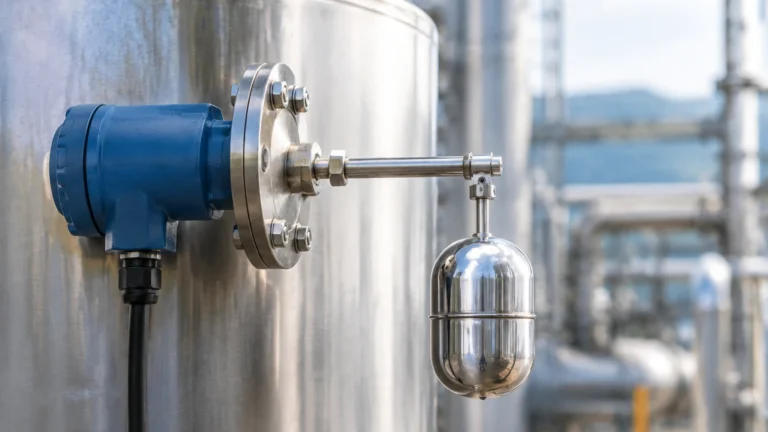
Accurate pressure drop monitoring requires a suite of reliable instruments. While DP transmitters handle the $\Delta P$ across the column, level sensors are required for the column sump (bottom) and the reflux drum.
Welk provides a range of industrial-grade sensors designed for these demanding environments. For the bottom level measurement, where temperatures are often high and the media may be viscous or prone to fouling, non-contacting radar level meters or high-durability hydrostatic transmitters are preferred. For a comprehensive look at available sensor technologies, you may visit our Main Page to review product options and application support.
Selection Criteria for DP Transmitters
When selecting instrumentation for monitoring distillation column pressure drop, consider the following:
1. Turndown Ratio: The ability of the transmitter to maintain accuracy over a wide range of flow rates.
2. Response Time: Rapid detection of pressure fluctuations is necessary to trigger automated safety interlocks during a flood.
3. Chemical Compatibility: Wetted parts (diaphragms) must resist corrosion from the process media.
4. Stability: The sensor must resist drift caused by ambient temperature changes or process vibrations.
Technical Comparison: Trays vs. Packing
The expected distillation column pressure drop varies significantly depending on the type of internals used. The following table provides a general comparison of typical pressure drop characteristics per theoretical stage (or meter of height).
| Feature | Trayed Columns | Packed Columns (Random) | Packed Columns (Structured) |
| :— | :— | :— | :— |
| Typical $\Delta P$ per Stage | 3.0 – 8.0 mbar (300–800 Pa) | 1.0 – 3.0 mbar (100–300 Pa) | 0.2 – 1.0 mbar (20–100 Pa) |
| Liquid Holdup | High | Medium | Low |
| Capacity for Solids | Better | Poor | Very Poor |
| Vacuum Suitability | Limited | Good | Excellent |
| Primary Resistance | Hydrostatic head | Frictional resistance | Minimal frictional path |
*Note: Values are indicative of standard atmospheric organic separations. Actual values depend on liquid/vapor densities and viscosities.*

Installation Considerations and Best Practices
The accuracy of a distillation column pressure drop measurement is often determined more by the installation of the instrument than by the instrument itself. Poorly placed taps or improperly managed impulse lines can lead to false readings.
Pressure Tap Placement
Pressure taps should be located in the vapor space of the column, away from liquid inlets or reflux return points to avoid liquid entering the impulse lines. The bottom tap is typically located above the maximum liquid level of the sump but below the bottom tray or packing support. The top tap is located below the mist eliminator or the top vapor outlet.
Impulse Line Management
In many distillation processes, the vapor can condense in the impulse lines, creating a liquid head that offsets the pressure reading. To prevent this:
* Remote Seals: Use capillary-based remote seals (diaphragm seals) to keep the process fluid out of the transmitter body. This is the gold standard for vacuum or high-viscosity applications.
* Purging: In some cases, a small, constant flow of inert gas (like nitrogen) is used to keep impulse lines clear of process vapors.
* Sloping: If using standard impulse lines, they must be sloped (typically 1:12) back toward the column to allow condensate to drain naturally.
Calibration and Zeroing
Because the vertical distance between the top and bottom taps can be 20, 40, or even 60 meters, the weight of the air or gas inside the impulse lines (or the fill fluid in remote seals) must be accounted for. "Zeroing" the transmitter under process temperature but at zero flow is essential for an accurate baseline.
Common Risks and Limitations
While monitoring distillation column pressure drop is highly effective, there are limitations and risks that engineers must mitigate:
1. Fouling and Plugging: In processes involving polymers or heavy oils, the internals can become fouled. This restricts the flow area, causing a gradual increase in the "baseline" pressure drop over months of operation. If the pressure taps themselves plug, the reading will become sluggish or "frozen."
2. Foaming: If the process fluid foams, the liquid holdup increases dramatically without a corresponding increase in liquid feed rate. This causes an unexpected rise in $\Delta P$. While DP transmitters detect the pressure change, they cannot distinguish between foaming and high liquid loading without secondary diagnostics (such as a foam probe or sight glass).
3. Vapor Surges: Sudden changes in reboiler heat duty can cause vapor surges. If the DP transmitter has too much damping (filtering), it may miss these transient events that could lead to tray damage.
4. Inert Gas Accumulation: In vacuum systems, the accumulation of non-condensable gases can alter the pressure profile, potentially masking the true hydraulic pressure drop of the column.
Frequently Asked Questions (FAQs)
Q: How do I know if my pressure drop is "normal"?
A: Normal pressure drop is established during the initial commissioning or after a fresh turnaround. It should be compared against the manufacturer’s design data. Significant deviations from the baseline at the same feed rate and heat duty indicate a problem.
Q: Can I use pressure drop to calculate the liquid level on a tray?
A: Indirectly, yes. In a trayed column, the majority of the wet pressure drop is due to the liquid head. However, since vapor velocity also contributes, $\Delta P$ is not a pure level measurement. Dedicated level sensors in the sump are required for inventory control.
Q: Why is pressure drop lower in vacuum columns?
A: In vacuum distillation, the boiling point of the mixture is lowered to prevent thermal degradation. High pressure drop would increase the pressure at the bottom of the column, raising the boiling temperature and defeating the purpose of the vacuum. Therefore, structured packing is used to keep the distillation column pressure drop as low as possible (often <1 mbar per stage).
Q: What does a fluctuating pressure drop indicate?
A: Rapidly fluctuating $\Delta P$ often indicates "slugging" or unstable hydraulics, where the column is cycling between loading and incipient flooding. It can also be caused by unstable reboiler control or surging reflux pumps.
Conclusion
Managing distillation column pressure drop is a balancing act between maximizing throughput and maintaining separation efficiency. By understanding the underlying principles of vapor-liquid resistance and employing high-quality instrumentation, operators can maintain stable production and extend the lifespan of column internals.
Selecting the right combination of differential pressure transmitters and level sensors is the first step toward a robust monitoring strategy. For technical specifications on sensors capable of withstanding the high temperatures and pressures of industrial distillation, consult the engineering resources available on our Main Page. Proper installation, regular calibration, and a keen eye on $\Delta P$ trends remain the most effective ways to ensure process reliability in the modern chemical plant.