Electrolyzer Efficiency
Electrolyzer Efficiency
In the rapidly evolving landscape of green hydrogen production and industrial electrochemistry, electrolyzer efficiency stands as the primary metric for determining the economic viability and operational success of a project. As industries transition toward decarbonization, the ability to convert electrical energy into chemical energy with minimal loss is paramount. This guide explores the technical foundations of electrolyzer efficiency, the critical role of precise level measurement in maintaining optimal performance, and the engineering considerations for selecting instrumentation in these demanding environments.
Understanding Electrolyzer Efficiency in Industrial Applications
Electrolyzer efficiency is generally defined as the ratio of the energy content of the produced hydrogen (based on its Higher Heating Value or Lower Heating Value) to the total electrical energy consumed during the process. However, in a B2B industrial context, efficiency is not a single figure but a combination of several thermodynamic and electrochemical factors.
Voltage Efficiency
The voltage efficiency is the ratio between the theoretical cell voltage (reversible voltage) and the actual operating voltage. Overpotentials—caused by activation losses at the electrodes, ohmic losses in the electrolyte and membranes, and mass transport limitations—increase the required voltage, thereby reducing efficiency. Minimizing these losses is a core focus of stack design.
Faraday Efficiency
Also known as current efficiency, Faraday efficiency measures how effectively the electrical current is used to produce hydrogen rather than driving side reactions or being lost to internal currents. High Faraday efficiency indicates that the gas-liquid separation and membrane integrity are functioning correctly, preventing the recombination of hydrogen and oxygen.
System-Level Efficiency (Balance of Plant)
True industrial efficiency must account for the Balance of Plant (BOP). This includes the energy consumed by water circulation pumps, cooling systems, power electronics (rectifiers), and gas purification units. Inaccurate process control in the BOP can lead to significant energy waste, undermining the efficiency of a high-performance electrolyzer stack.
Measurement Principles: The Link Between Level Control and Efficiency
To maintain high electrolyzer efficiency, precise control over the liquid levels within the system is mandatory. Level measurement instruments are primarily used in gas-liquid separators and electrolyte storage tanks. Before selecting a device, it is essential to understand the measurement principles employed in these applications.
Radar Level Measurement (Time-of-Flight)
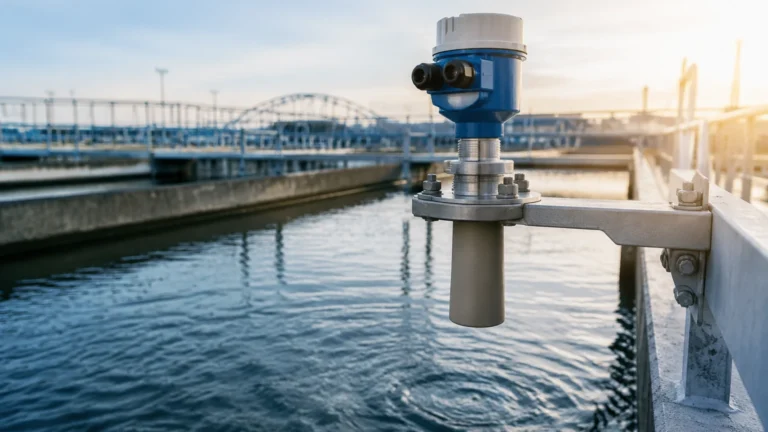
Radar level meters, particularly those operating at high frequencies (e.g., 80 GHz), utilize the Time-of-Flight (ToF) principle. The device emits a microwave signal that reflects off the surface of the liquid. By measuring the time it takes for the signal to return, the sensor calculates the distance with millimeter precision. This non-contact method is ideal for electrolyzers because it is unaffected by changes in gas pressure or temperature within the separator vessel.
Hydrostatic Level Measurement
Hydrostatic transmitters measure the pressure exerted by the liquid column. Based on the formula $P = \rho \cdot g \cdot h$ (where $P$ is pressure, $\rho$ is density, $g$ is gravity, and $h$ is height), the level is derived. In alkaline electrolyzers, where the density of the potassium hydroxide (KOH) solution remains relatively constant, hydrostatic sensors provide a robust and cost-effective solution, provided the materials are chemically resistant.
Ultrasonic Level Measurement
Ultrasonic sensors emit high-frequency sound waves that reflect off the liquid surface. While effective for atmospheric buffer tanks, their use in high-pressure electrolyzer separators is limited because the speed of sound varies significantly with gas density and composition, which can fluctuate during hydrogen production.
The Role of Level Instrumentation in Optimizing Performance
Precise level control directly impacts electrolyzer efficiency in several ways:
1. Prevention of Gas Crossover: In the gas-liquid separator, the liquid level must be maintained within a narrow band. If the level drops too low, gas can enter the liquid circulation loop (gas crossover), which poses a severe safety risk and reduces Faraday efficiency.
2. Optimal Electrode Immersion: In certain electrolyzer designs, maintaining a consistent electrolyte level ensures that the electrodes are fully utilized, preventing localized hotspots and uneven current distribution that can degrade the stack.
3. Reduced Purification Load: Stable level control prevents liquid carryover into the gas stream. If electrolyte droplets enter the gas phase, the downstream dryers and purifiers must work harder, increasing the energy consumption of the Balance of Plant.
For engineers seeking to optimize these parameters, reviewing advanced sensor options on the Main Page of industrial instrument providers is a critical step in system design.
Selection Table: Level Measurement Technologies for Electrolyzers
Choosing the right technology depends on the electrolyzer type—whether it is Alkaline, Proton Exchange Membrane (PEM), or Anion Exchange Membrane (AEM).
| Technology | Typical Application | Advantages | Limitations |
| :— | :— | :— | :— |
| 80 GHz Radar | Gas-Liquid Separators | Non-contact, extremely accurate, works in high pressure (up to 40+ bar). | Higher initial investment. |
| Hydrostatic | Electrolyte Storage | Simple installation, reliable for dense liquids like KOH. | Requires chemical compatibility (e.g., PTFE diaphragms). |
| Magnetic Level Gauge | External Bypass Chambers | Visual indication plus electronic output; no power required for visual. | Mechanical parts can stick if electrolyte crystallizes. |
| Ultrasonic | Deionized Water Tanks | Cost-effective for non-pressurized, stable environments. | Not suitable for high-pressure or foaming surfaces. |
Installation Considerations for Corrosive Electrolyte Environments
When installing level sensors to monitor electrolyzer efficiency, environmental factors must be addressed to ensure long-term reliability.
* Chemical Compatibility: Alkaline electrolyzers use concentrated KOH or NaOH (typically 25-30%). Wetted parts of level sensors must be constructed from materials like 316L stainless steel, Hastelloy, or coated with PTFE/PVDF to prevent corrosion.
* Pressure and Temperature: Industrial electrolyzers often operate at elevated temperatures (60°C to 90°C) and pressures (up to 30 bar or higher). Instruments must be rated for these conditions to avoid seal failure or signal drift.
* Mounting Position: Sensors should be mounted away from the electrolyte inlet to avoid turbulence and false readings caused by splashing. For radar sensors, ensuring a clear "line of sight" without internal obstructions like heating coils is vital.
* Dead Zones: Every sensor has a "dead zone" (blocking distance) at the top of its range. In compact separator vessels, this must be accounted for to prevent the liquid from entering the non-measurable area, which could lead to overflow.
Limitations and Operational Challenges
Despite advancements in technology, certain factors can challenge the accuracy of level measurement and, by extension, the calculation of electrolyzer efficiency.
* Foam Formation: The electrochemical reaction often produces foam on the surface of the electrolyte. Radar and ultrasonic signals can be absorbed or scattered by foam, leading to signal loss. Selecting a radar frequency and antenna design that can penetrate or ignore foam is essential.
* Gas Bubbles: In hydrostatic measurement, a high concentration of gas bubbles in the liquid (gas holdup) changes the effective density of the fluid. This can cause the sensor to report a level lower than the actual physical height, potentially leading to overfilling.
* Electromagnetic Interference (EMI): Electrolyzers operate with high-current DC power supplies. Instrumentation must have robust shielding and grounding to prevent electrical noise from interfering with the 4-20mA or digital (HART/Modbus) signals.
Frequently Asked Questions (FAQs)
Q: How does temperature affect level measurement accuracy in an electrolyzer?
A: Temperature affects liquid density, which can impact hydrostatic sensors. Modern transmitters often include temperature compensation. For radar sensors, temperature has a negligible effect on the microwave signal, making them more stable in fluctuating thermal environments.
Q: Can I use the same level sensor for both PEM and Alkaline electrolyzers?
A: Not necessarily. PEM electrolyzers use pure water, which has a low dielectric constant, requiring high-sensitivity radar. Alkaline electrolyzers use corrosive KOH, requiring specific chemical resistance. Always check the wetted material specifications on the Main Page of the manufacturer's catalog.
Q: What is the maintenance interval for level sensors in hydrogen service?
A: Non-contact radar sensors generally require minimal maintenance as they have no moving parts. Hydrostatic sensors should be checked annually for diaphragm scaling or corrosion, especially in alkaline systems where salt crystallization can occur.
Q: Does the presence of hydrogen gas affect radar signals?
A: Hydrogen has a very low dielectric constant and does not significantly attenuate high-frequency radar signals, allowing for accurate measurement even in high-pressure hydrogen atmospheres.
Conclusion
Optimizing electrolyzer efficiency is a multi-faceted challenge that requires a deep understanding of both electrochemical processes and precise process control. By implementing accurate, reliable level measurement solutions, operators can ensure safety, minimize energy waste in the Balance of Plant, and maximize the hydrogen yield per kilowatt-hour. Whether utilizing radar, hydrostatic, or ultrasonic technologies, selecting the correct instrument based on the specific chemistry and pressure of the system is a foundational step in successful green hydrogen production. For detailed technical specifications and product selection support, engineers are encouraged to explore the comprehensive resources available on the Welk Main Page.