Elko Mining Expo 2025
Elko Mining Expo 2025
The Elko Mining Expo 2025 stands as one of the most significant professional gatherings for the North American mining industry. Held in the heart of Nevada’s gold country, this event serves as a critical platform for engineers, site managers, and procurement specialists to evaluate the latest advancements in extraction and processing technology. As the industry shifts toward greater automation and more stringent environmental monitoring, the role of precision instrumentation—specifically level measurement—has become a focal point for operational efficiency.
In mining operations, level measurement is not merely a matter of inventory control; it is essential for safety, environmental compliance, and process optimization. Whether managing tailings dams, chemical reagents for heap leaching, or water treatment facilities, selecting the correct sensing technology is paramount. This guide explores the technological landscape that professionals will encounter at the elko mining expo 2025 and provides a framework for selecting level measurement solutions that withstand the rigors of the mining environment.
Fundamental Principles of Level Measurement in Mining
Before selecting an instrument for a mining application, it is vital to understand the underlying physical principles of the most common technologies. Mining environments present unique challenges, including heavy dust, corrosive chemicals, and turbulent surfaces, which dictate which measurement principle is most suitable.
Radar Level Measurement (Non-Contact)
Radar level meters operate using high-frequency electromagnetic waves, typically in the 26 GHz or 80 GHz range. The sensor emits a signal that reflects off the surface of the material and returns to the receiver. The time-of-flight or Frequency Modulated Continuous Wave (FMCW) shift is used to calculate the distance.
* Advantages: Radar is unaffected by dust, vacuum, pressure, or temperature fluctuations. 80 GHz radar, in particular, offers a narrow beam angle, making it ideal for tall, narrow silos or tanks with internal obstructions.
* Mining Application: Ore bins, crushed stone silos, and chemical storage tanks.
Ultrasonic Level Measurement
Ultrasonic sensors emit acoustic pressure waves that reflect off the surface of the medium. The sensor measures the time interval between the pulse emission and the echo reception.
* Advantages: Cost-effective for liquid applications and simple to install.
* Limitations: Ultrasonic waves are significantly affected by air temperature, heavy dust, and surface foam, which can attenuate the signal.
* Mining Application: Water management systems and sumps where dust is minimal.
Hydrostatic Level Measurement
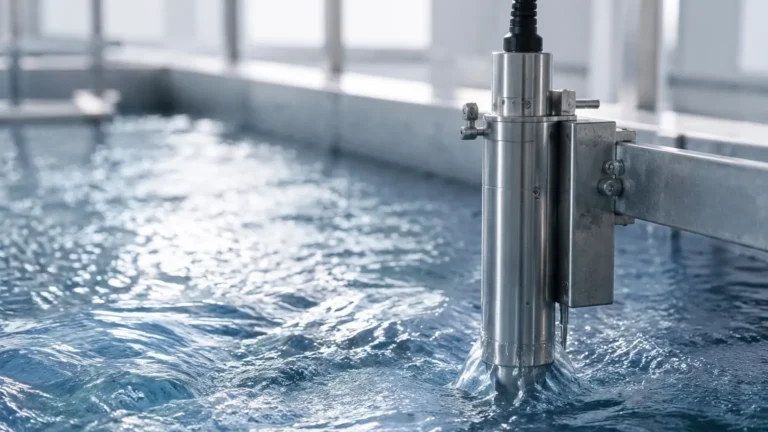
This principle relies on the relationship between the height of a liquid column and the pressure exerted at the base. A pressure transmitter (often submersible) measures the head pressure, which is then converted to a level reading based on the density of the fluid.
* Advantages: Highly reliable for deep wells and tanks where surface conditions (like foam or turbulence) make non-contact methods difficult.
* Mining Application: Deep well monitoring and wastewater tanks.
Technology Selection for Mining Environments
Choosing the right instrument depends on the physical state of the material (solid vs. liquid), the presence of dust or foam, and the required accuracy. The following table provides a comparison of technologies frequently discussed at events like the elko mining expo 2025.
| Application | Recommended Technology | Why? |
| :— | :— | :— |
| Ore Bins / Silos | 80 GHz Radar | Penetrates heavy dust; narrow beam avoids wall interference. |
| Tailings Dams | Radar or Hydrostatic | Radar for surface level; Hydrostatic for deep-water pressure monitoring. |
| Acid/Cyanide Tanks | Radar (PTFE Coated) | Non-contact prevents corrosion; PTFE resists aggressive vapors. |
| Crusher Surges | Heavy-duty Radar | Withstands vibration and high-impact dust environments. |
| Water Sumps | Ultrasonic | Cost-effective for clear liquids in open-air environments. |
| Slurry Tanks | Radar or Magnetic Gauge | Radar handles turbulence; Magnetic gauges provide local visual indication. |
Critical Installation Considerations for Harsh Environments
Proper installation is often the difference between a reliable sensor and a failed process loop. Mining sites are characterized by mechanical stress and environmental extremes that must be accounted for during the design phase.
1. Dust and Build-up Mitigation
In dry processing areas, dust accumulation on the sensor face can cause signal loss. For radar units, using a "dust shield" or a parabolic antenna with an air purge connection allows for periodic cleaning using compressed air without removing the sensor from the process.
2. Beam Angle and Obstructions
In narrow silos (common in mineral processing), the beam angle of a non-contact sensor is critical. A standard 26 GHz radar may have a beam angle of 10° to 15°, which might hit internal ladders or structural braces. An 80 GHz radar typically offers a beam angle of 3° to 4°, allowing it to "see" between obstructions to the material surface.
3. Mounting Location
Sensors should never be mounted directly above the fill stream. The turbulence and falling material will create false echoes or physically damage the instrument. Ideally, sensors should be mounted at 1/3 of the radius from the tank wall to get an average representative level of the cone (for solids) or the vortex (for agitated liquids).
4. Grounding and Surge Protection
Nevada, the host of the elko mining expo 2025, is prone to electrical storms. Since many level sensors are mounted at the top of tall metal structures, they are susceptible to lightning strikes and power surges. Using isolated 4-20mA loops and dedicated surge protection modules is a standard requirement for mining reliability.
Addressing Limitations and Operational Risks
While modern instrumentation is highly advanced, every technology has physical boundaries. Understanding these prevents costly downtime.
* Dielectric Constant (dk): Radar relies on the reflectivity of the material. Materials with a very low dk (like certain dry powders or hydrocarbons) may not reflect enough energy for a reliable signal. In these cases, guided wave radar (GWR) or high-sensitivity pulse radar is required.
* Surface Foam: In flotation cells used for mineral separation, thick foam can absorb ultrasonic signals and scatter radar signals. For these applications, hydrostatic transmitters or specialized froth-level sensors are often more effective.
* Temperature Extremes: In high-altitude mining sites, temperatures can drop well below -30°C (-22°F). Instruments must be rated for these temperatures, often requiring integrated heaters or specialized housing materials to prevent electronic failure.
The Role of Level Measurement in Mining Safety
Safety is a core theme of the elko mining expo 2025. Level measurement plays a direct role in preventing environmental disasters, such as tailings dam failures or chemical spills. Redundancy is the industry standard for high-risk applications. For example, a tailings pond might use a non-contact radar for primary measurement and a series of level switches (vibrating fork or float-based) as high-high alarms to trigger emergency shut-off valves.
Furthermore, the integration of level data into a centralized SCADA system allows for real-time leak detection. If a reagent tank level drops without a corresponding valve opening, the system can immediately alert operators to a potential containment breach. For those looking to upgrade their current systems, it is beneficial to Review product options and application support to ensure the selected hardware meets the specific safety integrity levels (SIL) required for the site.
Frequently Asked Questions (FAQs)
Q: How does 80 GHz radar differ from 26 GHz radar in mining?
A: 80 GHz radar uses a shorter wavelength, which allows for a much smaller antenna and a narrower beam. This is particularly useful in mining for avoiding internal tank structures and providing better accuracy in dusty environments where 26 GHz might struggle with signal scattering.
Q: Can level sensors handle abrasive slurries?
A: Yes, but non-contact methods like radar are preferred because they do not touch the abrasive medium. If a contact method like hydrostatic is used, the diaphragm must be made of wear-resistant materials like ceramic or protected by a chemical seal.
Q: What is the maximum range for radar level meters in silos?
A: Modern high-power radar units can measure distances up to 120 meters (approximately 393 feet), which covers the vast majority of large-scale mining storage requirements.
Q: Is wireless level measurement viable for remote mining sites?
A: Absolutely. Many sensors now support WirelessHART or LoRaWAN protocols, which are ideal for monitoring remote water tanks or tailings dams where running kilometers of cable is cost-prohibitive.
Conclusion
As the industry prepares for the elko mining expo 2025, the focus remains on making mining smarter, safer, and more efficient. Level measurement technology is a cornerstone of this evolution. By understanding the principles of radar, ultrasonic, and hydrostatic measurement, and by adhering to rigorous installation standards, mining professionals can ensure their operations remain productive even in the harshest environments. For detailed technical specifications and to explore the latest in industrial measurement, visit the Main Page of leading instrumentation providers to stay ahead of the technological curve.