Enbase Detechtion
Enbase Detechtion
In the modern industrial landscape, the integration of remote monitoring and precise field instrumentation has become a cornerstone for operational efficiency. The concept of enbase detechtion represents the synergy between edge-level data collection and centralized asset management. For process engineers and facility managers, understanding how level measurement technologies feed into these broader monitoring frameworks is essential for optimizing throughput, ensuring safety, and reducing manual oversight.
Industrial level measurement is no longer a localized requirement. Whether managing a fleet of chemical storage tanks or monitoring remote water treatment facilities, the data generated at the tank level must be accurate, reliable, and compatible with digital ecosystems. This guide explores the technical principles of level detection, the selection criteria for various technologies, and how these instruments integrate into comprehensive monitoring solutions.
Principles of Level Measurement Technology
Before selecting a solution for enbase detechtion and remote monitoring, it is critical to understand the underlying physics of the primary measurement technologies. Each method has specific strengths and environmental limitations.
Radar Level Measurement (ToF)
Radar level meters operate on the Time of Flight (ToF) principle. The instrument emits high-frequency microwave pulses (typically in the 26 GHz or 80 GHz range) toward the surface of the medium. These pulses are reflected back to the sensor. The distance is calculated based on the time interval between emission and reception, using the constant speed of light.
Because microwaves do not require a medium for travel, radar is largely unaffected by changes in temperature, pressure, or the presence of vapors and dust. This makes it a preferred choice for volatile liquids and high-precision industrial applications.
Ultrasonic Level Sensing
Ultrasonic sensors utilize acoustic waves to detect the level of a substance. The transducer emits a sound pulse that travels through the air, hits the surface of the material, and returns to the sensor. The distance is determined by the time taken for the echo to return, adjusted for the speed of sound in the specific atmosphere.
While cost-effective and non-contact, ultrasonic measurement is sensitive to the composition of the air. Factors such as heavy foam, high-pressure vapors, or extreme turbulence can attenuate the sound signal, leading to inaccuracies. It is most effective in stable, atmospheric water and wastewater applications.
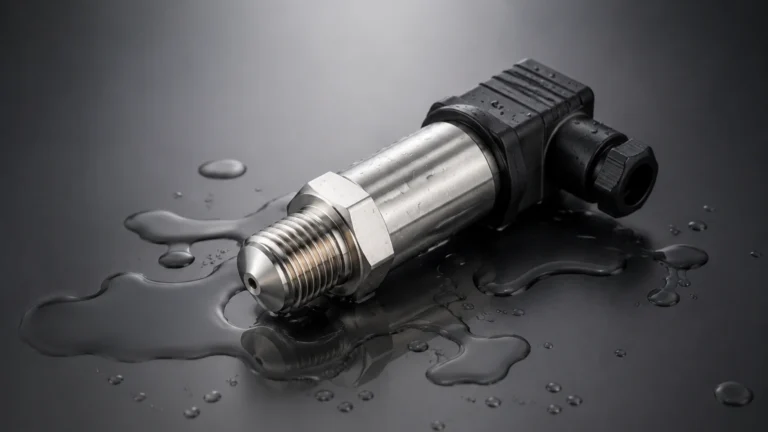
Hydrostatic Level Transmission
Hydrostatic measurement relies on the principle that the pressure at the bottom of a liquid column is directly proportional to the height of that column ($P = \rho gh$). A pressure transmitter is installed at the base of the tank or submerged in the liquid. By measuring the static pressure exerted by the liquid and knowing the density of the medium, the level can be calculated with high repeatability.
This method is contact-based and highly reliable for liquids with consistent density, such as fuel oil or clean water. However, if the density of the medium changes due to temperature fluctuations or chemical composition shifts, the transmitter must be recalibrated to maintain accuracy.
Integrating Level Sensors into Enbase Detechtion Frameworks
The term enbase detechtion often refers to the broader capability of detecting and monitoring asset states across a distributed network. For level measurement, this integration involves converting physical readings into digital data that can be transmitted via cellular, satellite, or industrial Ethernet protocols.
Data Communication Protocols
To function within a remote monitoring system, level meters must support standardized communication protocols. Common interfaces include:
* 4-20 mA HART: Allows for digital information to be superimposed on a standard analog signal, providing diagnostic data alongside the level reading.
* Modbus RTU/TCP: A widely used industrial protocol for connecting sensors to Remote Terminal Units (RTUs) or Programmable Logic Controllers (PLCs).
* NB-IoT and LoRaWAN: Low-power, wide-area network protocols that enable battery-powered sensors to transmit data over long distances directly to the cloud.
Edge Processing
Modern instruments often perform "edge processing," where raw signal data is filtered and converted into engineering units (e.g., meters, liters, or percentage of volume) before transmission. This reduces the bandwidth required for remote monitoring and ensures that the central platform receives clean, actionable data.
Selection Criteria for Level Measurement Instruments
Choosing the right technology for enbase detechtion requires a detailed analysis of the process environment. The following table provides a comparison of the most common technologies used in industrial automation.
| Feature | Radar (Non-Contact) | Ultrasonic | Hydrostatic | Magnetic Level Gauge |
| :— | :— | :— | :— | :— |
| Measurement Range | Up to 120m | Up to 30m | Up to 200m (H2O) | Up to 6m (standard) |
| Accuracy | ±1mm to ±3mm | ±0.25% of range | ±0.1% to ±0.5% | ±5mm to ±10mm |
| Pressure Limits | Up to 160 bar | Atmospheric | Submerged depth | Up to 320 bar |
| Temperature Limits | -40°C to +450°C | -40°C to +80°C | -20°C to +80°C | -196°C to +450°C |
| Media Type | Liquids, Solids, Slurries | Liquids, Coarse Solids | Liquids only | Clean Liquids |
| Impact of Foam | Minimal (80GHz) | High | None | None |
| Maintenance | Very Low | Low | Moderate (Cleaning) | Low |
Installation Considerations and Best Practices
Even the most advanced sensor will fail to provide accurate data if installed incorrectly. When setting up a system for enbase detechtion, engineers must account for the physical geometry of the vessel and the properties of the medium.
1. Dead Zones (Blocking Distance): Every non-contact sensor has a "dead zone" directly beneath the transducer where measurement is impossible. For ultrasonic sensors, this is typically 0.2m to 0.5m. For radar, it can be as low as 0.05m. Ensure the sensor is mounted high enough to avoid the maximum liquid level entering this zone.
2. Beam Angle and Obstructions: Radar and ultrasonic signals spread as they travel. If the beam hits internal tank structures like ladders, agitators, or heating coils, it will create false echoes. Sensors should be installed away from the tank wall (typically at 1/4 to 1/3 of the tank diameter) and clear of obstructions.
3. Mounting Nozzles: The height and diameter of the mounting nozzle can affect signal quality. A nozzle that is too long or narrow may cause signal ringing. For radar, the antenna should ideally extend slightly past the bottom of the nozzle.
4. Stilling Wells: In applications with heavy surface turbulence or foam, installing the sensor inside a stilling well (a vertical pipe) can provide a calm surface for measurement and eliminate lateral interference.

Risks and Limitations in Remote Detection
While enbase detechtion systems offer significant advantages, there are inherent risks that must be managed to ensure data integrity.
* Signal Interference: In metal tanks, multiple reflections (multipath interference) can occur. Advanced software algorithms, such as false echo suppression, are required to "map out" these static reflections.
* Environmental Factors: Extreme condensation or ice buildup on the face of an ultrasonic or radar transducer can block the signal. Selecting sensors with PTFE or specialized coatings can mitigate this risk.
* Power Management: For remote sites relying on battery or solar power, the power consumption of the level meter is a critical factor. Hydrostatic and low-power radar units are often preferred in these scenarios.
* Density Fluctuations: In hydrostatic systems, if the liquid density changes (e.g., mixing of chemicals or temperature-induced expansion), the level reading will drift. Integrated temperature compensation or secondary sensors may be necessary.
Frequently Asked Questions (FAQ)
Q: Can radar level meters measure through plastic tank walls?
A: Yes, certain radar frequencies can penetrate non-metallic materials like plastic or fiberglass. This allows for measurement without cutting into the tank, which is ideal for corrosive chemicals stored in IBCs or polyethylene tanks.
Q: How does foam affect enbase detechtion accuracy?
A: Foam is a significant challenge for ultrasonic sensors as it absorbs the sound waves. Radar is more resilient, especially high-frequency 80 GHz radar, which has a narrower beam and better penetration. However, very dense, thick foam may still attenuate the radar signal.
Q: What is the difference between a level switch and a level transmitter?
A: A level switch provides point detection (e.g., "tank full" or "tank empty"), whereas a level transmitter provides continuous measurement of the level across the entire range of the tank. For comprehensive monitoring, transmitters are usually required.
Q: How often do these sensors need calibration?
A: Radar and ultrasonic sensors are generally maintenance-free and do not require periodic recalibration once commissioned, provided the environment remains stable. Hydrostatic sensors may require annual checks to account for potential sensor drift or changes in media density.
Conclusion
Effective enbase detechtion relies on the selection of robust, accurate instrumentation that can withstand the rigors of industrial environments while providing seamless data integration. By understanding the principles of radar, ultrasonic, and hydrostatic measurement, engineers can design systems that minimize risk and maximize operational visibility. For more detailed technical specifications and to explore a wide range of industrial measurement instruments, Review product options and application support to find the right solution for your specific process requirements.
Welk continues to provide advanced level measurement solutions, from high-frequency radar to versatile level switches, ensuring that your data remains accurate from the field to the cloud. Proper planning, from initial technology selection to precise installation, is the key to a successful remote monitoring strategy.