Explosion Proof Level Switch
Explosion Proof Level Switch
In industrial environments where flammable gases, vapors, or combustible dusts are present, safety is the primary engineering priority. An explosion proof level switch is a critical safety and process control component designed to operate reliably in these hazardous locations without becoming a source of ignition. These devices provide point-level detection—identifying when a substance reaches a specific height in a tank, silo, or pipe—and trigger alarms or control systems to prevent overfills, dry runs, or equipment damage.
For engineers and procurement specialists, selecting the correct explosion proof level switch requires a deep understanding of both the measurement physics and the specific hazardous area classifications of the site. This guide examines the core principles, selection criteria, and installation requirements for these specialized instruments.
Understanding the Role of Explosion Proof Level Switches
The fundamental purpose of an explosion proof level switch is to contain any internal spark or heat within its housing, or to operate with such low energy that it cannot ignite the surrounding atmosphere. In industries such as oil and gas, chemical processing, and grain handling, a standard electrical switch could potentially cause a catastrophic event if a spark occurs during contact closure in the presence of volatile substances.
These switches are typically housed in heavy-duty, flameproof enclosures (often designated as Ex d) or designed to be intrinsically safe (Ex i) when used with an appropriate barrier. By providing reliable high-level or low-level alerts, they ensure that industrial automation systems remain within safe operational boundaries.
Core Measurement Principles and Technologies
Level switches utilize various physical principles to detect the presence or absence of a medium. The choice of technology depends heavily on the state of the material (liquid vs. solid) and its physical properties.
Vibrating Tuning Fork Switches
The vibrating level switch, or tuning fork switch, utilizes piezoelectric crystals to vibrate a metal fork at its natural resonance frequency (typically around 400 Hz to 1200 Hz). When the fork is immersed in a liquid or solid, the frequency changes or the vibration is dampened. An internal electronic circuit detects this shift and switches the output state.
* Applications: Excellent for most liquids and free-flowing powders.
* Advantages: No moving parts to wear out, unaffected by turbulence or bubbles, and compact design.
Magnetic Float Level Switches
Magnetic float switches operate on the principle of buoyancy. A float containing a permanent magnet moves up and down a stem in response to the liquid level. Inside the stem, a hermetically sealed reed switch is positioned at the set point. When the magnet in the float approaches the reed switch, the magnetic field causes the contacts to close or open.
* Applications: Clean liquids, water treatment, and fuel tanks.
* Advantages: Simple, low-cost, and requires no power to the sensing element itself.
Rotary Paddle Level Switches
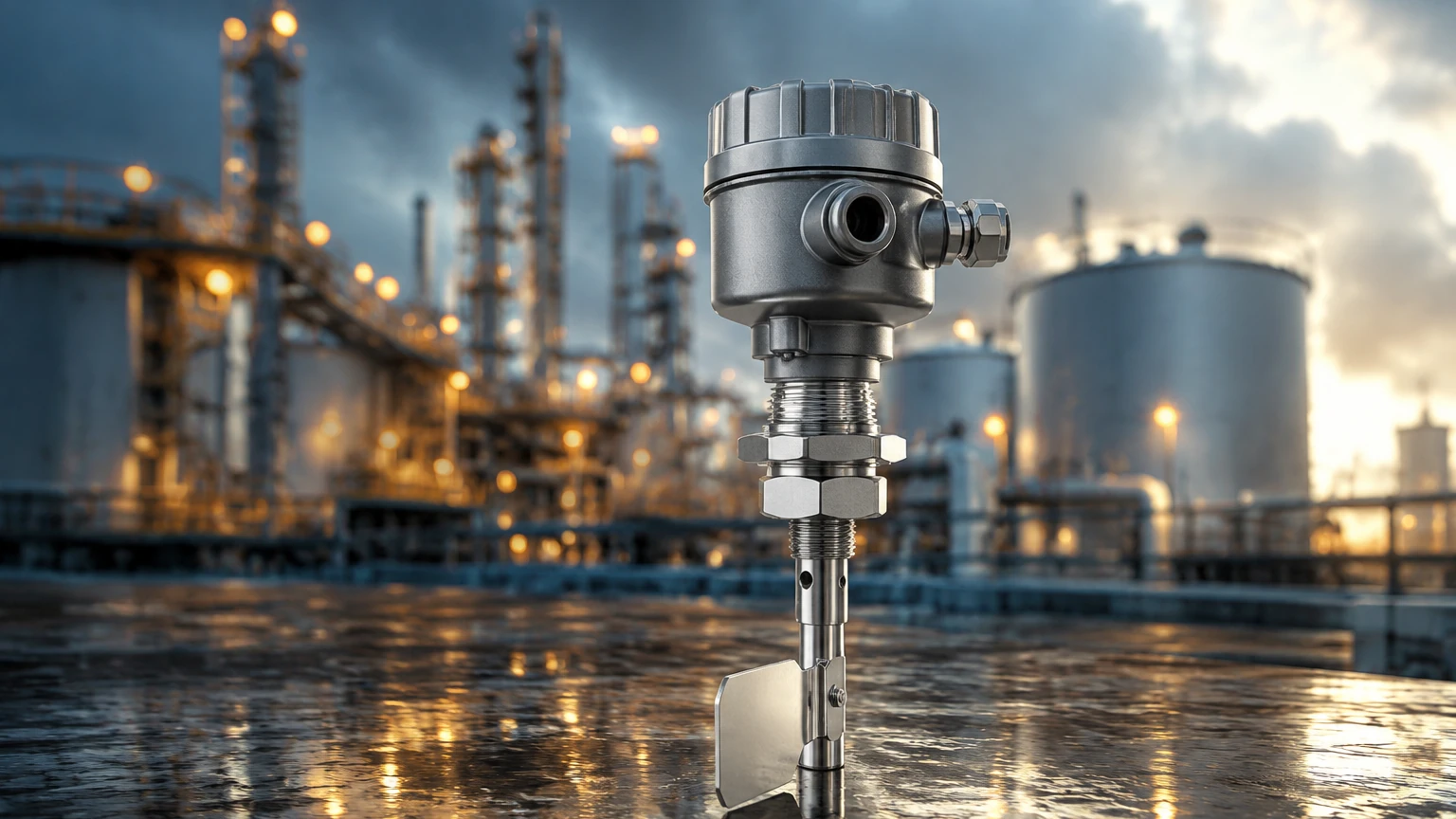
Designed specifically for bulk solids and powders, the rotary paddle switch uses a low-speed motor that rotates a paddle. When the material reaches the paddle, it creates mechanical resistance (torque), causing the motor to pivot and trigger a microswitch, which also cuts power to the motor.
* Applications: Grain silos, cement hoppers, and plastic pellet bins.
* Advantages: Robust and highly visible indication of state for heavy materials.
Capacitance Level Switches
Capacitance switches measure the change in electrical capacitance between a probe and the tank wall (or a ground reference). As the medium covers the probe, the dielectric constant changes, altering the capacitance. When the capacitance reaches a predetermined threshold, the switch is activated.
* Applications: Slurries, corrosive liquids, and interface detection.
* Advantages: Can handle high temperatures and pressures; suitable for sticky materials if equipped with active shield technology.
Hazardous Area Classifications and Protection Methods
When specifying an explosion proof level switch, it is essential to match the device's certification to the site's hazardous zone classification. International standards like ATEX (Europe) and IECEx (Global) define these zones based on the frequency and duration of the explosive atmosphere.
1. Zone 0 / Zone 20: Explosive atmosphere is present continuously or for long periods (e.g., inside a fuel tank).
2. Zone 1 / Zone 21: Explosive atmosphere is likely to occur in normal operation.
3. Zone 2 / Zone 22: Explosive atmosphere is not likely to occur, but if it does, it persists for a short period only.
Protection Types
* Flameproof (Ex d): The enclosure is strong enough to withstand an internal explosion of a gas or vapor and prevents the transmission of the explosion to the outside atmosphere. The joints of the enclosure are designed to cool the escaping gases before they reach the outside.
* Intrinsically Safe (Ex i): The electrical circuit is designed such that it cannot produce enough energy (either through sparking or heat) to ignite the explosive atmosphere, even under fault conditions. This requires an external safety barrier.
Technical Selection Criteria for Industrial Applications
Choosing the right instrument involves more than just the explosion-proof rating. Engineers must evaluate the following process parameters:
* Media Density: For float switches, the liquid density must be higher than the float's buoyancy. For tuning forks, the minimum density (e.g., 0.5 g/cm³) must be respected.
* Process Temperature: Standard switches may handle up to 80°C (176°F), but high-temperature versions with thermal extensions can withstand over 250°C (482°F).
* Process Pressure: Ensure the housing and process connection can handle the maximum vessel pressure. Common ratings include 1.6 MPa (232 psi) to 4.0 MPa (580 psi).
* Chemical Compatibility: The wetted parts (usually Stainless Steel 304 or 316L) must be resistant to the medium. For highly corrosive acids, PTFE or PFA coatings are required.
* Viscosity and Coating: If the medium is sticky (like molasses or heavy oil), a tuning fork might "bridge," leading to false readings. In such cases, a capacitance switch with a coating-rejection circuit is preferred.
Practical Selection Table for Level Switch Technologies
| Technology | Suitable Media | Max Pressure (Typical) | Maintenance Level | Best Use Case |
| :— | :— | :— | :— | :— |
| Vibrating Fork | Liquids, light solids | 4.0 MPa (580 psi) | Low | Overfill protection in chemical tanks |
| Magnetic Float | Clean liquids | 2.5 MPa (362 psi) | Moderate | Fuel storage and water sumps |
| Rotary Paddle | Bulk solids, powders | Atmospheric | Moderate | High-level alarm in grain silos |
| Capacitance | Liquids, slurries | 10.0 MPa (1450 psi) | Low | High-pressure/High-temp reactors |
| Hydrostatic | Liquids | Dependent on depth | Low | Deep well or open tank monitoring |
Installation and Maintenance Best Practices
Correct installation is vital to maintaining the explosion-proof integrity of the system. Even the most robust explosion proof level switch can fail if the installation bypasses safety protocols.
Mounting Considerations
* Orientation: Most tuning fork and float switches can be mounted horizontally (side of tank) or vertically (top of tank). Ensure the switch is not placed directly in the path of a filling stream to avoid mechanical damage or false triggers.
* Nozzle Length: For side-mounted switches, ensure the nozzle length does not prevent the medium from reaching the sensing element or cause material to build up inside the nozzle.
Wiring and Sealing
* Cable Glands: Only use certified explosion-proof cable glands that match the protection type (Ex d or Ex e). The threads must match the housing (e.g., NPT 1/2" or M20x1.5).
* Conduit Seals: In Ex d installations, a conduit seal (sealing fitting) is often required within 450 mm (18 inches) of the enclosure to prevent the passage of gases through the conduit system.
* Grounding: Ensure both internal and external grounding points are connected to the plant's earthing system to prevent static buildup.
Maintenance Routine
While many modern switches are maintenance-free, periodic inspections are recommended:
* Check for Build-up: In solid applications, ensure the paddle or fork is not encrusted with material.
* Seal Integrity: Inspect the enclosure O-rings for signs of degradation to ensure the IP rating (typically IP66/IP67) is maintained.
* Functional Test: Manually trigger the switch (if safe to do so) to verify the control room receives the correct signal.
Common Limitations and Operational Constraints
No single technology is perfect for every application. Awareness of limitations prevents operational failures:
* Mechanical Wear: Rotary paddles and float switches have moving parts. Over time, bearings may seize or floats may puncture.
* Dielectric Changes: Capacitance switches may require recalibration if the moisture content or chemical composition of the medium changes significantly.
* Turbulence: High-velocity inflow or agitation can cause float switches to bounce, leading to "chatter" in the relay. In these cases, a time-delay relay or a stilling well should be used.
* Foam: Many level switches struggle with foam. Tuning forks might detect the foam as liquid, while ultrasonic sensors might lose the signal entirely. Specially tuned capacitance or radar-based switches are often better for heavy foam.
Frequently Asked Questions (FAQs)
Q: Can I use an explosion proof level switch in a non-hazardous area?
A: Yes, explosion-proof devices are built to high industrial standards and can be used in safe areas. However, they are generally more expensive than standard versions due to the certified housing and rigorous testing.
Q: What is the difference between a level switch and a level transmitter?
A: A level switch provides a discrete output (on/off) at a specific point. A level transmitter provides a continuous signal (e.g., 4-20mA) representing the actual level from 0% to 100%.
Q: How do I choose between an Ex d and an Ex i switch?
A: Ex d (flameproof) is often easier to integrate into existing power systems as it does not require a safety barrier, but the housing is bulkier. Ex i (intrinsically safe) is safer for Zone 0 applications but requires a dedicated IS barrier in the control cabinet.
Q: Can Welk provide customized solutions for unique tank geometries?
A: Yes, as a professional manufacturer, Welk offers customized OEM/ODM services, including specialized probe lengths, materials, and process connections to fit specific industrial requirements.
For engineers looking to integrate these instruments into their process automation systems, it is important to review all technical specifications against the site's safety audit. To explore the full range of available technologies and find the right fit for your specific application, you may Review product options and application support on our Main Page. Selecting the right explosion proof level switch is not just about compliance—it is about ensuring long-term reliability and the safety of the workforce.