Grain Sensor
Grain Sensor
In the agricultural and industrial processing sectors, the accurate monitoring of bulk solids is a fundamental requirement for operational efficiency. A grain sensor is a specialized instrument designed to measure the level, volume, or presence of grain within silos, bins, and hoppers. Unlike liquid level measurement, grain presents unique challenges such as high dust concentrations, uneven surfaces (the angle of repose), and varying bulk densities.
Selecting the appropriate grain sensor requires a deep understanding of the physical properties of the material being stored—whether it is corn, wheat, soybeans, or rice—and the environmental conditions of the storage vessel. This guide examines the primary measurement principles used in modern grain sensors, provides selection criteria for engineering teams, and outlines best practices for installation and maintenance.
Understanding Grain Level Measurement Principles
Before selecting a specific device, it is essential to understand the physics behind how different sensors interact with bulk solids. Grain sensors generally fall into two categories: non-contact and contact-based measurement.
Radar Level Measurement (Non-Contact)
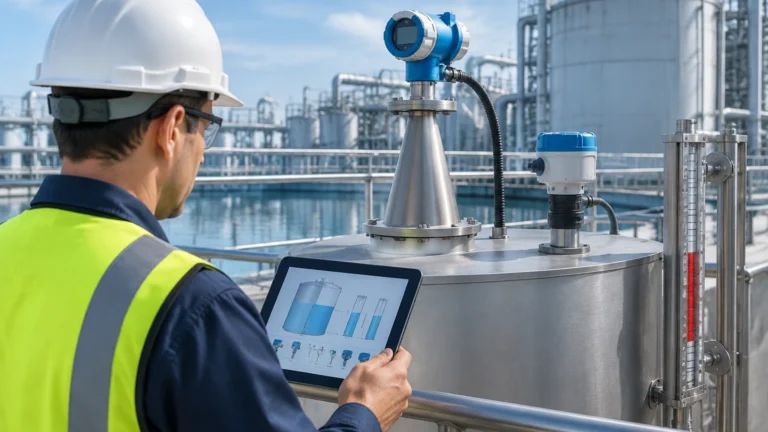
Radar technology, particularly Frequency Modulated Continuous Wave (FMCW) radar, has become the industry standard for grain level monitoring. These sensors emit high-frequency electromagnetic pulses (typically in the 26GHz or 80GHz range) toward the grain surface. The sensor calculates the distance based on the time it takes for the signal to reflect back.
* 80GHz Radar: This higher frequency allows for a narrower beam angle, which is critical in tall, narrow silos. It minimizes interference from internal structures like ladders or stay-braces and provides superior penetration through heavy dust clouds generated during filling.
* Advantages: Not affected by temperature, pressure, or dust. Highly accurate (±2mm).
Ultrasonic Level Measurement (Non-Contact)
Ultrasonic sensors use sound waves to detect the grain surface. The sensor emits an acoustic pulse that reflects off the grain and returns to the transducer. The distance is calculated based on the speed of sound.
* Limitations: Sound waves are significantly affected by air temperature fluctuations and high dust levels, which can attenuate the signal. In grain silos, where dust is prevalent during loading, ultrasonic sensors may experience "signal loss."
* Best Use Case: Small bins with minimal dust or indoor grain processing areas.
Capacitance Level Measurement (Contact)
Capacitance sensors utilize a probe inserted into the silo. The grain acts as a dielectric material between the probe and the silo wall (or a ground reference). As the grain level rises, the capacitance changes proportionally.
* Considerations: These sensors require direct contact with the material. They are effective for point-level detection (high/low alarms) but can be prone to errors if grain moisture content fluctuates significantly, as moisture changes the dielectric constant.
Guided Wave Radar (Contact)
Guided Wave Radar (GWR) uses a cable or rod to guide the microwave pulse to the grain surface. While highly accurate, the significant downward pull (tensile load) exerted by settling grain on the cable must be accounted for in the silo roof design.
Comparing Technologies: Radar vs. Ultrasonic vs. Mechanical
Choosing the right technology involves balancing accuracy, reliability, and budget. The following table provides a comparison of the most common technologies used for grain sensing.
| Feature | 80GHz Radar | Ultrasonic | Capacitance | Electromechanical (Yo-Yo) |
| :— | :— | :— | :— | :— |
| Measurement Type | Non-contact | Non-contact | Contact | Contact |
| Accuracy | High (±2mm) | Moderate (±10mm) | Moderate | High (±1cm) |
| Dust Resistance | Excellent | Poor | Good | Excellent |
| Maintenance | Low | Low | Moderate | High (Moving parts) |
| Typical Range | Up to 120m | Up to 30m | Up to 20m | Up to 50m |
| Cost | Higher | Lower | Moderate | Moderate |
For comprehensive technical specifications and to Review product options and application support, engineers should evaluate the specific dielectric properties of their grain type alongside these technology profiles.
Key Selection Criteria for Industrial Grain Storage
When specifying a grain sensor for a B2B application, several technical factors must be confirmed to ensure the longevity of the instrument.
1. Angle of Repose and Surface Profile
Unlike liquids, grain does not form a flat surface. It forms a cone when filling and a depression when emptying. This "angle of repose" can lead to measurement errors if the sensor is not positioned correctly. Advanced radar sensors often include software algorithms to average the surface profile, providing a more accurate volume calculation rather than a simple distance-to-product measurement.
2. Dust and Explosion Protection
Grain dust is highly combustible. Sensors installed in grain elevators or silos must carry appropriate hazardous area certifications, such as ATEX or IECEx (Class II, Div 1/2). Non-sparking electronics and dust-tight housings (IP66/67) are mandatory requirements for safety compliance.
3. Vessel Dimensions
The height and diameter of the silo dictate the beam angle requirements. A wide beam angle from a low-frequency sensor may hit the silo walls, causing false echoes. For tall, narrow silos (e.g., 30 meters high and 4 meters wide), an 80GHz radar with a beam angle of 3° to 4° is recommended to ensure the signal only reflects off the grain.
4. Mounting and Process Connections
Standard grain sensors typically use flange mountings or threaded connections. Because grain surfaces are uneven, using a swiveling holder or an aiming flange allows the technician to tilt the sensor toward the center of the grain cone, optimizing signal return.
Installation Best Practices for Bulk Solids
Proper installation is as critical as the technology selection itself. Incorrect placement can lead to "dead zones" or unreliable data.
* Avoid the Fill Stream: Never mount a grain sensor directly in the path of the incoming grain. The falling material will block the signal and may physically damage contact-based sensors.
* Distance from Walls: Sensors should generally be mounted at 1/2 to 2/3 of the radius of the silo. Mounting too close to the wall can result in interference from the wall surface or buildup on the silo side.
* Nozzle Length: If using a mounting nozzle, ensure it is as short as possible. A long nozzle can create internal reflections (ringing) that interfere with the sensor’s ability to detect the grain surface near the top of the silo.
* Structural Obstructions: Identify the location of internal ladders, cross-braces, or temperature cables. Modern radar sensors allow for "false signal suppression," where the user can program the sensor to ignore echoes from these fixed objects.
Common Risks and Operational Limitations
While modern grain sensors are robust, certain conditions can still challenge their performance:
1. Bridging and Rat-holing: Grain can sometimes stick to the walls (bridging) or empty only from the center (rat-holing). A sensor may report a full silo even if the center is empty. In these cases, multiple point-level switches or multi-point scanners may be required for safety.
2. Acoustic Noise: In ultrasonic applications, the noise of pneumatic filling systems can overwhelm the sensor's signal. Radar is immune to this noise.
3. Dielectric Constant (εr): Grain typically has a low dielectric constant (between 2.0 and 5.0). If the grain is extremely dry, the radar signal may be weak. Selecting a sensor with a high dynamic range ensures that even weak reflections are captured.
4. Tensile Loads: For GWR (Guided Wave Radar) or Yo-Yo sensors, the downward force of the grain during discharge can reach several tons. The roof of the silo must be structurally reinforced to handle these loads, or the cable may be ripped out.
Frequently Asked Questions (FAQ)
Q: How do I measure the volume of grain if the surface is not flat?
A: The most accurate method is to use a radar sensor with a wide dynamic range and an aiming flange to target the slope of the grain. For high-precision inventory, some facilities use 3D solids scanners that take multiple measurements across the surface to map the topography.
Q: Can one grain sensor work for different types of grain?
A: Yes, most radar and ultrasonic sensors are versatile. However, you may need to adjust the sensitivity or dielectric constant settings in the sensor's software if you switch from a high-moisture grain to a very dry grain.
Q: Is maintenance required for non-contact sensors?
A: While non-contact sensors have no moving parts, in extremely dusty environments, a layer of dust can eventually accumulate on the lens or transducer face. Many industrial radar sensors feature a "purging" connection that allows for the use of compressed air to periodically clean the sensor face automatically.
Q: What is the maximum height a grain sensor can measure?
A: High-end radar sensors can measure distances up to 120 meters (approx. 393 feet), which covers even the largest industrial grain terminals.
Conclusion
Implementing a reliable grain sensor system is a strategic investment that reduces waste, improves safety, and optimizes supply chain logistics. By prioritizing radar technology for high-dust environments and adhering to strict installation protocols, facility managers can achieve precise inventory control. For those looking to upgrade their current systems or specify new projects, it is advisable to consult with a specialist manufacturer to ensure the selected hardware meets the specific dielectric and structural requirements of the facility. For more information on industrial level measurement solutions, visit the Main Page to explore technical documentation and product specifications.