How Does Coriolis Flow Meter Work
How Does Coriolis Flow Meter Work
In the landscape of industrial process control, the ability to measure mass flow directly, rather than inferring it from volume or velocity, represents a significant leap in precision. The Coriolis flow meter is widely regarded as the "gold standard" for accuracy in fluid measurement. Unlike technologies that are sensitive to changes in temperature, pressure, or viscosity, the Coriolis meter provides a direct measurement of mass. Understanding how does coriolis flow meter work is essential for engineers and plant managers who require high-precision data for custody transfer, chemical dosing, and complex industrial automation.
Understanding the Coriolis Effect in Fluid Dynamics
To answer the question of how does coriolis flow meter work, one must first look at the physics of the Coriolis effect. Named after the French physicist Gaspard-Gustave de Coriolis, this effect describes the inertial force that acts on objects in motion within a frame of reference that rotates.
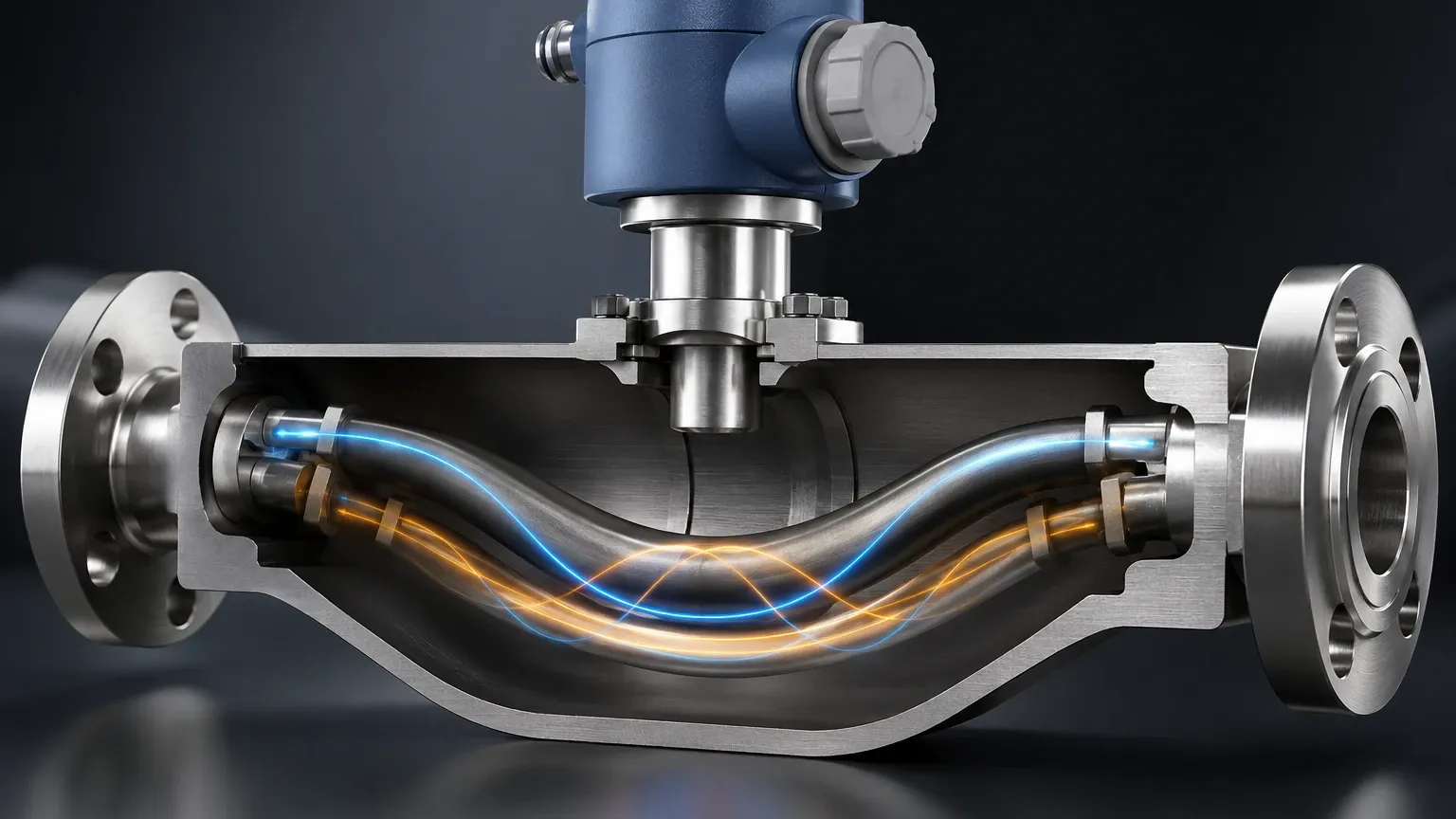
In an industrial flow meter, this rotation is simulated through high-frequency vibration. The meter typically consists of one or two measuring tubes that are vibrated by an electromagnetic drive coil. When no fluid is flowing, the tubes vibrate in a uniform, symmetrical fashion. However, as fluid enters the vibrating tube, it is forced to take on the vertical momentum of the vibrating tube.
As the fluid moves toward the center of the vibration (the loop of the tube), it resists the increasing vertical velocity of the tube, pushing back against it. Conversely, as the fluid moves away from the center toward the exit, it resists the decreasing vertical velocity, pushing forward. This opposing force on the inlet and outlet sides causes the tube to twist. This twisting motion is the physical manifestation of the Coriolis force, and its magnitude is directly proportional to the mass flow rate of the fluid passing through the tube.
Internal Components and Measurement Mechanism
A Coriolis flow meter is a sophisticated assembly of mechanical and electronic components designed to detect minute physical changes. The primary components include:
* Measuring Tubes: These can be U-shaped, curved, or straight. The shape is chosen based on the trade-off between sensitivity and pressure drop.
* Drive Coil: An electromagnetic assembly that induces the vibration of the tubes at their resonant frequency.
* Pick-off Sensors: Usually located at the inlet and outlet sections of the tube. These sensors (often electromagnetic coils) detect the vibration of the tubes and convert the mechanical motion into sine wave electrical signals.
* Temperature Sensor (RTD): Since the elasticity of the tube material changes with temperature, an internal sensor compensates for these changes to maintain accuracy.
* Transmitter: The electronic "brain" that processes the signals from the pick-off sensors, calculates the phase shift, and converts it into a flow rate value.
The Phase Shift Principle
When there is no flow, the sine waves generated by the inlet and outlet pick-off sensors are in phase—they peak at exactly the same time. As fluid flows and the tube twists, the sine waves shift out of alignment. The time difference between these two signals is known as the "phase shift" or "Delta T." The transmitter measures this phase shift with extreme precision (often in nanoseconds), as it is the primary indicator of mass flow.
Why Direct Mass Measurement Matters in Industrial B2B Applications
Traditional flow measurement technologies, such as turbine or ultrasonic meters, measure volumetric flow. Volume is highly susceptible to environmental changes. For instance, a liter of fuel at 10°C contains more energy-producing mass than a liter of fuel at 40°C due to thermal expansion.
By measuring mass directly, Coriolis meters eliminate the need for complex compensation calculations for temperature and pressure. This is particularly critical in industries such as:
1. Chemical Processing: Precise dosing of reactants is required to ensure chemical reactions occur safely and efficiently.
2. Oil and Gas: In custody transfer, where ownership of expensive fluids changes hands, even a 0.1% error can result in significant financial discrepancies.
3. Food and Beverage: Mass-based recipes ensure product consistency regardless of seasonal temperature variations in the processing plant.
Furthermore, Coriolis meters can simultaneously measure fluid density. The resonant frequency at which the tubes vibrate changes depending on the mass of the fluid inside them. A heavier (denser) fluid will cause the tubes to vibrate more slowly, while a lighter fluid will allow for faster vibration. This dual-capability makes them invaluable for quality control.
Technical Selection Criteria for Coriolis Flow Meters
Selecting the right Coriolis meter requires a balance of technical specifications and application requirements. Engineers must evaluate the following criteria:
Practical Selection Table
| Feature | U-Shaped Tube | Straight Tube |
| :— | :— | :— |
| Sensitivity | High; better for low flow rates | Lower; requires higher flow for accuracy |
| Pressure Drop | Moderate to High | Low; ideal for gravity-fed systems |
| Cleanability | Difficult; may trap solids | Excellent; self-draining and CIP-friendly |
| Installation Space | Requires significant vertical/horizontal space | Compact; easy to fit in tight piping |
| Vibration Resistance | Generally good | Highly sensitive to external piping vibration |
| Typical Accuracy | ±0.05% to ±0.1% | ±0.1% to ±0.2% |
Installation Best Practices and Environmental Considerations
While Coriolis meters are highly accurate, their performance is heavily dependent on proper installation. Because the measurement principle relies on detecting minute vibrations, external interference can introduce noise into the signal.
1. Vibration Isolation: The meter should be installed away from heavy machinery, pumps, or vibrating equipment. If vibration is unavoidable, flexible couplings or specialized mounting brackets should be used to isolate the meter.
2. Orientation: For liquid applications, the tubes should ideally point downward (in a U-shape) to prevent gas bubbles from being trapped. For gas applications, the tubes should point upward to prevent condensate buildup.
3. Zero Calibration: After installation and under full-pipe, zero-flow conditions, a "zero trim" must be performed. This accounts for the specific stresses and orientation of the meter in its installed position.
4. Straight Run Requirements: Unlike many other flow technologies, Coriolis meters generally do not require long straight runs of pipe before or after the meter, making them versatile for retrofitting into existing systems.
Limitations and Operational Risks
Despite their advantages, Coriolis meters are not a universal solution for every application. Understanding their limitations is key to avoiding project failures.
* Initial Cost: Coriolis meters are among the most expensive flow measurement technologies. The ROI must be justified by the need for high accuracy or multi-variable data (mass, density, temperature).
* Gas Entrainment: While modern meters have improved "entrained gas management" (EGM) algorithms, large slugs of air in a liquid stream can dampen the tube vibration, leading to measurement errors or a total loss of signal.
* Size Constraints: Coriolis meters become prohibitively heavy and expensive for pipe sizes larger than 250 mm (10 inches). In large-diameter pipes, other technologies like ultrasonic or electromagnetic meters are often preferred.
* Pressure Drop: The internal geometry of curved tubes can cause a significant pressure drop in the system, which may require larger pumps or higher system pressures.
Integrating Flow and Level Data for Process Optimization
In a comprehensive industrial automation setup, flow measurement and level measurement work in tandem. While a Coriolis meter tells you how much material is moving through a pipe, level sensors—such as radar or ultrasonic transmitters—tell you how much material remains in storage.
For example, in a chemical blending tank, a Coriolis meter ensures the precise mass of each ingredient is added. Simultaneously, a level meter provides a redundant check to ensure the tank does not overflow and monitors the total inventory available for the next batch. For engineers looking to optimize these systems, reviewing the Main Page of a specialized instrument manufacturer like Welk can provide insights into how different sensing technologies, including radar level meters and hydrostatic transmitters, can be integrated with flow data to create a robust process control loop.
Frequently Asked Questions (FAQ)
Q: Can Coriolis flow meters measure gases?
A: Yes, Coriolis meters are excellent for gas measurement, especially at high pressures. However, because gases have much lower density than liquids, the signal-to-noise ratio is lower, and careful sizing is required to ensure the mass is sufficient to twist the tubes.
Q: How often do Coriolis meters need recalibration?
A: Because there are no moving parts in the fluid stream (no bearings or gears to wear out), Coriolis meters are extremely stable. Many industries only require recalibration every 2 to 5 years, depending on the criticality of the process and local regulations.
Q: Does viscosity affect the measurement?
A: No. One of the primary benefits of the Coriolis principle is that it is independent of Reynolds number. It can measure everything from water to thick resins and polymers with the same level of accuracy, provided the pump can overcome the pressure drop.
Q: What is the typical turndown ratio?
A: Coriolis meters offer an impressive turndown ratio, often exceeding 100:1. This means a single meter can accurately measure both very low and very high flow rates within the same process line.
Conclusion
The Coriolis flow meter remains a cornerstone of modern industrial metrology. By leveraging the fundamental laws of physics to provide direct mass measurement, it bypasses the inaccuracies inherent in volumetric systems. When integrated with reliable level measurement solutions and installed with a clear understanding of environmental factors, these instruments provide the data integrity required for high-stakes industrial operations. For those seeking to enhance their facility's measurement capabilities, exploring the full range of industrial instrumentation on the Main Page is the first step toward achieving superior process control.