How Is Green Hydrogen Produced
How Is Green Hydrogen Produced
As the global industrial sector shifts toward decarbonization, green hydrogen has emerged as a cornerstone of the energy transition. Unlike traditional hydrogen production methods that rely on fossil fuels, green hydrogen offers a carbon-neutral alternative. Understanding how is green hydrogen produced is essential for engineers and plant managers who must design, operate, and maintain the complex fluid handling systems required for this process.
In the context of industrial automation, the production of green hydrogen involves precise control over water feedstocks, electrolyte concentrations, and gas-liquid separation. Accurate level measurement is critical to ensuring the safety and efficiency of these systems. This guide explores the technical processes of green hydrogen production and the instrumentation required to manage it effectively.
The Fundamental Process: Water Electrolysis
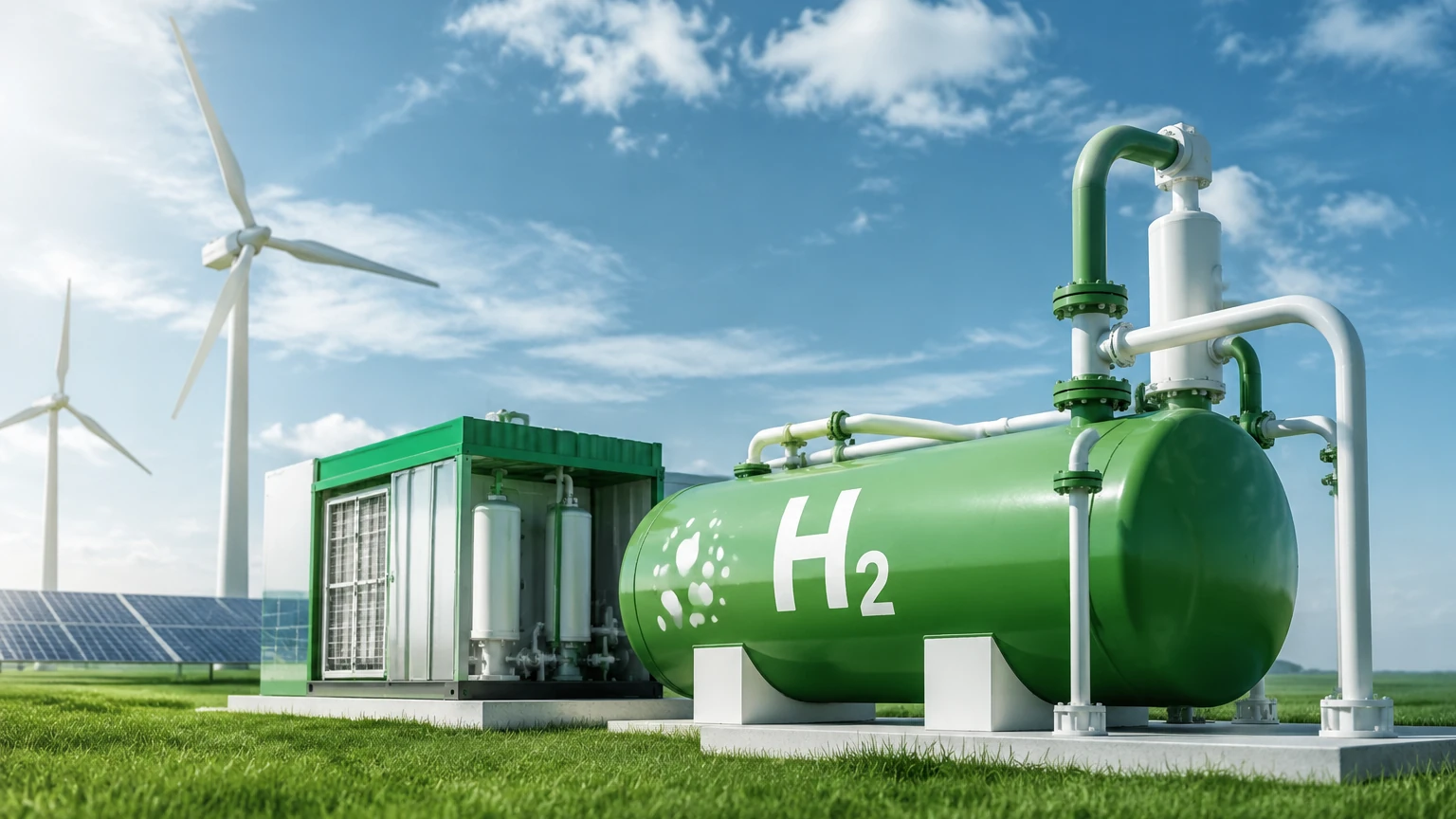
At its core, green hydrogen is produced through a process called electrolysis. This involves using an electric current to split water ($H_2O$) into its component parts: hydrogen ($H_2$) and oxygen ($O_2$). For the hydrogen to be classified as "green," the electricity used in this process must originate from renewable sources such as solar, wind, or hydroelectric power.
The chemical reaction occurs in a unit known as an electrolyzer. Within the electrolyzer, two electrodes (an anode and a cathode) are submerged in an electrolyte or separated by a specialized membrane. When a direct current (DC) is applied:
1. At the Cathode: Hydrogen ions are reduced to form hydrogen gas.
2. At the Anode: Oxygen ions are oxidized to form oxygen gas.
While the chemistry is straightforward, the industrial execution requires sophisticated balance-of-plant (BoP) systems, where level sensors play a vital role in monitoring separator tanks and water storage units.
Leading Electrolyzer Technologies
There are several primary methods used in the industry today to facilitate electrolysis. Each has unique requirements for fluid management and level control.
1. Alkaline Electrolysis (AEL)
Alkaline electrolysis is the most mature and commercially established technology. It uses a liquid electrolyte solution, typically potassium hydroxide (KOH) or sodium hydroxide (NaOH) dissolved in water.
* Process: The electrodes are separated by a diaphragm that allows ions to pass but prevents gas mixing.
* Level Measurement Need: It is critical to monitor the level of the caustic electrolyte in the circulation tanks to prevent pump cavitation and ensure the electrodes remain submerged.
2. Proton Exchange Membrane (PEM) Electrolysis
PEM electrolyzers use a solid polymer electrolyte. They are highly valued for their ability to respond quickly to the fluctuating power outputs of renewable energy sources.
* Process: Pure water is fed to the anode side. Protons pass through the membrane to the cathode to form hydrogen gas.
* Level Measurement Need: PEM systems require high-purity deionized water. Level sensors must be compatible with ultra-pure water and capable of operating in compact, high-pressure separator vessels.
3. Solid Oxide Electrolysis Cells (SOEC)
SOEC is an emerging high-temperature technology that uses steam instead of liquid water.
* Process: Operating at temperatures between 700°C and 850°C, these systems are highly efficient when integrated with industrial waste heat.
* Level Measurement Need: While the primary reaction involves steam, level monitoring is still required for the feedwater systems and condensate recovery tanks.
The Role of Level Measurement in Hydrogen Production
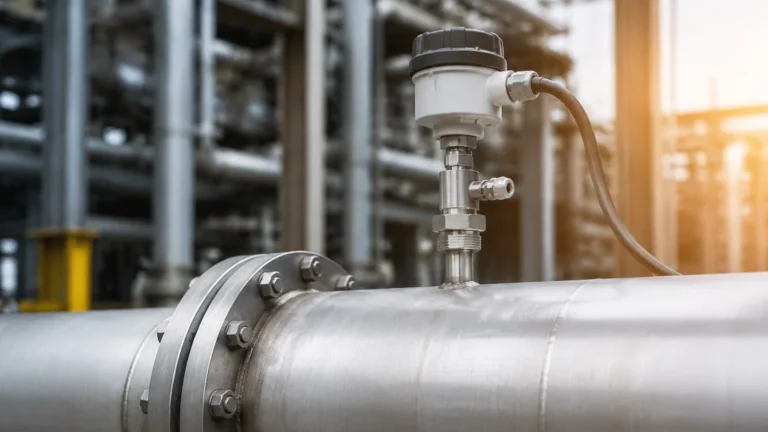
In any facility where green hydrogen is produced, maintaining precise liquid levels is a safety and operational mandate. Level instruments are used in three primary areas:
1. Feedwater Storage: Ensuring a continuous supply of demineralized water to the electrolyzer stack.
2. Gas-Liquid Separators: After electrolysis, the hydrogen and oxygen gases are mixed with water or electrolyte. Separator tanks remove the liquid from the gas stream. If the level is too high, liquid can carry over into the gas processing equipment; if too low, gas can escape into the liquid return lines (gas blow-by).
3. Electrolyte Mixing Tanks: Monitoring the concentration and volume of caustic solutions in AEL systems.
For a comprehensive overview of the instruments used in these applications, you can review product options and application support on our Main Page.
Measurement Principles and Recommendations
Before selecting a sensor, it is important to understand the physical principles that govern level measurement in hydrogen applications.
Radar Level Measurement (ToF)
Radar sensors operate on the Time-of-Flight (ToF) principle. They emit microwave pulses that reflect off the liquid surface. By measuring the time it takes for the signal to return, the device calculates the distance.
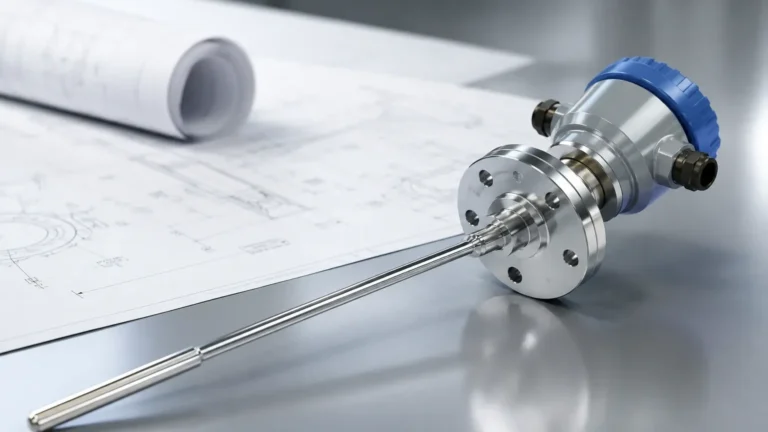
* Guided Wave Radar (GWR): Uses a probe to guide the signal. It is ideal for small separator tanks where internal obstructions or foam might interfere with a non-contact signal.
* Non-Contact Radar: Best for large storage tanks. Since it does not touch the medium, it is highly resistant to corrosive electrolytes.
Magnetic Level Gauges (MLG)
Magnetic level gauges utilize a float containing a high-intensity magnet. As the liquid level changes, the float moves a series of external magnetic flags or a transmitter.
* Benefit: They provide a clear visual indication without requiring power, which is a critical safety backup in hydrogen plants. They can be equipped with reed switches for point-level alarms.
Hydrostatic Pressure
This principle measures the pressure exerted by the liquid column ($P = \rho gh$). It is a reliable, cost-effective method for atmospheric storage tanks. However, in pressurized electrolyzers, a differential pressure (DP) transmitter is required to compensate for the high headspace pressure.
Ultrasonic Level Sensors
Ultrasonic sensors use sound waves. While effective for water storage, they are generally not recommended for high-pressure hydrogen environments because the speed of sound changes significantly with gas density and composition.
Selection Table for Hydrogen Production Applications
| Application | Recommended Technology | Key Advantage | Limitation |
| :— | :— | :— | :— |
| H2/O2 Separator Tanks | Guided Wave Radar (GWR) | Accurate in high pressure (up to 40 MPa) | Must account for probe material compatibility |
| Caustic Electrolyte Storage | Non-Contact Radar | No contact with corrosive KOH/NaOH | Requires proper mounting to avoid nozzle interference |
| Deionized Water Feed | Ultrasonic or Hydrostatic | Cost-effective and reliable | Not suitable for high-pressure zones |
| System Safety Backup | Magnetic Level Gauge | Visual verification without power | Moving parts (float) require periodic inspection |
| High-Temp Steam (SOEC) | Differential Pressure | Handles extreme temperatures | Requires impulse lines and heat tracing |
Installation and Safety Considerations
When implementing level measurement in a green hydrogen facility, several engineering factors must be addressed:
* Hazardous Area Certification: Hydrogen is highly flammable (Group IIC). All electronic instrumentation must be ATEX, IECEx, or UL certified as intrinsically safe or explosion-proof.
* Material Compatibility: Hydrogen can cause "hydrogen embrittlement" in certain metals. For wetted parts, high-grade stainless steel (316L) or specialized alloys are often required. For caustic electrolytes, PTFE or PP coatings are recommended.
* Pressure and Temperature: Electrolyzers often operate at pressures ranging from 3 MPa to 35 MPa (30 to 350 bar). Sensors must be rated for these process conditions with appropriate safety factors.
* Sealing and Permeation: Hydrogen atoms are extremely small and can permeate through standard seal materials. Use of metal-to-metal seals or specialized elastomers is necessary to prevent leaks.
Frequently Asked Questions (FAQ)
Q: Why is level control so critical in gas-liquid separators?
A: If the liquid level drops too low, hydrogen gas can enter the oxygen stream (or vice versa), creating an explosive mixture. If the level is too high, water can enter the compressors or fuel cells downstream, causing mechanical damage.
Q: Can I use a standard pressure transmitter for level in a pressurized electrolyzer?
A: No. A standard transmitter only measures total pressure. You must use a Differential Pressure (DP) transmitter or a Radar sensor to isolate the liquid level from the high-pressure gas headspace.
Q: How does the low density of hydrogen affect level measurement?
A: While the gas is low density, the liquid being measured (water or electrolyte) is dense. However, the low dielectric constant of hydrogen gas means that radar signals pass through it easily, making radar an excellent choice for these applications.
Conclusion
Understanding how is green hydrogen produced is the first step in designing a resilient industrial system. By integrating advanced level measurement technologies—such as radar and magnetic gauges—operators can ensure that the electrolysis process remains stable, efficient, and safe. As the industry scales, the precision of these instruments will be a defining factor in the economic viability of green hydrogen as a global fuel source.
For technical assistance in selecting the right level measurement solution for your hydrogen project, please visit our Main Page to connect with our engineering team.