Hydrogen Flow Measurement
Hydrogen Flow Measurement
Hydrogen is rapidly becoming a cornerstone of the global energy transition, serving as a clean fuel source for transport, power generation, and industrial feedstock. However, from an engineering perspective, hydrogen flow measurement presents unique challenges that distinguish it from standard natural gas or compressed air applications. Its low molecular weight, high diffusivity, and wide flammability limits require specialized instrumentation and rigorous installation standards to ensure both accuracy and safety.
In industrial automation and process control, selecting the right flow meter for hydrogen requires a deep understanding of gas laws, fluid dynamics, and material science. This guide explores the fundamental principles of hydrogen flow measurement, compares available technologies, and provides a framework for selecting the most appropriate solution for your facility.
Understanding the Physical Challenges of Hydrogen
Before evaluating specific measurement technologies, it is essential to recognize the physical properties that make hydrogen flow measurement difficult:
1. Low Density: Hydrogen is the lightest element. At standard temperature and pressure (STP), its density is approximately 0.089 kg/m³. This low density means that many traditional flow meters, which rely on fluid momentum or force, may struggle to generate a measurable signal at low flow rates.
2. Small Molecular Size: Hydrogen molecules are extremely small, leading to high diffusivity. They can penetrate many materials and leak through seals that would be considered gas-tight for heavier hydrocarbons. This necessitates high-integrity sealing and specific material selections to prevent Hydrogen Induced Cracking (HIC).
3. High Speed of Sound: The speed of sound in hydrogen is roughly 1,300 m/s, nearly four times faster than in air. This significantly impacts ultrasonic flow measurement techniques.
4. Wide Flammability Range: Hydrogen has a flammability range of 4% to 75% in air. Any instrumentation used in hydrogen service must meet strict hazardous area certifications (e.g., ATEX, IECEx, or Class I Div 1).
Core Measurement Principles for Hydrogen
Different measurement principles offer varying degrees of accuracy and reliability depending on the pressure, temperature, and required turndown ratio of the application.
Thermal Mass Flow Measurement
Thermal mass flow meters operate on the principle of heat transfer. A heated sensor is placed in the flow stream, and as hydrogen molecules pass over it, they carry heat away. The amount of cooling is directly proportional to the mass flow rate of the gas.
Because hydrogen has a very high thermal conductivity, thermal mass meters are exceptionally sensitive and can measure very low flow rates. However, they require precise gas composition data, as the presence of impurities can significantly alter the heat transfer coefficient and lead to measurement errors.
Coriolis Mass Flow Measurement
Coriolis meters provide a direct mass flow measurement by vibrating a tube through which the fluid flows. The mass of the fluid causes a phase shift in the vibration (the Coriolis effect), which is measured by sensors.
For hydrogen, Coriolis meters are often preferred for high-pressure applications, such as hydrogen refueling stations. Because they measure mass directly, they are not affected by changes in pressure or temperature. The primary limitation is at low pressures, where the low density of hydrogen may not provide enough mass to generate a reliable signal-to-noise ratio in the vibrating tubes.
Differential Pressure (DP) Measurement
DP flow measurement involves placing a primary element, such as an orifice plate or Venturi tube, in the pipe to create a pressure drop. The square root of the pressure difference between the upstream and downstream sides is proportional to the flow rate.
While DP is a mature and well-understood technology, it introduces a permanent pressure loss into the system. For hydrogen applications, where energy efficiency is often a priority, large pressure drops are undesirable. Additionally, DP meters require secondary transmitters for pressure and temperature compensation to calculate mass flow accurately.
Ultrasonic (Transit-Time) Measurement
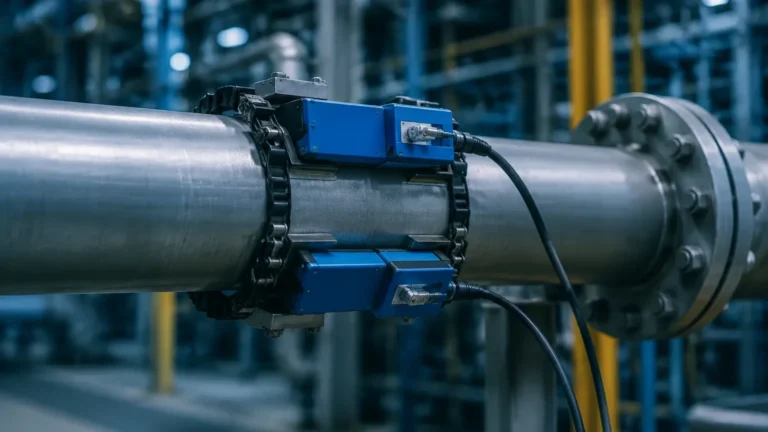
Ultrasonic flow meters use transducers to send sound pulses across the flow stream. The difference in time between pulses traveling with the flow and those traveling against it is used to calculate the velocity.
Given the high speed of sound in hydrogen, ultrasonic meters must use high-frequency electronics and specialized transducers. They offer the advantage of being non-intrusive (no pressure drop) and having a high turndown ratio, making them suitable for large-diameter pipelines and custody transfer.
Key Evaluation Criteria for Instrument Selection
When specifying a flow meter for hydrogen service, engineers must evaluate several technical parameters to ensure long-term reliability.
Turndown Ratio and Rangeability
Turndown ratio refers to the range between the maximum and minimum flow rates that a meter can measure accurately. In hydrogen distribution, flow rates can fluctuate significantly. Ultrasonic and thermal mass meters typically offer higher turndown ratios (up to 100:1) compared to DP meters (typically 4:1 or 10:1).
Material Compatibility and Embrittlement
Hydrogen embrittlement is a phenomenon where hydrogen atoms diffuse into the metal lattice of a pipe or instrument, causing it to become brittle and crack. Standard carbon steel is often unsuitable. Stainless steel 316/316L is the industry standard for hydrogen service, though high-pressure applications may require specialized alloys like Hastelloy or Monel.
Accuracy and Repeatability
For process control, a repeatability of ±0.5% may be sufficient. However, for custody transfer or billing, high accuracy (±0.1% to ±1.0% of rate) is required. Coriolis and ultrasonic meters generally provide the highest accuracy levels for hydrogen mass flow.
Practical Selection Table for Hydrogen Flow Meters
| Technology | Typical Accuracy | Pressure Drop | Turndown | Best Use Case |
| :— | :— | :— | :— | :— |
| Thermal Mass | ±1.0% of Reading | Negligible | 100:1 | Low-pressure process monitoring, leak detection |
| Coriolis | ±0.5% of Mass | Moderate | 20:1 | High-pressure refueling, chemical dosing |
| Ultrasonic | ±1.0% of Rate | Zero | 50:1 | Large pipeline distribution, custody transfer |
| Vortex | ±1.5% of Rate | Moderate | 15:1 | High-velocity steam or gas utility lines |
| Differential Pressure | ±2.0% of Span | High | 4:1 | Steady-state industrial processes, legacy systems |
Installation and Safety Considerations
Proper installation is as critical as the selection of the meter itself. For comprehensive instrumentation support across various industrial media, engineers often Review product options and application support to ensure all components of the measurement loop are compatible.
Hazardous Area Compliance
Hydrogen is classified as a Group IIC gas (the most volatile group). All electrical components of the flow meter must be certified as intrinsically safe (Ex i) or explosion-proof (Ex d). Cable glands and junction boxes must also meet these rigorous standards.
Piping and Straight Runs
Most flow technologies (except Coriolis and some specialized thermal meters) require a specific length of straight pipe upstream and downstream of the meter to ensure a stable flow profile. For hydrogen, turbulence can be more pronounced due to high velocities, so following the manufacturer’s "straight run" requirements is essential for accuracy.
Leak Integrity
Given hydrogen’s ability to leak through minor imperfections, welded connections are preferred over threaded ones. If flanges are used, specialized gaskets (such as spiral-wound stainless steel with graphite filler) should be employed. Helium leak testing is often performed on the installed system before commissioning with hydrogen.
Common Risks and Limitations
Engineers should be aware of the following risks when implementing hydrogen flow measurement:
* Calibration Mismatch: Many meters are calibrated using air or nitrogen and then adjusted using a conversion factor for hydrogen. This can introduce errors. Whenever possible, specify a meter that has been calibrated on hydrogen or a gas mix that closely mimics hydrogen’s properties.
* Vibration Sensitivity: Coriolis meters are sensitive to external mechanical vibrations. In a plant environment with heavy pumps or compressors, the meter must be properly isolated to prevent measurement noise.
* Contamination: While hydrogen is often high-purity, green hydrogen produced via electrolysis may contain moisture. Water droplets can cause significant errors in thermal mass and ultrasonic meters. Proper filtration and moisture separation are required upstream of the measurement point.
Frequently Asked Questions (FAQ)
Q: Can I use a standard natural gas flow meter for hydrogen?
A: Generally, no. While the principles are similar, the materials, seals, and calibration factors must be specifically rated for hydrogen. Using a standard meter can lead to inaccurate readings and potential safety hazards due to material embrittlement.
Q: What is the impact of pressure on hydrogen flow measurement?
A: Hydrogen is highly compressible. At high pressures, its density increases, which generally makes it easier to measure for Coriolis and DP meters. However, high pressure also increases the risk of leaks and requires more robust housing for the sensors.
Q: How often should hydrogen flow meters be recalibrated?
A: This depends on the technology and the criticality of the measurement. For custody transfer, annual calibration is standard. For general process monitoring, every 2 to 3 years may be sufficient, provided the meter includes self-diagnostic capabilities to detect sensor drift.
Conclusion
Accurate hydrogen flow measurement is vital for the efficiency and safety of modern industrial operations. By understanding the physical properties of the gas and the strengths of various measurement principles—ranging from thermal mass for low-flow sensitivity to Coriolis for high-pressure mass accuracy—engineers can design systems that are both reliable and compliant with safety standards. Always prioritize material compatibility and hazardous area certifications to mitigate the risks associated with this volatile but essential energy carrier.