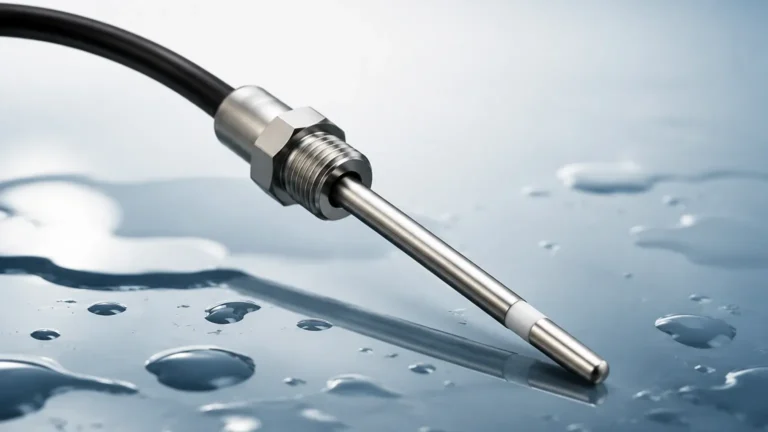
Ifm Pi2796
Ifm Pi2796
In the landscape of industrial automation and process control, selecting the correct level measurement instrument is critical for operational efficiency, safety, and product quality. The ifm pi2796 is a prominent pressure sensor frequently utilized for hydrostatic level measurement, particularly in hygienic applications. This article provides a technical deep dive into the ifm pi2796, exploring its measurement principles, technical specifications, and how it compares to other technologies like radar and ultrasonic sensors offered by professional manufacturers such as Welk.
Understanding the Measurement Principle: Hydrostatic Pressure
Before evaluating specific hardware like the ifm pi2796, it is essential to understand the underlying physics of its operation. The pi2796 operates on the principle of hydrostatic pressure measurement.
In an open tank or vessel, the pressure exerted by a liquid at a specific depth is directly proportional to the height of the liquid column above it. This relationship is expressed by the formula:
P = ρ × g × h
Where:
* P is the hydrostatic pressure (measured by the sensor).
* ρ (rho) is the density of the liquid.
* g is the gravitational constant (approximately 9.81 m/s²).
* h is the height of the liquid.
Because gravity and (ideally) density remain constant, the pressure measured at the bottom of the tank provides an accurate representation of the liquid level. The ifm pi2796 utilizes a ceramic-capacitive measuring cell to detect this pressure. Unlike traditional metallic diaphragms, ceramic cells are highly resistant to mechanical stress and chemical corrosion, making them suitable for harsh industrial environments.
Key Features of the ifm pi2796
The ifm pi2796 is specifically engineered for use in the food, beverage, and pharmaceutical industries. Its design reflects the stringent requirements of these sectors, focusing on hygiene, precision, and integration.
1. Hygienic Design and Materials
The sensor features a flush-mount design, which eliminates dead spaces where bacteria or product residue could accumulate. The wetted parts are typically constructed from high-grade stainless steel (1.4404 / 316L) and high-purity ceramics (99.9% Al2O3). This ensures compatibility with Clean-in-Place (CIP) and Steam-in-Place (SIP) processes.
2. Digital and Analog Communication
Equipped with both a traditional 4-20 mA analog output and IO-Link digital communication, the pi2796 supports modern Industry 4.0 architectures. IO-Link allows for remote parameterization, detailed diagnostics, and digital data transmission, which eliminates the signal loss associated with analog-to-digital conversion.
3. Integrated Display and User Interface
The unit includes a 4-digit alphanumeric display that provides real-time pressure or level readings. This is complemented by an integrated LED ring that provides visual status feedback, allowing operators to assess the state of the process at a glance.
Technical Specifications Overview
| Feature | Specification |
| :— | :— |
| Measuring Range | -1 to 25 bar (-14.5 to 362.6 psi) |
| Process Connection | G 1 Aseptoflex Vario |
| Accuracy | < ± 0.2% of the span |
| Operating Voltage | 18 to 30 V DC |
| Protection Rating | IP 67; IP 68; IP 69K |
| Media Temperature | -25 to 125 °C (145 °C for max. 1h) |
| Output Signals | Analog (4-20 mA) and IO-Link |
Selection Criteria: Hydrostatic vs. Other Technologies
While the ifm pi2796 is an excellent choice for many applications, engineers must determine if hydrostatic measurement is superior to non-contact methods for their specific use case. Professional manufacturers like Welk provide a diverse range of instruments, including radar and ultrasonic sensors, which may be more appropriate in certain scenarios. For a broader look at available measurement technologies, engineers can consult the Main Page of specialized instrument providers.
Comparison Table: Level Measurement Technologies
| Technology | Hydrostatic (e.g., pi2796) | Radar (80GHz/26GHz) | Ultrasonic |
| :— | :— | :— | :— |
| Measurement Type | Contact (Pressure) | Non-contact (Microwave) | Non-contact (Sound) |
| Effect of Foam | Minimal | Low to Moderate | High (Absorbs signal) |
| Effect of Density | High (Requires constant density) | None | None |
| Installation | Bottom or Side of Tank | Top of Tank | Top of Tank |
| Ideal Application | Hygienic food/bev, deep wells | Volatile liquids, solids | Water treatment, sumps |
| Pressure Limits | High pressure capability | High pressure capability | Atmospheric/Low pressure |
Practical Installation Considerations
To ensure the accuracy and longevity of the ifm pi2796, proper installation is paramount. Because the sensor relies on the weight of the liquid, its placement determines the zero point of the measurement.
Mounting Location
The sensor should be installed at the lowest possible point in the tank to measure the full range of the liquid. If the sensor is installed on a side wall, the volume of liquid below the sensor will not be measured (the "dead zone").
Process Connections
The pi2796 uses the G 1 Aseptoflex Vario connection. It is vital to use the correct adapters and sealing rings (such as PEEK or EPDM) to maintain the hygienic integrity of the vessel. Over-tightening can damage the ceramic cell, while under-tightening can lead to leaks or contamination.
Calibration and Zeroing
After installation, the sensor must be zeroed to account for the mounting position and any atmospheric pressure offsets. With IO-Link, this can be done digitally. If the density of the liquid changes (e.g., switching from water to a heavy syrup), the sensor must be recalibrated, as the hydrostatic pressure will change even if the level remains the same.

Limitations and Common Risks
While the ifm pi2796 is a robust instrument, it is not a universal solution. Engineers should be aware of the following limitations:
1. Pressurized Tanks: In a closed, pressurized vessel, the sensor at the bottom will measure the sum of the liquid's hydrostatic pressure and the gas pressure above it. To get an accurate level reading, a second sensor is required to measure the headspace pressure, or a differential pressure transmitter must be used.
2. Density Fluctuations: If the process involves liquids with varying densities (due to temperature changes or chemical composition shifts), the level reading will drift. In such cases, a non-contact radar sensor from a provider like Welk may be more reliable.
3. Sedimentation: If the liquid contains heavy solids that settle at the bottom, they can coat the ceramic diaphragm, leading to sluggish response times or measurement errors.
Maintenance and Troubleshooting
The ceramic cell of the pi2796 is designed for long-term stability, but periodic maintenance is recommended.
* Visual Inspection: Check for signs of wear on the seals and ensure the display is clear and functioning.
* Cleaning: While the flush design is CIP-compatible, ensure that the cleaning agents used are compatible with the 1.4404 stainless steel and the specific sealing materials chosen.
* Signal Verification: Periodically compare the digital or analog output against a physical dipstick measurement or a secondary reference sensor to ensure no drift has occurred.
Frequently Asked Questions (FAQ)
Q: Can the ifm pi2796 be used for dry bulk solids?
A: No. Hydrostatic sensors require a liquid medium to exert uniform pressure across the diaphragm. For solids, radar or ultrasonic level meters are recommended.
Q: What is the advantage of the ceramic cell over a metallic one?
A: Ceramic cells are virtually immune to "oil fill" leakage because they are dry cells. They also offer superior abrasion resistance and can handle higher overpressure ratings without permanent deformation.
Q: Does the sensor require a specific orientation?
A: While it can be mounted in any orientation, it is best to mount it horizontally on the side or vertically at the bottom. Avoid mounting locations where air pockets can form against the diaphragm.
Q: Is the pi2796 suitable for vacuum applications?
A: Yes, the pi2796 is rated for vacuum down to -1 bar, making it suitable for vacuum-assisted filling or evaporation processes.
Conclusion
The ifm pi2796 is a highly capable hydrostatic pressure sensor that excels in hygienic environments where precision and reliability are non-negotiable. By understanding the principles of hydrostatic measurement and the specific technical requirements of the application, engineers can effectively integrate this sensor into their control systems. For applications where density varies or non-contact measurement is preferred, exploring the full catalog of radar and ultrasonic solutions on the Main Page of industrial specialists like Welk is a recommended next step in the selection process.