Endress&hauser
Endress&hauser
In the landscape of industrial automation, the precision of level measurement is a cornerstone of process safety, inventory management, and operational efficiency. Endress&hauser has long been established as a primary reference in this field, offering a vast portfolio of sensors designed for diverse media ranging from aggressive chemicals to bulk solids. For engineers and procurement specialists, understanding the technical nuances of these instruments—and how they compare to specialized manufacturers like Welk—is essential for optimizing plant performance.
This guide examines the core measurement principles utilized by industry leaders, provides a framework for selecting the appropriate technology, and outlines the practical installation requirements necessary to ensure long-term reliability. For those seeking to compare specific instrument specifications or source cost-effective alternatives, visiting the Main Page provides access to a wide range of industrial level measurement solutions.
1. Core Measurement Principles
Before selecting a specific instrument from the Endress&hauser catalog or an alternative manufacturer, it is vital to understand the physics governing the measurement. Industrial level sensors generally fall into two categories: continuous measurement and point level detection.
Radar Level Measurement (Time-of-Flight)
Radar sensors, such as the Micropilot series, operate on the Time-of-Flight (ToF) principle. The device emits high-frequency electromagnetic pulses (typically in the 26 GHz or 80 GHz range) toward the product surface. These pulses are reflected by the medium and received by the antenna. The distance ($D$) to the product surface is proportional to the time of flight ($t$) of the pulse:
$$D = c \cdot \frac{t}{2}$$
Where $c$ is the speed of light. Because electromagnetic waves do not require a medium for travel, radar is highly effective in vacuums and is largely unaffected by temperature or pressure changes. However, the reliability of the reflection depends on the dielectric constant (εr) of the medium. Materials with low dielectric constants, such as certain oils, reflect less energy than water-based liquids.
Ultrasonic Level Measurement
Ultrasonic sensors, like the Prosonic line, utilize mechanical sound waves. The transducer emits an ultrasonic pulse that bounces off the surface of the liquid or solid. Unlike radar, the speed of sound is heavily dependent on the composition and temperature of the gas phase (usually air) through which it travels. Most modern sensors include integrated temperature compensation to account for these variations. These are ideal for water treatment and open-channel flow applications but are unsuitable for vacuum environments or processes with heavy foam.
Hydrostatic Level Measurement
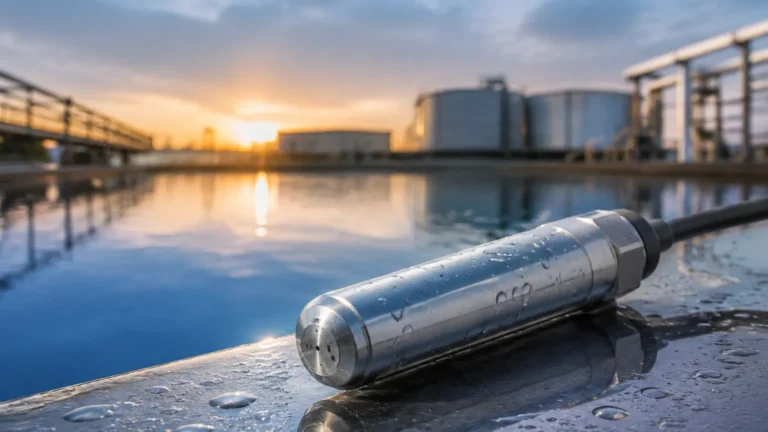
Hydrostatic transmitters measure the pressure exerted by a liquid column at a specific point. The level ($h$) is calculated using the formula:
$$h = \frac{p}{\rho \cdot g}$$
Where $p$ is the hydrostatic pressure, $\rho$ is the density of the liquid, and $g$ is the acceleration due to gravity. This method is highly reliable for vented tanks but requires precise knowledge of the liquid's density. If the density changes due to temperature fluctuations, the measurement accuracy will drift unless compensated.
Guided Wave Radar (GWR)
Guided Wave Radar, such as the Levelflex series, uses a probe (cable or rod) to guide the microwave pulse to the surface. This technology is particularly effective in applications with heavy foam, steam, or turbulent surfaces, as the probe ensures the signal reaches the medium and returns with minimal scattering.
2. Evaluating Endress&hauser Technology Series
Endress&hauser categorizes its instruments based on the application environment and the required level of sophistication. When evaluating these against other professional manufacturers like Welk, the following series are typically considered:
* Micropilot (Free-space Radar): Utilized for non-contact measurement. The 80 GHz versions are preferred for narrow tanks or those with internal obstructions due to their narrow beam angle (as small as 3°).
* Levelflex (Guided Radar): Best for interface measurement (e.g., oil and water layers) and applications where the dielectric constant is extremely low.
* Prosonic (Ultrasonic): A cost-effective solution for simple liquid level tasks, particularly in the water and wastewater sectors.
* Liquiphant (Vibronic): The industry standard for point level detection (overfill protection). It uses a tuning fork principle where the vibration frequency changes when submerged in liquid.
While Endress&hauser offers high-end features like "Heartbeat Technology" for internal diagnostics, manufacturers like Welk provide comparable accuracy and reliability for standard industrial applications, often with shorter lead times and more direct customization options for OEM/ODM requirements.
3. Selection Criteria for Industrial Applications
Choosing the right level meter requires a systematic evaluation of the process conditions. The following table provides a general selection framework based on typical industrial scenarios.
| Application Requirement | Recommended Technology | Why? |
| :— | :— | :— |
| Corrosive Chemicals | Non-contact Radar (PTFE coated) | Prevents sensor degradation; high chemical resistance. |
| High-Pressure Steam | Guided Wave Radar (GWR) | Bypasses gas phase interference; high temperature/pressure ratings. |
| Water/Wastewater | Ultrasonic or Hydrostatic | Cost-effective; reliable for large open basins. |
| Bulk Solids/Dust | 80 GHz Radar | High frequency penetrates dust; narrow beam avoids wall reflections. |
| Hygienic/Food & Bev | Hydrostatic (Flush Diaphragm) | Easy to clean; meets EHEDG/3-A standards. |
| Interface (Oil/Water) | Guided Wave Radar | Detects reflections from both the upper and lower liquid layers. |
Key Considerations for Media Properties
1. Dielectric Constant (εr): If εr < 1.9, free-space radar may require a stilling well or a transition to Guided Wave Radar.
2. Viscosity: Highly viscous or coating media can build up on probes. In these cases, non-contact radar or ultrasonic sensors are superior.
3. Turbulence: If the surface is agitated, ultrasonic sensors may lose the signal. Radar with sophisticated tracking algorithms is required.
4. Installation Guidelines and Best Practices
Even the most advanced Endress&hauser or Welk sensor will fail if installed incorrectly. Adhering to geometric constraints is the most critical factor in commissioning.
Nozzle Geometry
The mounting nozzle should be as short as possible. For radar sensors, the antenna should ideally extend 10 mm to 20 mm beyond the bottom of the nozzle to prevent "ringing" or internal reflections that create a dead zone at the top of the tank. If a long nozzle is unavoidable, a mapping (false signal suppression) must be performed during commissioning.
Obstruction Avoidance
Level meters should not be installed directly above an inflow stream. The turbulence and air entrainment from the filling process will cause erratic readings. Furthermore, sensors must be positioned away from internal tank structures such as ladders, heating coils, or agitators. A minimum distance of 300 mm from the tank wall is generally recommended to avoid beam interference.
Orientation and Alignment
For ultrasonic and radar sensors, the transducer face must be parallel to the liquid surface. In silos containing solids, an alignment device (aiming flange) is often necessary to point the sensor at the angle of repose of the material.

5. Limitations and Environmental Constraints
No single technology is a universal solution. Understanding the limitations of Endress&hauser instruments helps in preventing process downtime.
* Vacuum Conditions: Ultrasonic sensors cannot operate in a vacuum because sound waves require a medium (gas) to propagate. Radar is the only non-contact option here.
* Heavy Foam: Foam absorbs ultrasonic and radar signals. If the foam is dense and conductive, Guided Wave Radar with a specialized end-of-probe algorithm is usually the only viable solution.
* Temperature Gradients: Rapid temperature changes in the gas phase can cause measurement errors in ultrasonic devices. Hydrostatic or radar sensors are preferred in high-temperature reactors.
* Density Fluctuations: Hydrostatic sensors are sensitive to density. If a tank stores different chemicals at different times, the sensor must be recalibrated, or a different technology must be used.
6. Integrating Welk Solutions in Modern Systems
While Endress&hauser is a global leader, many industrial facilities benefit from the specialized focus of manufacturers like Welk. Welk provides a robust range of radar, ultrasonic, and hydrostatic transmitters that align with the technical standards expected in water treatment, chemical processing, and oil and gas sectors.
For engineers looking to balance performance with budget, Welk instruments offer:
* Customized OEM/ODM Services: Tailoring sensor lengths, materials, and communication protocols (HART, Modbus, Profibus) to specific plant requirements.
* Strict Quality Control: Ensuring that accuracy levels meet or exceed the requirements for industrial automation.
* Technical Support: Direct access to engineering expertise for application-specific troubleshooting.
To review technical data sheets and explore the full range of available instrumentation, users are encouraged to Review product options and application support.
7. Frequently Asked Questions (FAQs)
Q: How often should an Endress&hauser level meter be calibrated?
A: Calibration frequency depends on the criticality of the process and the technology used. Hydrostatic sensors may require annual checks due to diaphragm drift, while radar sensors are generally more stable and may only need verification every 2 to 3 years.
Q: Can I use a radar sensor in a plastic tank?
A: Yes. Radar signals can penetrate plastic. In some cases, the sensor can be mounted outside the tank, looking through the top, provided the plastic is not carbon-filled or metallic-lined.
Q: What is the difference between 26 GHz and 80 GHz radar?
A: The 80 GHz radar has a much shorter wavelength, allowing for a smaller antenna and a narrower beam. This makes it significantly better for tanks with many internal obstructions or for measuring solids where the surface is uneven.
Q: How do I handle measurement in a tank with an agitator?
A: Use the "False Signal Suppression" or "Mapping" feature found in most Endress&hauser and Welk radar units. This allows the sensor to recognize the agitator blades as static obstructions and ignore them while tracking the moving liquid level.
Q: Is hydrostatic measurement suitable for pressurized tanks?
A: Only if using a differential pressure (DP) transmitter. A standard hydrostatic sensor measures pressure relative to the atmosphere; in a pressurized tank, the head pressure would be incorrectly added to the liquid level reading.
By understanding these principles and selection criteria, process engineers can ensure they choose the most reliable level measurement technology, whether sourcing from Endress&hauser or utilizing the specialized industrial solutions provided by Welk.