Instrument Ph
Instrument Ph
In the landscape of industrial process control, the term instrument ph refers to the specialized hardware and analytical systems used to measure the acidity or alkalinity of a liquid solution. While often categorized under analytical instrumentation, pH measurement is inextricably linked to physical process parameters such as level, pressure, and temperature. For engineers and plant operators managing chemical treatment, water purification, or food and beverage production, understanding how to select, install, and maintain pH instrumentation is as critical as monitoring the volume of the medium within a storage vessel.
This guide provides a comprehensive overview of pH measurement technology, its operational synergy with level measurement systems, and the technical considerations required to ensure long-term accuracy in demanding industrial environments.
Understanding the Fundamentals of Industrial pH Measurement
Before selecting an instrument ph solution, it is essential to understand the electrochemical principles that govern its operation. pH is a measure of the hydrogen ion activity in a solution, defined mathematically as the negative logarithm of the hydrogen ion concentration. The scale typically ranges from 0 to 14, where 7 is neutral, values below 7 are acidic, and values above 7 are alkaline.
The Potentiometric Method
Most industrial pH instruments utilize the potentiometric measurement method. This involves measuring the voltage (electromotive force) generated between two electrodes immersed in the solution:
1. The Glass Electrode: This is the sensing electrode. It features a specialized pH-sensitive glass membrane that develops a potential proportional to the hydrogen ion concentration of the liquid.
2. The Reference Electrode: This electrode provides a stable, constant potential against which the sensing electrode is compared. It typically uses a silver/silver chloride (Ag/AgCl) internal element and a liquid junction to maintain electrical contact with the process medium.
The Nernst Equation
The relationship between the measured voltage and the pH value is defined by the Nernst Equation. At a standard temperature of 25°C (77°F), a change of one pH unit corresponds to a change of approximately 59.16 millivolts (mV). Because this millivolt output is temperature-dependent, modern pH instrumentation almost always includes an integrated Temperature Compensation (ATC) element, such as a Pt100 or Pt1000 RTD, to ensure accuracy across varying process temperatures.
The Relationship Between pH Monitoring and Level Control
In practical application, an instrument ph does not operate in isolation. It is usually part of a broader control loop that includes level measurement instruments. For example, in a neutralization tank, the level of the liquid must be known to ensure that the pH probe remains fully submerged and to calculate the volume of chemical reagents required for dosing.
Preventing Dry-Run Conditions
One of the most common causes of pH sensor failure is the dehydration of the glass membrane. If the liquid level in a tank drops below the sensor's installation point, the membrane dries out, leading to sluggish response times or permanent damage. Integrating high-accuracy level sensors, such as those found on the Main Page of industrial instrumentation providers, allows the control system to trigger an alarm or shut down the process before the pH probe is exposed to air.
Managing Submersion Pressure
Conversely, in deep tanks or pressurized vessels, the hydrostatic pressure exerted on the pH sensor's reference junction can cause process liquid to ingress into the electrode, poisoning the reference system. Understanding the relationship between the liquid level (height) and the resulting pressure is vital for selecting a sensor with a pressurized reference or a solid-state electrolyte.
Key Components of a pH Instrumentation System
A complete industrial pH measurement loop consists of four primary components:
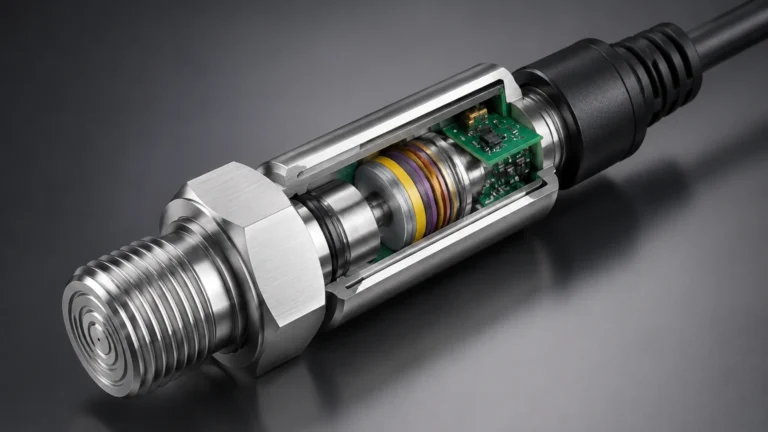
* The Sensor (Electrode): The primary element in contact with the process. Sensors vary by glass type (e.g., high temperature, hydrofluoric acid resistant) and junction style.
* The Transmitter/Analyzer: This device receives the low-impedance millivolt signal from the sensor, applies temperature compensation, and converts it into a standardized output, such as 4-20mA, Modbus RS485, or HART.
* The Cable: High-quality, low-noise coaxial cables are required to transmit the high-impedance signal from the sensor to the transmitter without interference.
* The Mounting Hardware (Housing): This includes immersion probes, flow-through cells, or retractable assemblies that allow the sensor to be removed for cleaning and calibration without stopping the process.
Selection Criteria for Industrial pH Sensors
Choosing the correct instrument ph requires an evaluation of the chemical and physical properties of the process medium. The following table outlines selection criteria based on common industrial challenges:
| Process Condition | Recommended Sensor Feature | Reason |
| :— | :— | :— |
| High Solids / Slurries | Flat surface glass / Teflon junction | Reduces fouling and mechanical abrasion. |
| Low Conductivity Water | Large surface area reference junction | Ensures stable electrical contact in pure water. |
| High Temperature (>80°C / 176°F) | High-temp glass / Pressurized reference | Prevents glass degradation and electrolyte depletion. |
| Chemical Reactors | Retractable housing | Allows for maintenance without draining the vessel. |
| Oily / Greasy Media | Open junction with solid electrolyte | Prevents clogging of the reference junction. |

Installation Guidelines for pH and Level Instrumentation
Proper installation is paramount for the reliability of any instrument ph. Unlike non-contact level meters (such as radar or ultrasonic sensors), pH probes are contact-based and are therefore subject to the dynamics of the fluid flow.
1. Angle of Installation: pH electrodes should never be installed horizontally or upside down. They must be mounted at an angle of at least 15° above the horizontal to ensure that the internal electrolyte stays in contact with the glass membrane and that air bubbles do not get trapped inside the electrode.
2. Submergence Depth: In tanks, ensure the probe is placed in a zone of active mixing. Avoid "dead zones" where the pH might not represent the bulk of the liquid. Coordinate this with the placement of your level transmitters to ensure the probe is always covered by at least 150mm (approx. 6 inches) of liquid.
3. Cable Protection: pH signals are extremely sensitive to moisture and electromagnetic interference (EMI). Use dedicated conduits and ensure that the sensor-to-transmitter distance is kept as short as possible. If the distance exceeds 15 meters (approx. 50 feet), a pre-amplifier should be used.
4. Flow Velocity: In pipeline installations, the flow velocity should be sufficient to keep the sensor clean but not so high that it causes cavitation or mechanical stress on the glass bulb. A velocity between 0.5 m/s and 2 m/s is generally ideal.
Maintenance, Calibration, and Troubleshooting
Even the most advanced instrument ph requires regular maintenance. Unlike a radar level meter, which may operate for years without intervention, pH electrodes drift over time due to aging and chemical exposure.
Calibration Procedures
Calibration should be performed using standard buffer solutions (typically pH 4.0, 7.0, and 10.0).
* Two-Point Calibration: The most common method. The sensor is placed in a pH 7.0 buffer to set the "zero point" (offset) and then in a pH 4.0 or 10.0 buffer to set the "slope."
* Slope and Offset: A healthy sensor should have an offset within ±30mV of the theoretical zero (0mV at pH 7) and a slope between 90% and 105% of the theoretical Nernstian value.
Cleaning Protocols
If the response becomes sluggish, cleaning is necessary.
* Inorganic Scale: Use a 5% Hydrochloric Acid (HCl) solution.
* Oil and Grease: Use a mild detergent or isopropyl alcohol.
* Proteins: Use a mixture of HCl and pepsin.
Frequently Asked Questions regarding pH Instrumentation
Q: How often should I calibrate my pH instrument?
A: The frequency depends on the process. In stable water treatment applications, once a month may suffice. In aggressive chemical processes, weekly or even daily calibration may be required to maintain accuracy.
Q: Can I use a standard level transmitter to control pH dosing?
A: A level transmitter alone cannot measure pH. However, it is an essential part of the control logic. The level transmitter tells the system *how much* liquid is present, while the pH instrument tells the system *what* the chemical state is. Both inputs are required for accurate chemical dosing.
Q: Why is my pH reading drifting?
A: Drifting is often caused by a clogged reference junction, a depleted electrolyte, or moisture in the cable connections. Ensure the junction is clean and the cable connectors are dry and corrosion-free.
Q: What is the lifespan of an industrial pH sensor?
A: In mild conditions, a sensor may last 12 to 24 months. In high-temperature or highly corrosive environments, the lifespan may be reduced to 3 to 6 months. Regular monitoring of the "slope" during calibration will indicate when a sensor is nearing the end of its life.
Conclusion
Effective liquid management in industrial settings requires a dual focus on physical and chemical properties. While level measurement ensures process safety and inventory control, the instrument ph ensures product quality and environmental compliance. By understanding the electrochemical principles of pH, selecting the appropriate sensor for the specific process environment, and integrating these readings with reliable level data, operators can achieve a robust and automated process control system. For those seeking to optimize their liquid measurement infrastructure, reviewing the latest advancements in both analytical and level measurement technology is the first step toward operational excellence.