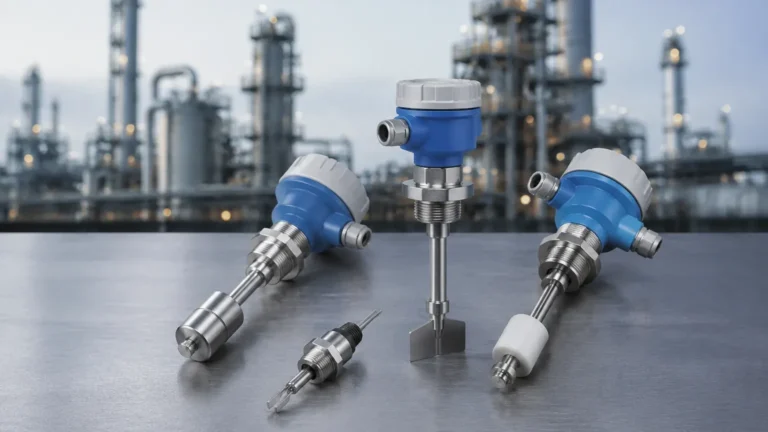
Kv31
Kv31
In the landscape of industrial process control, point-level detection remains a critical safety and operational requirement. The KV31 series represents a specialized category of vibrating fork level switches designed to provide high-reliability switching in both liquid and granular solid applications. As a professional manufacturer, Welk has integrated the KV31 into various industrial frameworks, ranging from simple water treatment facilities to complex chemical processing plants. This article serves as a technical reference for engineers and procurement specialists looking to understand the functional mechanics, application suitability, and installation requirements of the KV31 instrument.
Measurement Principles of Vibrating Fork Technology
Before selecting a specific model like the KV31, it is essential to understand the underlying physics of vibrating fork technology. This method, often referred to as "tuning fork" level detection, relies on the principle of frequency shifting caused by the damping effect of a medium.
Piezoelectric Excitation
The core of the KV31 instrument contains a pair of piezoelectric crystals. One crystal is used to excite the fork tines at their natural resonant frequency, typically around 1200 Hz to 1400 Hz for liquids. The second crystal acts as a receiver, monitoring the vibration frequency and amplitude. This closed-loop electronic circuit ensures that the fork remains in a constant state of vibration when it is not in contact with the process material.
The Damping Effect
When the process medium—whether it is a liquid, slurry, or fine-grained powder—covers the tines of the KV31, the physical mass of the medium imposes a damping force. This contact causes a significant shift in the resonant frequency and a reduction in vibration amplitude. The internal electronics detect this change and compare it against a pre-set threshold. Once the threshold is crossed, the device triggers an electronic output signal, such as a relay contact or a transistor switch (PNP/NPN), indicating that the level has reached the sensor's position.
Advantage Over Traditional Methods
Unlike float switches, which rely on mechanical movement and are prone to jamming due to debris or scaling, the KV31 has no moving parts. This makes it inherently more robust in environments where maintenance access is limited. Furthermore, the high-frequency vibration provides a self-cleaning effect, shedding small amounts of material buildup that might otherwise cause false readings in capacitive or conductive sensors.
Technical Specifications and Features of the KV31
The KV31 is engineered to bridge the gap between basic level switches and high-end analytical instrumentation. It is characterized by its compact form factor and high sensitivity. Below are the primary technical parameters typically associated with the Welk KV31 series:
* Housing Material: Typically constructed from 304 or 316L stainless steel to withstand corrosive environments.
* Wetted Parts: 316L stainless steel is standard, providing excellent compatibility with a wide range of industrial chemicals.
* Process Temperature: Standard models operate between -40°C and 150°C, with specialized high-temperature variants available for steam-heavy applications.
* Pressure Rating: Capable of withstanding process pressures up to 40 bar (4.0 MPa), making it suitable for pressurized storage tanks.
* Density Requirements: The KV31 can detect media with a minimum density as low as 0.5 g/cm³, allowing it to function in lightweight oils and aerated liquids.
* Viscosity Limit: It remains functional in liquids with viscosities up to 10,000 mm²/s.
For engineers evaluating these units for large-scale deployments, reviewing the comprehensive product options and application support on the Main Page is recommended to ensure the selected configuration matches the specific chemical compatibility of the site.
Practical Selection Table for Level Switches
Choosing the right instrument requires a comparison of the KV31 against other common technologies. The following table highlights the strengths and weaknesses of different point-level solutions.
| Feature | KV31 (Vibrating Fork) | Float Switch | Capacitive Switch | Ultrasonic Point Level |
| :— | :— | :— | :— | :— |
| Moving Parts | None | Yes | None | None |
| Media Type | Liquids & Solids | Liquids Only | Liquids & Solids | Liquids Only |
| Maintenance | Low | High | Medium | Low |
| Foam Sensitivity | Low | High | High | High |
| Build-up Tolerance| High | Low | Low | Medium |
| Cost-Effectiveness| High | Very High | Medium | Medium |
| Installation | Flexible | Vertical Only | Flexible | Flexible |
Application Scenarios for the KV31
The versatility of the KV31 makes it a staple in several key industries. Its ability to ignore foam and turbulence is particularly valued in high-activity process vessels.
Water and Wastewater Treatment
In municipal water treatment, the KV31 is frequently used for pump protection. By installing the switch at a low-level point in a sump or well, it can signal the control system to shut down pumps before they run dry, preventing catastrophic mechanical failure. It is also used in chemical dosing tanks to ensure that coagulants and flocculants are always available.
Chemical and Petrochemical Processing
Due to its stainless steel construction and explosion-proof options, the KV31 is ideal for monitoring hazardous liquids. It serves as an independent overfill protection layer (High-High Level Alarm) in storage tanks containing fuels, solvents, or acids. Its immunity to changes in dielectric constant makes it more reliable than capacitive probes when switching between different chemical batches.
Food and Beverage Industry
With polished tines and hygienic process connections (such as Tri-Clamp), the KV31 meets the stringent requirements of food processing. It is used to detect the level of syrups, juices, and cleaning-in-place (CIP) solutions. The vibration of the fork ensures that viscous food products do not cling to the sensor and cause "stuck" signals.

Installation Considerations and Best Practices
Proper installation is paramount to the longevity and accuracy of the KV31. While the device is robust, physical placement influences its performance significantly.
1. Orientation: The KV31 can be mounted horizontally or vertically. For horizontal mounting, the tines should be oriented such that the flat surfaces are vertical. This prevents material from resting on top of the tines, which could lead to false triggers.
2. Flow Streams: The sensor should not be placed directly in the path of a heavy fill stream. The kinetic energy of the falling material can damage the tines or cause intermittent signals. If placement near an inlet is unavoidable, a protective baffle or shield should be installed.
3. Nozzle Length: Ensure that the tines protrude fully into the vessel. If the mounting nozzle is too long, material can become trapped in the stagnant zone of the nozzle, preventing the medium from reaching the fork or preventing it from draining away once the level drops.
4. Cable Entry: Always point the cable glands downward to prevent moisture from entering the housing via capillary action along the power cable. Using a "drip loop" is a standard engineering best practice.
Limitations and Operational Constraints
While the KV31 is a highly versatile tool, it is not a universal solution for every level measurement challenge. Engineers must be aware of the following limitations:
* Granular Size: For solid applications, the particle size should not exceed 10 mm. Large rocks or heavy aggregates can wedge between the tines, physically jamming the vibration and requiring manual intervention.
* Extreme Coating: While the KV31 handles light build-up well, extremely viscous or "sticky" materials (like cold bitumen or heavy resins) that bridge the gap between the tines will cause a permanent "covered" signal.
* Turbulence: In extremely turbulent tanks, the fork may experience mechanical fatigue over many years. In such cases, using a stilling well or a different technology like hydrostatic pressure may be more appropriate.
* Gas Bubbles: While the KV31 is largely immune to foam, a very high concentration of gas bubbles in a liquid (aeration) can lower the effective density of the medium below the 0.5 g/cm³ threshold, leading to a failure to detect the liquid.
Frequently Asked Questions (FAQs)
Q: Does the KV31 require calibration for different liquids?
A: No. One of the primary advantages of the KV31 is that it is a "plug-and-play" device. Since it detects a change in frequency rather than an absolute value, it does not need to be calibrated for different densities or dielectric constants, provided the density is above the minimum threshold.
Q: Can the KV31 be used in vacuum tanks?
A: Yes, the KV31 is suitable for vacuum applications. However, the seal at the process connection must be rated for vacuum service to prevent air ingress into the vessel.
Q: How do I test if the KV31 is functioning without filling the tank?
A: Most KV31 units from Welk include a magnetic test point or a local test button on the electronics module. Touching a magnet to the designated housing area simulates a "covered" state, allowing the operator to verify the loop and alarm logic.
Q: What is the typical lifespan of a KV31 sensor?
A: In standard non-corrosive and non-abrasive environments, the KV31 can operate for over 10 years. The absence of mechanical wear parts significantly extends its service life compared to float-based systems.
Conclusion
The KV31 vibrating fork level switch is a cornerstone of modern industrial point-level detection. By leveraging the reliable physics of piezoelectric vibration, it offers a maintenance-free alternative to traditional mechanical switches. Whether used for overfill prevention in chemical tanks or dry-run protection in water pumps, the KV31 provides the accuracy and durability required for demanding B2B applications. For technical teams seeking to integrate these sensors into their automation architecture, understanding the specific density and viscosity requirements of their media is the first step toward a successful installation. For further exploration of level measurement technologies, visiting the Main Page provides access to a broader range of radar, ultrasonic, and hydrostatic solutions tailored to global industrial standards.