Laser Gas Analyzer
Laser Gas Analyzer
In modern industrial process control, the demand for real-time, high-precision gas monitoring has led to the widespread adoption of the laser gas analyzer. Unlike traditional extractive sampling systems that may suffer from long lag times and high maintenance requirements, laser-based systems—specifically those utilizing Tunable Diode Laser Absorption Spectroscopy (TDLAS)—offer non-contact, in-situ measurement capabilities. This technology has become a cornerstone in industries ranging from petrochemical refining and power generation to environmental monitoring and safety management.
Understanding the technical nuances of a laser gas analyzer is essential for instrumentation engineers and plant managers. These devices provide the high-speed response necessary for closed-loop control, ensuring that processes operate within optimal efficiency and safety parameters. This guide explores the fundamental principles, selection criteria, and practical installation considerations for implementing laser gas analysis in industrial environments.
Measurement Principles of Laser Gas Analyzers
The primary technology behind the modern industrial laser gas analyzer is Tunable Diode Laser Absorption Spectroscopy (TDLAS). This method relies on the unique "spectral fingerprint" of gas molecules. Every gas species absorbs light at specific, well-defined wavelengths.
The Beer-Lambert Law
At the core of the measurement is the Beer-Lambert Law, which describes the relationship between light absorption and the properties of the material through which the light is traveling. The formula is generally expressed as:
**I = I₀ * e^(-αLC)**
Where:
* I is the intensity of the light after passing through the gas.
* I₀ is the initial intensity of the laser light.
* α is the absorption coefficient (specific to the gas species and wavelength).
* L is the optical path length (the distance the laser travels through the gas).
* C is the concentration of the target gas.
Wavelength Tuning and Scanning
A laser gas analyzer uses a semiconductor diode laser that can be precisely tuned by varying its operating temperature and injection current. The analyzer sweeps the laser frequency across a specific absorption line of the target gas. Because the laser line width is much narrower than the gas absorption line, the system can resolve the absorption profile with extremely high specificity, effectively ignoring interference from other gases present in the process stream.
To improve the signal-to-noise ratio, many advanced analyzers employ Wavelength Modulation Spectroscopy (WMS). By modulating the laser at a high frequency and detecting the second harmonic (2f) signal, the instrument can filter out background noise and baseline shifts caused by window fouling or changes in laser intensity.
Key Components of a Laser Gas Analyzer System
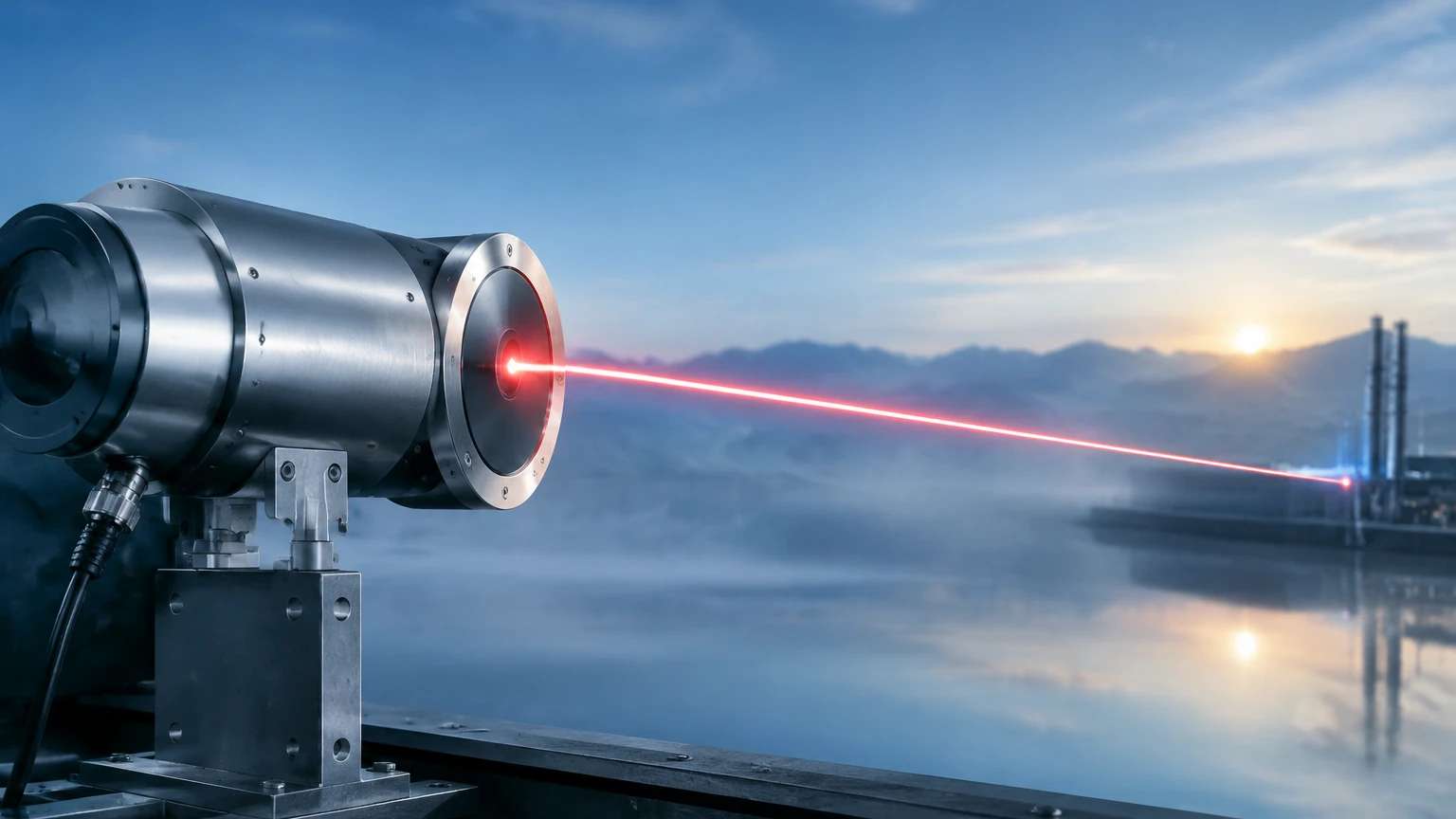
A typical in-situ laser gas analyzer consists of two main units: the Transmitter (Sender) and the Receiver. In some configurations, such as retro-reflective designs, both are housed in a single unit with a mirror on the opposite side of the stack.
1. Laser Source: Usually a Distributed Feedback (DFB) or Vertical-Cavity Surface-Emitting Laser (VCSEL) diode, chosen for its stability and narrow linewidth.
2. Optical Windows: These separate the analyzer electronics from the process gas. They must be made of materials transparent to the laser wavelength (e.g., quartz, sapphire, or calcium fluoride) and are often protected by a purge system.
3. Detector: A photodiode (typically InGaAs or Si) that converts the received light intensity into an electrical signal.
4. Processing Electronics: The "brains" of the unit that perform the fast Fourier transforms (FFT) or signal processing required to calculate the gas concentration, temperature, and pressure compensation.
5. Purge Interface: A mechanical assembly that introduces a clean gas (usually nitrogen or instrument air) to keep the optical windows free from dust and condensation.
Selection Criteria: Choosing the Right Analyzer
Selecting a laser gas analyzer requires a thorough understanding of the process conditions. Unlike level measurement instruments—where you might Review product options and application support on our Main Page to find a match for tank geometry—gas analyzers are highly sensitive to the chemical composition and physical state of the gas stream.
Practical Selection Table
| Parameter | Consideration | Importance |
| :— | :— | :— |
| Target Gas | O2, CO, CO2, NH3, H2O, CH4, HCl, etc. | Critical: The laser must be factory-set to the specific gas wavelength. |
| Measurement Range | ppm (parts per million) to % volume. | High: Determines the sensitivity and dynamic range of the detector. |
| Path Length | 0.5 meters to 15+ meters. | High: Longer paths increase sensitivity but require better mechanical stability. |
| Process Temperature | Up to 1500°C (with specialized cooling). | Critical: High temperatures cause line broadening and require thermal compensation. |
| Process Pressure | Vacuum to high pressure (e.g., 500 kPa). | High: Pressure affects the shape of the absorption line (pressure broadening). |
| Dust/Particulate Load | Measured in g/m³. | Moderate: High dust levels can attenuate the signal, requiring higher laser power or shorter paths. |
Installation and Commissioning Guidelines
The performance of a laser gas analyzer is heavily dependent on the quality of the installation. Because TDLAS is an optical measurement, alignment is the most critical factor.
Mechanical Alignment
The transmitter and receiver must be perfectly aligned across the process duct or stack. For path lengths exceeding 5 meters, even a fraction of a degree of misalignment can lead to significant signal loss. Most industrial analyzers include alignment flanges with adjustment bolts to fine-tune the beam path.
Purging Requirements
To prevent the process gas from contacting and fouling the optical windows, a continuous flow of purge gas is required.
* Purge Gas Selection: For oxygen measurement, nitrogen must be used as the purge gas. For moisture measurement, dry instrument air or nitrogen is required.
* Flow Rate: The flow rate must be high enough to overcome the process pressure and prevent "dead zones" where gas could accumulate near the window.
Environmental Protection
While many analyzers are rated for outdoor use (IP66/NEMA 4X), extreme temperatures can affect the diode laser's lifespan and tuning stability. In very hot climates, sunshades or vortex coolers may be necessary for the transmitter housing.
Limitations and Operational Risks
While highly effective, the laser gas analyzer is not a universal solution. Engineers must be aware of the following limitations:
* Optical Blockage: If the process contains extremely high levels of opaque dust or liquid droplets, the laser light may be completely extinguished. Most systems provide a "transmission" diagnostic; if transmission falls below 1% to 5%, the measurement becomes unreliable.
* Temperature and Pressure Limits: TDLAS relies on spectroscopic data libraries (like HITRAN). If the process conditions exceed the limits of these models, the accuracy of the concentration calculation will degrade unless custom calibration is performed.
* Mechanical Vibration: In large-diameter stacks or ducts, high-frequency vibrations can cause the laser beam to dance across the detector surface, introducing noise. Rigid mounting structures are mandatory.
* Cross-Interference: Although TDLAS is highly specific, at very high pressures, the absorption lines of different gases can broaden and overlap. This is rare but must be evaluated during the engineering phase.
Frequently Asked Questions (FAQ)
Q: How often does a laser gas analyzer need calibration?
A: One of the main advantages of TDLAS is its long-term stability. Because the measurement is based on fundamental physical constants (absorption lines), the "zero" point rarely drifts. Most users perform a calibration check once a year using a flow-through cell or a dedicated calibration gap.
Q: Can one analyzer measure multiple gases?
A: Standard TDLAS analyzers are typically designed for one or two gas species (e.g., CO and O2) if their absorption lines are close enough to be scanned by a single laser or if the unit houses multiple lasers. However, they are not multi-gas analyzers in the same way a Gas Chromatograph is.
Q: What is the typical response time?
A: In-situ laser gas analyzers are extremely fast, with response times (T90) often under 2 seconds. This makes them ideal for safety-critical applications like explosion limit monitoring.
Q: How does path length affect accuracy?
A: Generally, a longer path length (L) increases the total absorption, which improves the detection limit for low concentrations (ppm). However, for high-concentration measurements (%), a shorter path length is often preferred to avoid complete signal absorption (saturation).
Conclusion
The laser gas analyzer represents a significant leap forward in process instrumentation, providing the speed and reliability required for modern industrial automation. By understanding the principles of TDLAS, carefully selecting the instrument based on process parameters, and ensuring a stable, well-purged installation, facilities can achieve superior control over their emissions and process efficiency. For those integrating these systems alongside other instrumentation, such as level sensors for chemical storage or water treatment, visiting a comprehensive resource like the Main Page of an industrial specialist can provide the broader context needed for a successful plant-wide implementation.