Chloride Analyzer
Chloride Analyzer
In industrial process control and water quality management, the chloride analyzer serves as a critical instrument for monitoring the concentration of chloride ions ($Cl^-$). High chloride levels are a primary driver of stress corrosion cracking in stainless steel, particularly in high-pressure steam systems and cooling towers. Furthermore, in wastewater treatment and desalination plants, precise chloride measurement is essential for regulatory compliance and process efficiency.
Effective process automation requires not only the measurement of chemical composition but also the integration of physical parameters. While a chloride analyzer monitors the chemical state of a fluid, instruments such as radar level meters and ultrasonic sensors ensure that the volumes within storage tanks and reaction vessels are managed safely. For comprehensive monitoring solutions, engineers often Review product options and application support to find the right balance between chemical analysis and physical level measurement.
Measurement Principles of Chloride Analyzers
Before selecting a chloride analyzer, it is vital to understand the underlying measurement technologies. Most industrial analyzers utilize one of three primary methods: Ion-Selective Electrode (ISE), Colorimetric analysis, or Titration.
Ion-Selective Electrode (ISE)
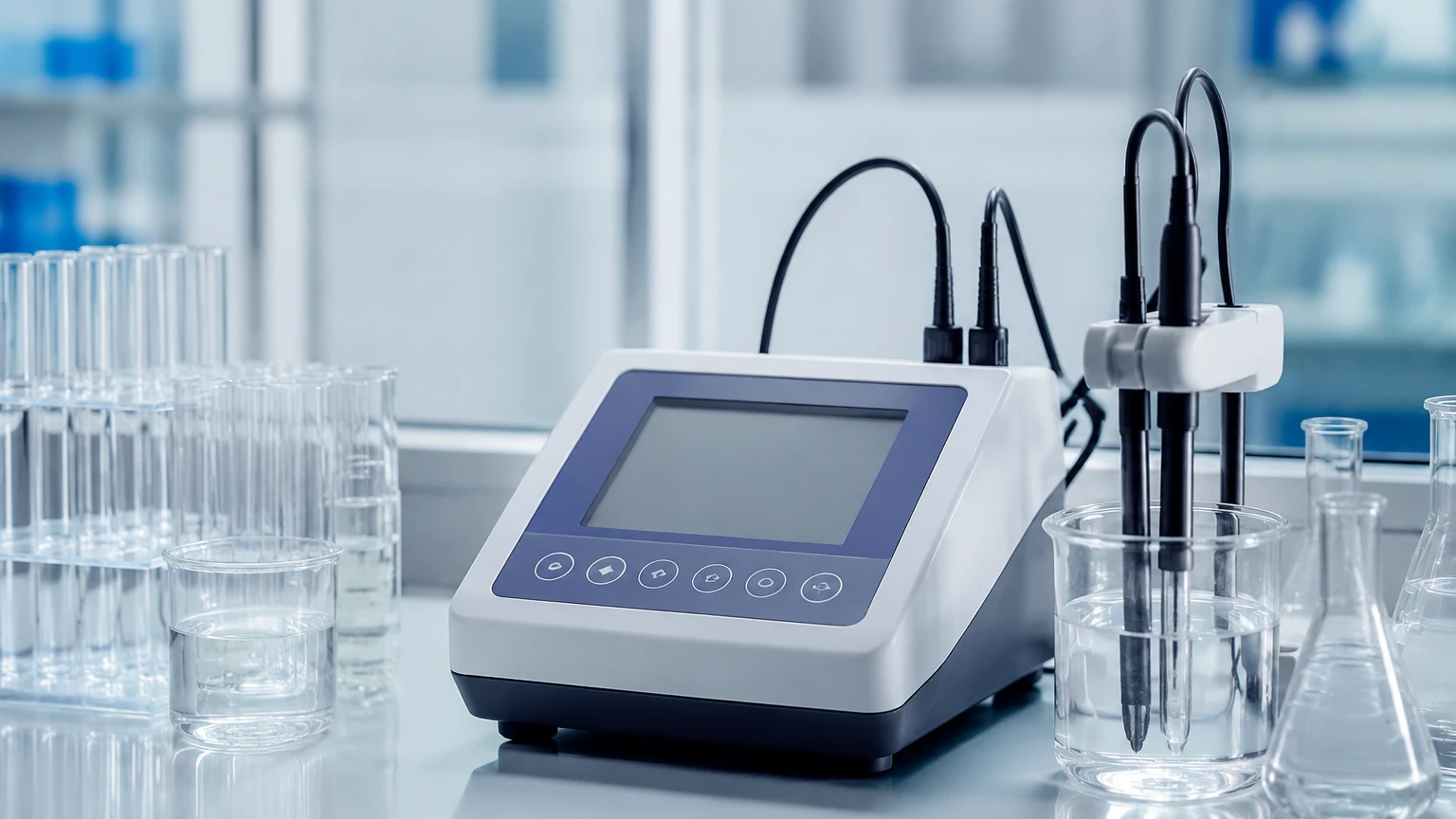
ISE is the most common method for continuous, online chloride monitoring. It operates on a potentiometric principle similar to a pH probe. The sensor consists of a chloride-sensitive membrane—typically a solid-state silver chloride/silver sulfide pellet.
When the sensor is immersed in a sample, a potential difference develops across the membrane that is proportional to the logarithm of the chloride ion activity. This relationship is governed by the Nernst Equation:
$$E = E^0 – \frac{RT}{nF} \ln(a_{Cl^-})$$
Where:
* $E$ is the measured potential.
* $E^0$ is the standard electrode potential.
* $R$ is the gas constant.
* $T$ is the absolute temperature in Kelvin.
* $a_{Cl^-}$ is the activity of the chloride ion.
ISE systems are preferred for their rapid response times and ability to operate without expensive reagents, though they require frequent calibration and ionic strength adjustment.
Colorimetric (Photometric) Analysis
Colorimetric chloride analyzers use the mercuric thiocyanate or ferric thiocyanate method. In this process, a reagent is added to the sample, reacting with the chloride ions to form a colored complex. The intensity of the color is directly proportional to the chloride concentration, measured by passing a light beam through the sample and detecting the absorbance at a specific wavelength (typically around 460 nm to 480 nm).
This method follows the Beer-Lambert Law. While highly accurate at low concentrations (sub-ppm levels), colorimetric analyzers require a steady supply of chemical reagents and more intensive maintenance of the fluidic system.
Automated Titration
For high-precision laboratory or batch-process applications, automated argentometric titration is used. Silver nitrate ($AgNO_3$) is added to the sample until the chloride is precipitated as silver chloride ($AgCl$). The endpoint is detected potentiometrically. This is considered the "gold standard" for accuracy but is less suitable for high-frequency online monitoring due to the mechanical complexity and long cycle times.
Selection Criteria for Industrial Applications
Choosing the correct chloride analyzer depends on the specific requirements of the process environment, the expected concentration range, and the presence of interfering ions.
| Feature | Ion-Selective Electrode (ISE) | Colorimetric Analyzer | Automated Titrator |
| :— | :— | :— | :— |
| Measurement Range | 0.5 mg/L to 10,000 mg/L | 0.01 mg/L to 100 mg/L | 10 mg/L to 100,000 mg/L |
| Accuracy | ±5% to 10% of reading | ±2% to 5% of reading | ±0.5% to 2% of reading |
| Response Time | Continuous (Real-time) | 5 to 15 minutes | 10 to 30 minutes |
| Maintenance | Low (Monthly calibration) | High (Reagent replacement) | Very High (Mechanical) |
| Common Use Case | Wastewater, Cooling Water | Boiler Feedwater, Ultrapure Water | Chemical Manufacturing |
Integration with Level Measurement Systems
In a B2B industrial context, a chloride analyzer rarely operates in isolation. It is typically part of a larger chemical dosing or water treatment skid. For instance, in a cooling tower, the chloride analyzer detects when salt concentrations have reached a threshold that requires a "blowdown" (discharging a portion of the water).
Simultaneously, level transmitters—such as those found on the Main Page of industrial instrument suppliers—monitor the water level in the basin to ensure that the pumps do not run dry during the blowdown process. In chemical storage tanks where chloride-removing resins or chemicals are kept, hydrostatic or radar level meters provide the inventory data necessary to ensure the analyzer always has the required process chemicals available for treatment.
Installation Considerations
To ensure the reliability of a chloride analyzer, several engineering factors must be addressed during the installation phase:
1. Sample Conditioning: Most analyzers require a clean, filtered sample. Suspended solids (TSS) can foul ISE membranes or clog the narrow tubing in colorimetric systems. A 50-micron filter is generally recommended for wastewater applications.
2. Flow Rate Regulation: For online ISE sensors, a constant flow rate (typically between 5 L/h and 20 L/h) is necessary to maintain a stable boundary layer at the electrode surface. Fluctuating flow can lead to signal drift.
3. Pressure Control: Analyzers usually operate at atmospheric pressure or very low positive pressure (less than 0.5 bar / 7.2 psi). If the process line is high-pressure, a pressure-reducing valve and a break tank must be installed.
4. Temperature Compensation: Since ion activity is temperature-dependent, the analyzer must include an integrated temperature sensor (Pt100 or Pt1000) to provide automatic compensation. The sample temperature should ideally be maintained between 5°C and 45°C.
5. Drainage: Reagent-based analyzers produce chemical waste. The installation site must have a dedicated drain line that complies with local environmental regulations regarding the disposal of treated samples.
Limitations and Common Risks
While modern chloride analyzers are robust, users should be aware of specific technical limitations:
* Interfering Ions: ISE sensors are susceptible to interference from other halides (Bromide, Iodide) and Sulfide ($S^{2-}$). Sulfide is particularly problematic as it can "poison" the silver-based electrode, requiring chemical cleaning or replacement.
* Ionic Strength Fluctuations: ISE measures ion *activity*, not just concentration. If the total dissolved solids (TDS) of the water varies significantly, the relationship between activity and concentration changes. This is mitigated by adding an Ionic Strength Adjustor (ISA) buffer to the sample.
* Fouling and Scaling: In hard water applications, calcium carbonate scale can build up on sensor surfaces. Automated cleaning cycles using diluted acid are often required for maintenance-free operation.
* Reagent Stability: For colorimetric units, reagents have a finite shelf life (typically 3 to 6 months). Exposure to extreme heat or light can degrade the chemicals, leading to inaccurate readings.
Frequently Asked Questions (FAQ)
Q: How often should a chloride analyzer be calibrated?
A: For most ISE-based online monitors, a weekly two-point calibration is recommended to account for electrode drift. Colorimetric systems often feature automated self-calibration cycles using a standard solution.
Q: Can I use a chloride analyzer to measure total salinity?
A: While chloride is a major component of salinity (especially in seawater), it is not the only one. Salinity is typically measured via electrical conductivity. However, a chloride analyzer provides a more specific measurement for corrosion control than a general conductivity meter.
Q: What is the difference between a chloride analyzer and a chlorine analyzer?
A: This is a common point of confusion. A chloride analyzer measures the chloride ion ($Cl^-$), which is a stable salt component. A chlorine analyzer measures "free" or "total" residual chlorine ($Cl_2$, $HOCl$, $OCl^-$), which are reactive disinfectants used in water treatment.
Q: Is it possible to measure chloride in oil or non-aqueous liquids?
A: Direct measurement with ISE or colorimetry requires an aqueous (water-based) sample. For oils, the chloride must first be extracted into a water phase using a solvent extraction process before analysis.
Conclusion
The implementation of a chloride analyzer is a strategic investment for any facility concerned with infrastructure longevity and process precision. By understanding the measurement principles—whether the real-time capabilities of ISE or the high precision of colorimetry—engineers can select the technology that best fits their maintenance budget and accuracy requirements.
When designing a complete process control loop, remember that chemical analysis is only half of the equation. Integrating these analyzers with reliable level measurement hardware ensures a holistic approach to industrial automation. For technical specifications on the physical sensors required to complement your chemical analysis, you may Review product options and application support to ensure your tanks and vessels are monitored with the same level of precision as your water chemistry.