Liquid Level Sensor Ultrasonic
Liquid Level Sensor Ultrasonic
In the landscape of industrial process control, the liquid level sensor ultrasonic has emerged as a cornerstone technology for non-contact measurement. By utilizing high-frequency sound waves to determine the distance to a liquid surface, these instruments provide a reliable, maintenance-free solution for a diverse range of applications, from municipal water treatment to complex chemical processing. As a professional manufacturer, Welk specializes in delivering these advanced measurement solutions, ensuring accuracy and cost-effectiveness across global industrial automation sectors.
Selecting the appropriate liquid level sensor ultrasonic requires a deep understanding of the underlying physics, the environmental factors influencing sound propagation, and the specific mechanical constraints of the installation site. This guide provides a comprehensive technical overview to assist engineers and procurement professionals in evaluating ultrasonic technology for their specific operational needs.
Measurement Principles of Ultrasonic Sensors
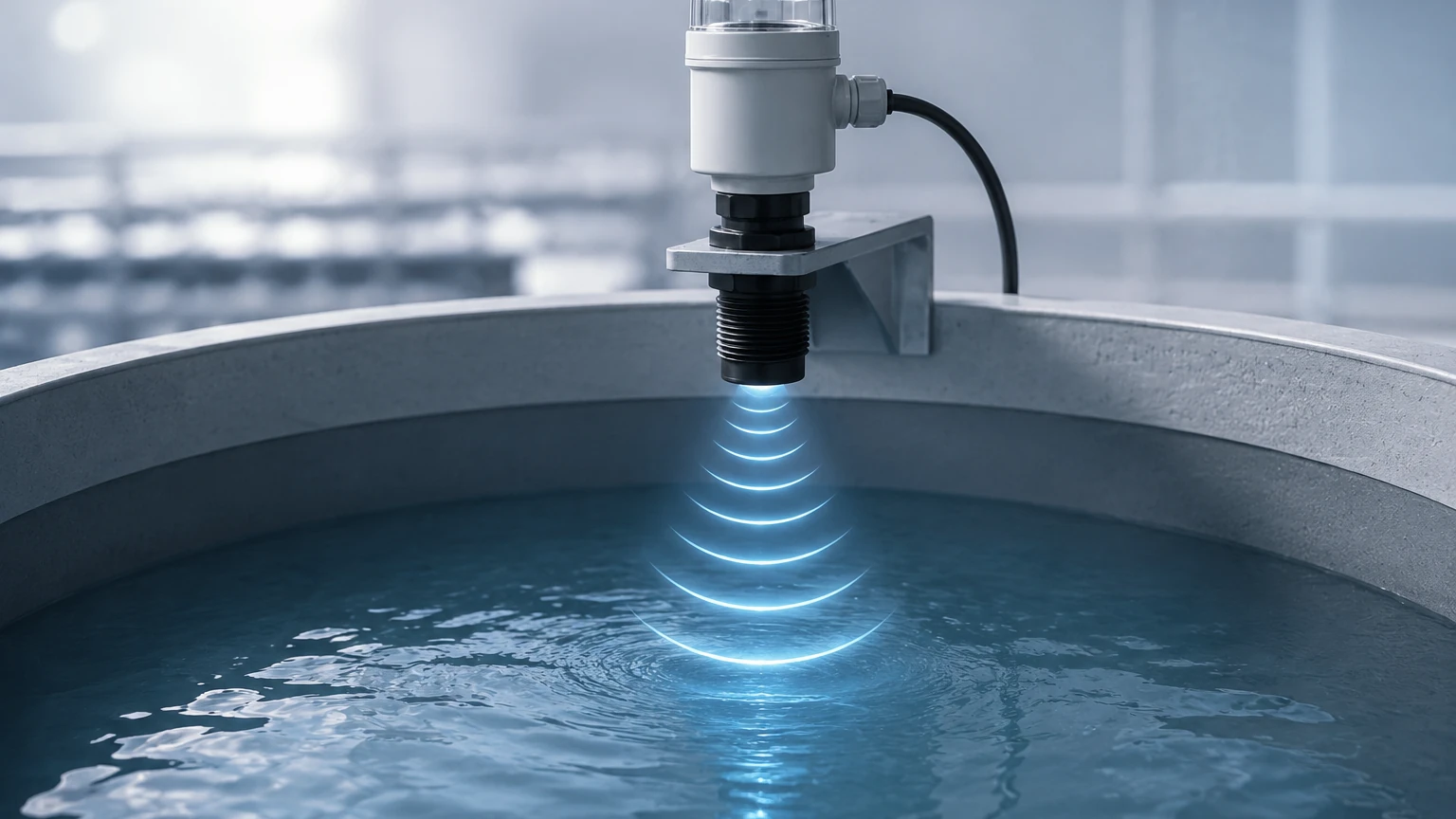
The operation of a liquid level sensor ultrasonic is based on the "Time-of-Flight" (ToF) principle. The sensor’s transducer emits a burst of ultrasonic pulses—typically in the range of 20 kHz to 200 kHz—toward the surface of the target medium. These sound waves travel through the air, strike the liquid surface, and are reflected back to the transducer, which now acts as a receiver.
The Time-of-Flight Equation
The distance between the sensor and the liquid surface is calculated using the following formula:
D = (v × t) / 2
Where:
* D is the distance to the liquid surface (meters).
* v is the speed of sound in the air or gas medium (approximately 343 m/s at 20°C).
* t is the total time elapsed between the emission of the pulse and the reception of the echo (seconds).
Since the pulse travels to the surface and back, the product of velocity and time is divided by two to determine the one-way distance. The actual level of the liquid is then derived by subtracting this measured distance from the total height of the tank (the "Empty" calibration point).
Temperature Compensation
The speed of sound is not constant; it fluctuates based on the temperature of the medium through which it travels. In air, the speed of sound increases by approximately 0.6 m/s for every degree Celsius rise in temperature. To maintain high accuracy, modern liquid level sensor ultrasonic units include integrated temperature sensors to provide real-time compensation, ensuring that fluctuations in ambient or process temperatures do not skew the level readings.
Key Advantages in B2B Industrial Applications
Ultrasonic technology is favored in many industrial sectors due to its non-contact nature. Unlike hydrostatic transmitters or float switches, the ultrasonic sensor does not come into physical contact with the process media. This offers several distinct advantages:
1. Reduced Maintenance: Without moving parts or components submerged in potentially corrosive or viscous liquids, the risk of mechanical wear, clogging, or chemical degradation is virtually eliminated.
2. Versatility: These sensors are suitable for a wide array of liquids, including wastewater, acids, alkalis, and oils, provided the surface is relatively calm and the atmosphere does not interfere with sound travel.
3. Ease of Installation: Most ultrasonic sensors can be mounted at the top of a tank or vessel, allowing for installation and calibration without draining the tank or halting production.
4. Cost-Effectiveness: For standard atmospheric tanks, ultrasonic sensors provide a high-precision measurement at a lower total cost of ownership compared to guided wave radar or high-end pressure transmitters.
Technical Selection Criteria
When specifying a liquid level sensor ultrasonic for an industrial project, several technical parameters must be evaluated to ensure reliable performance. For more detailed product specifications and application support, engineers can refer to the Main Page of our technical catalog.
Measuring Range and Dead Zone
Every ultrasonic sensor has a minimum and maximum measuring range. The minimum range is defined by the "Dead Zone" (or blocking distance). This is a region immediately below the transducer face where the sensor cannot accurately process echoes because the transducer is still vibrating from the initial pulse emission. Typical dead zones range from 0.2 meters to 0.5 meters (approx. 8 to 20 inches), depending on the frequency of the sensor.
Beam Angle
The ultrasonic pulse does not travel in a straight line but spreads out in a conical shape. The beam angle (usually between 5° and 12°) determines the footprint of the signal at the liquid surface. It is critical to ensure that no internal tank obstructions, such as ladders, pipes, or agitators, fall within this beam path, as they will cause false echoes.
Process Environment
* Pressure: Ultrasonic sensors are generally designed for atmospheric or near-atmospheric applications. High pressure increases the density of the gas, which can affect the transducer's ability to vibrate and transmit sound.
* Vapor and Dust: Heavy steam, solvent vapors, or thick dust can absorb or scatter the ultrasonic signal, leading to a loss of echo.
* Foam: Liquid surfaces covered in thick, dense foam often absorb the sound pulse rather than reflecting it, making ultrasonic measurement difficult.
Practical Selection Table
The following table outlines typical configurations for Welk ultrasonic level instruments based on common industrial requirements.
| Feature | Compact Ultrasonic Sensor | Extended Range Sensor | Chemical-Resistant Model |
| :— | :— | :— | :— |
| Measuring Range | 0.4m to 5m | 0.5m to 15m | 0.3m to 10m |
| Dead Zone | ≤ 0.3m | ≤ 0.5m | ≤ 0.4m |
| Accuracy | ±0.25% of FS | ±0.25% of FS | ±0.5% of FS |
| Output Signal | 4-20mA / RS485 | 4-20mA / HART | 4-20mA / Modbus |
| Housing Material | ABS / Plastic | Aluminum Alloy | PVDF / PTFE |
| Operating Temp | -20°C to +60°C | -40°C to +80°C | -20°C to +70°C |
| Protection Class | IP65 | IP67 | IP68 |
Installation Considerations and Best Practices
Proper installation is the most significant factor in the long-term reliability of a liquid level sensor ultrasonic. Engineers should adhere to the following guidelines during the design and commissioning phases:
1. Positioning
The sensor should be mounted perpendicular to the liquid surface. If the sensor is tilted, the reflected pulse may not return to the transducer, resulting in a "Lost Echo" error. For most applications, the sensor should be placed at least 200mm (approx. 8 inches) away from the tank wall to avoid interference from wall reflections.
2. Avoiding Obstructions
If a tank contains internal structures like heating coils or support beams, the sensor must be positioned so that the ultrasonic beam (considering its spread angle) clears these objects. If an obstruction is unavoidable, many modern sensors offer "False Echo Suppression" software, allowing the user to map out and ignore static reflections.
3. Turbulence and Agitation
In tanks with heavy agitation or turbulent surfaces, the reflected signal may become scattered. In such cases, installing the sensor inside a "stilling well" (a vertical pipe that dampens surface movement) can provide a stable environment for the ultrasonic pulse to measure accurately.
4. Outdoor Installations
For sensors installed outdoors, a sunshade or protective cover is recommended. Direct sunlight can heat the sensor housing significantly above the actual ambient air temperature, leading to inaccurate temperature compensation and measurement errors.
Limitations and Technology Comparisons
While the liquid level sensor ultrasonic is a versatile tool, it is not a universal solution. Understanding its limitations is essential for risk management.
* Vacuum Conditions: Sound requires a medium to travel. In a vacuum, ultrasonic sensors cannot function.
* High-Temperature Gradients: If there is a significant temperature difference between the liquid and the air space (e.g., hot liquid in a cold tank), the resulting thermoclines can refract the sound waves, leading to inaccuracies.
* Comparison with Radar: For applications involving high pressure, high temperature, or heavy foam, Radar (FMCW or Pulse) is often preferred. Radar uses electromagnetic waves which are not affected by air temperature or vacuum. However, for standard water and chemical storage, ultrasonic remains the more economical choice.
Maintenance and Troubleshooting
Due to the lack of contact with the media, maintenance for an ultrasonic sensor is minimal. However, the following checks should be performed periodically:
* Transducer Face Inspection: In high-humidity or splashing environments, condensation or residue can build up on the transducer face. This should be cleaned gently with a soft cloth and water/mild detergent. Avoid using abrasive tools that could scratch the transducer surface.
* Cable Integrity: Ensure that cable glands are tight and that there is no moisture ingress into the electronic housing.
* Signal Strength Monitoring: Most digital ultrasonic sensors provide a signal quality or "Echo Strength" metric. A gradual decline in this value may indicate build-up on the sensor or changing process conditions like increased foaming.
Frequently Asked Questions (FAQ)
Q: Can a liquid level sensor ultrasonic measure the level of solids?
A: Yes, but with caveats. Solids like grain, sand, or plastic pellets have an "angle of repose" which reflects the sound wave away from the sensor. Furthermore, solids absorb more sound than liquids. Consequently, the effective range for solids is typically half of the rated range for liquids.
Q: How does wind affect the measurement?
A: In outdoor open-channel flow or large lagoons, strong winds can "blow" the ultrasonic pulse away or create air turbulence that dissipates the signal. In these environments, using a sensor with a higher power output or a protective wind shield is advised.
Q: What is the maximum distance an ultrasonic sensor can measure?
A: Standard industrial ultrasonic sensors typically cover ranges up to 15 or 20 meters (approx. 50 to 65 feet). For distances beyond 30 meters, the signal attenuation in air becomes too great for reliable measurement, and radar or long-range laser technology is usually required.
Q: Is the sensor affected by the color or transparency of the liquid?
A: No. Unlike optical or laser sensors, ultrasonic waves reflect based on the density difference between the air and the liquid. Whether the liquid is clear, opaque, black, or multi-colored does not affect the measurement.
Conclusion
The liquid level sensor ultrasonic remains one of the most reliable and efficient tools for industrial level monitoring. By understanding the importance of temperature compensation, beam angles, and the specific constraints of the process environment, engineers can implement a solution that minimizes maintenance and maximizes data accuracy. For professionals seeking to integrate these sensors into their automation systems, reviewing the comprehensive product range on our Main Page is the first step toward optimized process control. Welk continues to support global industries with robust instrumentation designed for the rigors of modern industrial applications.