Nitrate Probe
Nitrate Probe
In industrial water treatment and environmental monitoring, the nitrate probe serves as a critical analytical tool for real-time nitrogen management. Nitrates ($NO_3^-$) are a primary indicator of water quality, particularly in municipal wastewater treatment, agricultural runoff monitoring, and industrial process control. High nitrate levels can lead to eutrophication in natural water bodies and pose health risks in drinking water supplies. For engineers and plant operators, selecting the correct nitrate probe involves understanding the underlying chemical principles, the physical constraints of the installation site, and the maintenance requirements of different sensor technologies.
While level measurement instruments, such as those found on the Main Page of industrial instrumentation providers, ensure that tanks and basins do not overflow or run dry, analytical probes like the nitrate sensor provide the qualitative data necessary to optimize chemical dosing and biological processes.
Measurement Principles of Nitrate Probes
There are two primary technologies used in modern nitrate probes: Ion-Selective Electrodes (ISE) and Ultraviolet (UV) Absorption (Spectrophotometry). Each operates on a distinct physical or chemical principle, which dictates its suitability for specific environments.
Ion-Selective Electrode (ISE) Technology
ISE nitrate probes operate similarly to a pH probe. They utilize a membrane that is selectively permeable to nitrate ions. When the probe is immersed in a solution, an electrical potential develops across the membrane. This potential is proportional to the logarithm of the nitrate ion activity, as described by the Nernst equation.
* Components: An ISE probe typically consists of the nitrate-selective electrode and a reference electrode. Many modern units are "combination" probes that house both in a single body.
* Advantages: Lower initial capital cost and the ability to measure in turbid water without the need for complex light paths.
* Limitations: ISE sensors are susceptible to interference from other ions (such as chloride) and require frequent calibration due to electrode drift.
UV Absorption (Spectrophotometric) Technology
UV nitrate probes take advantage of the fact that nitrate ions absorb ultraviolet light at specific wavelengths, typically around 210 nm to 220 nm. By passing a UV light beam through a known path length of the water sample and measuring the attenuation of light, the concentration of nitrate can be calculated using the Beer-Lambert Law.
* Components: A light source (often a xenon flash lamp), a measurement cell or optical path, and a detector.
* Advantages: High stability, no chemical reagents required, and very low maintenance compared to ISE sensors. They are often "reagent-free."
* Limitations: Higher initial cost and potential interference from suspended solids or dissolved organic matter, though many sensors use a second wavelength (around 275 nm) to compensate for these interferences.
Key Evaluation Criteria for Industrial Applications
When specifying a nitrate probe for a B2B industrial environment, technical buyers must look beyond the price tag. The total cost of ownership is heavily influenced by the following factors:
1. Measurement Range and Accuracy
Industrial processes vary widely. A probe used for drinking water monitoring may need a range of 0–50 mg/L with high precision, whereas a probe used in a wastewater denitrification tank might need a range of 0–100 mg/L or higher. Accuracy is typically expressed as a percentage of the measured value or a fixed mg/L offset (e.g., ±5% or ±0.5 mg/L).
2. Interference Resistance
In wastewater, the presence of chloride ions can significantly skew ISE readings. If the chloride concentration is high or highly variable, a UV-based probe is generally preferred. Conversely, if the water has extremely high turbidity that cannot be managed by optical cleaning systems, ISE might be the only viable option.
3. Response Time ($T_{90}$)
For real-time process control, such as adjusting the carbon source feed in a denitrification basin, the response time is vital. UV probes often provide near-instantaneous readings, while ISE probes may have a slight lag as the membrane reaches equilibrium.
Selection Table: ISE vs. UV Nitrate Probes
| Feature | Ion-Selective Electrode (ISE) | UV Absorption (Optical) |
| :— | :— | :— |
| Initial Cost | Lower | Higher |
| Maintenance Frequency | High (Monthly calibration/cleaning) | Low (Quarterly inspection) |
| Consumables | Replacement membranes/electrolyte | None (Long-life lamps) |
| Interference | Chloride, Bromide, Perchlorate | Turbidity, Organic Carbon (COD) |
| Calibration Stability | Moderate to Low (Drift is common) | High (Very stable) |
| Typical Application | Small-scale WWTP, temporary monitoring | Large municipal plants, drinking water |
| Operational Life | 6–24 months (Membrane dependent) | 5–10 years (Lamp dependent) |
Installation Considerations
Correct installation is as important as the technology itself. A nitrate probe installed in a "dead zone" of a tank where there is no circulation will provide inaccurate data that does not represent the bulk fluid.
Mounting Methods
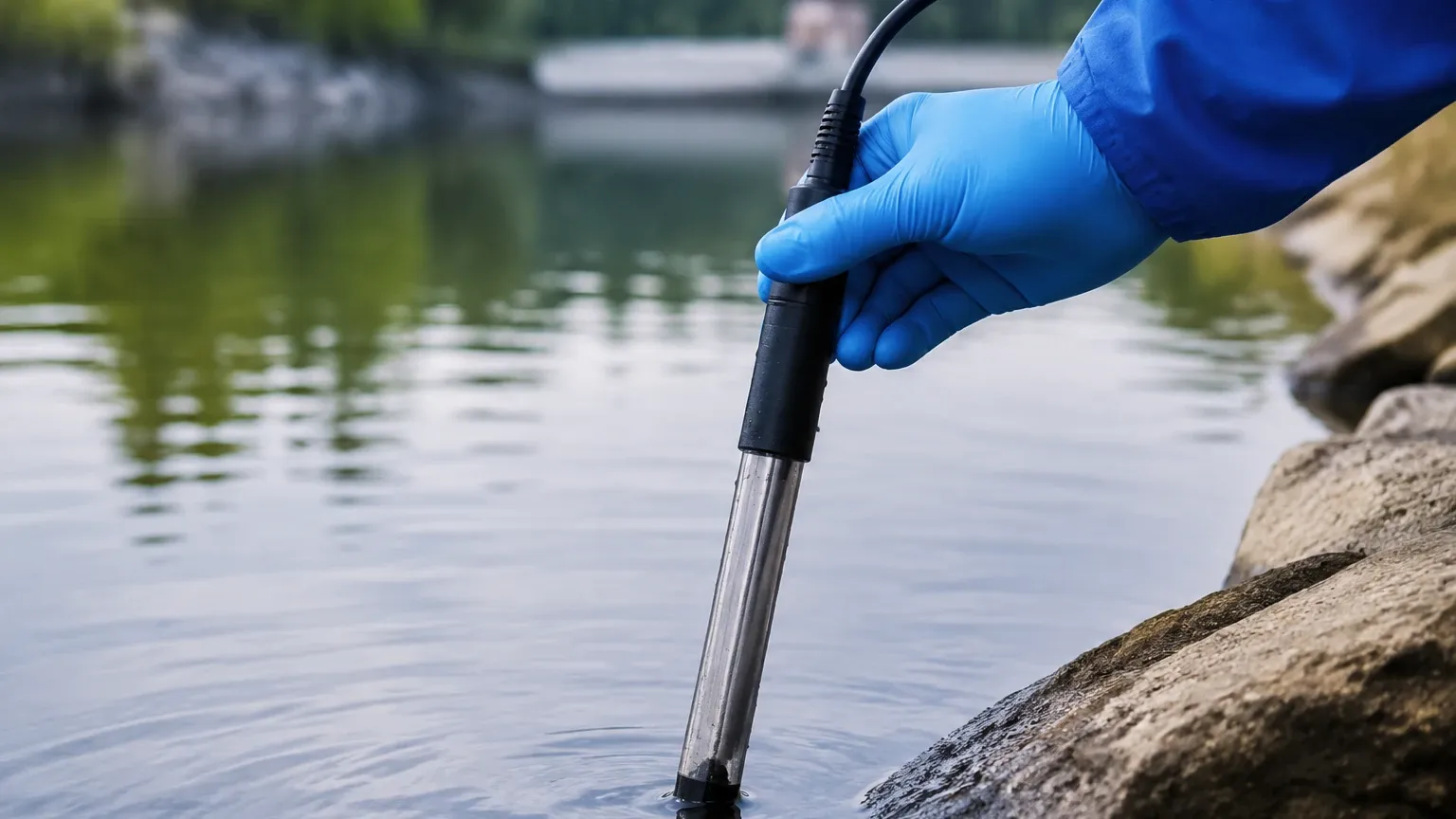
* Immersion Mounting: The probe is suspended in an open channel or tank via a mounting bracket or float. This is common in wastewater treatment.
* Flow-Through Cells: The water is pumped through a small chamber containing the probe. This allows for better control over the environment and is common in drinking water applications.
* Insertion Mounting: The probe is installed directly into a pressurized pipe via a ball valve or flange. This requires the probe to withstand the process pressure (often up to 6 bar or 87 psi).
Positioning and Flow
Probes should be positioned where there is consistent flow to prevent the buildup of solids on the sensor face. In aeration basins, the probe should be placed away from air diffusers to prevent air bubbles from interfering with the optical path or electrode surface. For UV probes, the optical window must be perpendicular to the flow to encourage a "self-cleaning" action, though mechanical wipers are often still necessary.
Limitations and Common Risks
Every nitrate probe has its "Achilles' heel." Identifying these risks early prevents costly downtime.
1. Biofouling: In nutrient-rich water, bacteria and algae will grow on the sensor surface. For ISE probes, this blocks ion exchange. For UV probes, it blocks the light. Most industrial-grade probes now include automatic cleaning systems, such as compressed air blasts or mechanical wipers.
2. Temperature Sensitivity: Chemical activity and optical properties change with temperature. High-quality probes include an integrated temperature sensor to provide automatic compensation.
3. Chemical Compatibility: The housing of the probe (often stainless steel 316L, PVC, or Titanium) must be compatible with the process fluid. In highly corrosive industrial effluents, specialized plastics or exotic metals may be required.
Integrating Nitrate Monitoring with Level Measurement
In a comprehensive industrial automation strategy, nutrient monitoring is rarely a standalone task. For instance, in a sequencing batch reactor (SBR), the nitrate probe tells the PLC when the denitrification phase is complete. Simultaneously, a radar level meter or ultrasonic sensor monitors the liquid level to control the decanting phase.
Welk provides a range of level measurement solutions that complement analytical instrumentation. By integrating level data with nitrate concentration data, operators can calculate the total mass load of nitrogen entering or leaving a facility, which is often a requirement for regulatory compliance. Effective level control ensures that the analytical probes remain submerged at the correct depth, preventing dry-run damage to sensitive ISE membranes.
Frequently Asked Questions (FAQs)
Q: How often should I calibrate my nitrate probe?
A: For ISE probes, weekly or bi-weekly calibration checks are recommended due to electrode drift. UV probes are much more stable and may only require a calibration check every 3 to 6 months, depending on the stability of the water matrix.
Q: Can a nitrate probe measure nitrite ($NO_2$)?
A: Standard nitrate ISE probes are designed specifically for $NO_3^-$. However, UV spectrophotometric probes can sometimes be configured to measure both nitrate and nitrite, as they have distinct absorption spectra, though this often requires more advanced multi-wavelength analysis.
Q: What is the maximum pressure a nitrate probe can handle?
A: Most immersion-style probes are designed for atmospheric pressure. However, specialized insertion probes can handle up to 6–10 bar (87–145 psi). Always check the manufacturer's specification before installing in a pressurized line.
Q: Does turbidity affect nitrate readings?
A: Yes. In ISE probes, extreme turbidity can coat the membrane. In UV probes, suspended solids scatter light, which the sensor might interpret as high nitrate. Using a probe with a secondary compensation wavelength (275 nm) is essential in turbid applications.
Q: How long do the sensors last?
A: The body of the probe can last many years. However, ISE membranes are consumables and typically last 6 to 18 months. UV lamps in optical probes are rated for thousands of flashes and generally last 3 to 5 years before requiring factory service.
Summary for Engineering Selection
Choosing a nitrate probe requires a balance between the required precision and the available maintenance budget. For critical process control where reliability is paramount and the budget allows, UV absorption probes are the industry standard due to their stability and reagent-free operation. For smaller facilities or temporary monitoring projects where lower upfront costs are necessary, ISE probes remain a functional choice, provided the staff is trained to perform regular calibration and membrane maintenance. Regardless of the technology chosen, ensuring the probe is integrated into a wider instrumentation network—including robust level measurement—is the key to successful industrial water management.