Paddle Level Switch
Paddle Level Switch
In the landscape of industrial automation and bulk solids management, the paddle level switch remains one of the most reliable and widely utilized instruments for point level detection. Designed specifically to monitor the presence or absence of dry bulk materials in silos, hoppers, and bins, these mechanical sensors provide a robust solution for preventing overfills and ensuring process continuity. This guide examines the mechanical principles, selection criteria, and installation best practices for paddle level switches in modern B2B industrial environments.
Measurement Principle of Paddle Level Switches
The operation of a paddle level switch is based on a simple yet effective electromechanical principle. At its core, the device consists of a low-speed synchronous motor, a mechanical linkage, and a rotating paddle (or vane) that extends into the process vessel.
The Rotation Cycle
When the bin or silo is empty, the motor drives the paddle to rotate freely at a slow speed, typically around 1 to 5 revolutions per minute (RPM). The motor is held in place by a tension spring. As long as there is no material obstructing the paddle, the rotation continues uninterrupted, indicating a "low" or "empty" state.
Torque and Switching
When the material level rises and reaches the paddle, the bulk solid exerts mechanical resistance against the rotating blades. This resistance creates torque that overcomes the tension of the internal spring. The motor then shifts slightly from its original position, which triggers one or two internal microswitches.
1. Signal Switch: The first switch changes the output state (e.g., from Normally Open to Normally Closed) to alert the control system (PLC or DCS) that the material has reached the set point.
2. Motor Switch: The second switch (in many designs) cuts the power to the motor itself. This prevents the motor from straining against the stalled paddle, significantly extending the service life of the internal components.
Once the material level drops and the paddle is no longer obstructed, the tension spring pulls the motor back to its operating position, the microswitches reset, and the motor restarts the rotation.
Key Components and Construction
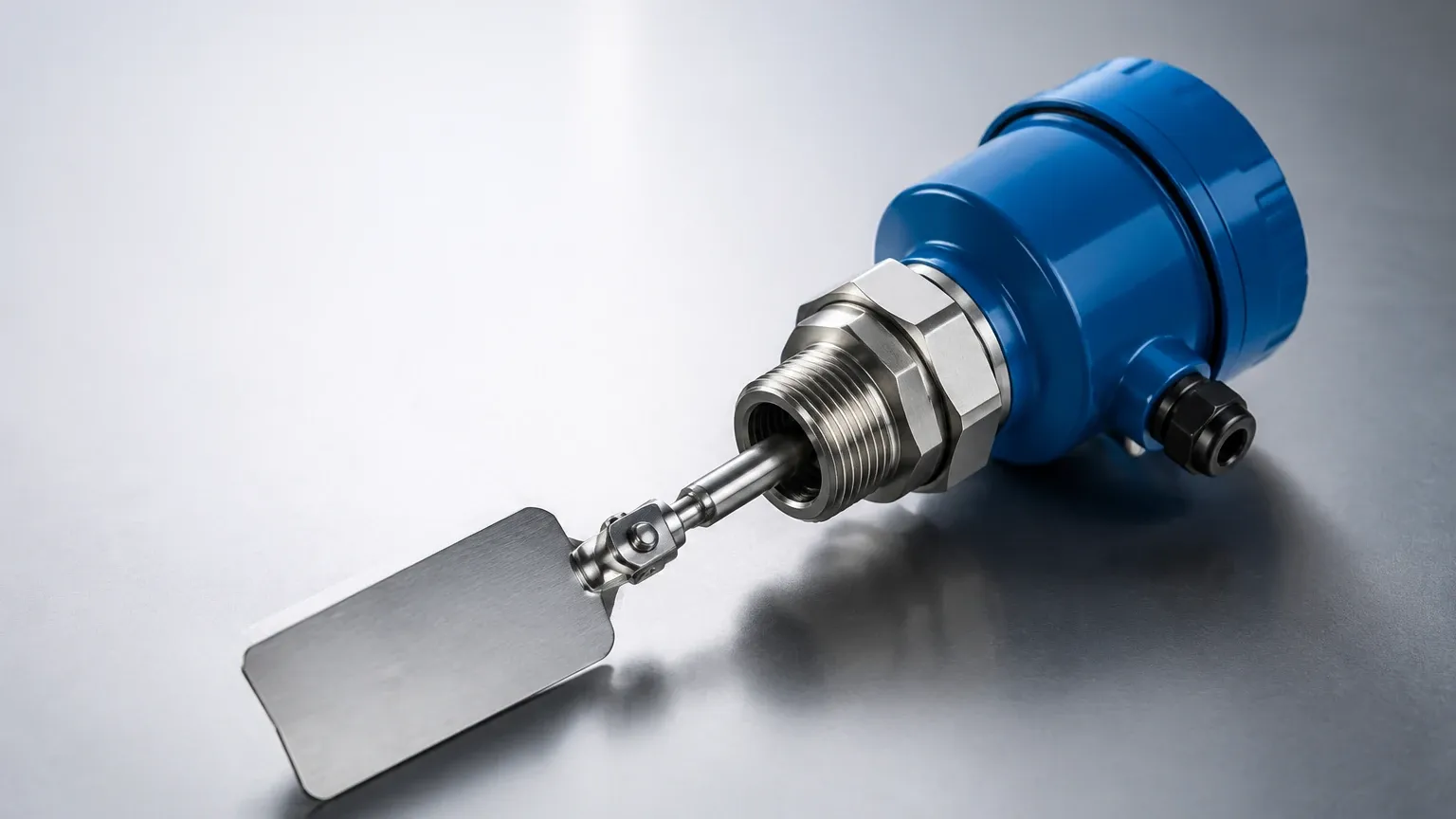
A professional-grade paddle level switch is engineered to withstand harsh industrial environments. The primary components include:
* Housing: Usually constructed from die-cast aluminum or reinforced polymer, rated for IP65 or IP66 to protect against dust and moisture ingress.
* Motor: A high-quality synchronous motor designed for continuous or intermittent operation.
* Shaft and Seals: The shaft connects the motor to the paddle. High-performance units utilize triple shaft seals or mechanical seals to prevent fine powders from migrating into the housing.
* The Paddle: Available in various shapes (scimitar, cross, or vane) and materials (typically 304 or 316 stainless steel) to suit different material densities.
* Process Connection: Threaded (e.g., G 1-1/2") or flanged connections allow for secure mounting to the vessel wall.
Technical Selection Criteria
Selecting the correct paddle level switch requires an understanding of the physical properties of the material being measured. The following table provides a general guideline for matching paddle types and settings to material characteristics.
Selection Reference Table
| Material Category | Typical Density (kg/m³) | Recommended Paddle Shape | Sensitivity Setting |
| :— | :— | :— | :— |
| Light Powders (e.g., fumed silica) | < 100 | Large Scimitar / Folding | High |
| Plastic Pellets / Resins | 400 – 700 | Standard Cross / Vane | Medium |
| Grains and Feeds | 600 – 800 | Standard Cross | Medium |
| Heavy Aggregates / Sand | > 1,200 | Heavy-duty Single Vane | Low |
| Cement / Fly Ash | 1,000 – 1,500 | Standard Vane | Medium-Low |
Factors to Confirm Before Purchase
1. Bulk Density: The material must be heavy enough to stop the paddle. For very light materials, a larger paddle surface area is required.
2. Process Temperature: Standard models typically handle up to 80°C (176°F). For high-temperature applications, such as hot fly ash, units with thermal decouplers or extended shafts can handle up to 250°C (482°F) or higher.
3. Pressure: Most paddle switches are designed for atmospheric pressure, but specialized versions can operate in vessels pressurized up to 10 bar (145 psi).
4. Insertion Length: Depending on whether the switch is used for high-level or low-level detection, shaft extensions (up to 3 meters or approximately 10 feet) may be necessary.
To explore specific configurations for your facility, you can Review product options and application support on our Main Page.
Industrial Applications
The versatility of the paddle level switch makes it a staple in several key industries:
* Agriculture and Food Processing: Monitoring grain elevators, flour silos, and animal feed hoppers. Stainless steel paddles are often used to meet food-grade requirements.
* Construction Materials: Detecting levels of cement, sand, gravel, and gypsum in batching plants.
* Chemical and Plastics: Managing plastic resin pellets, PVC powders, and various chemical additives.
* Mining and Minerals: Level control for crushed ores, coal, and mineral processing tailings.
* Water Treatment: Measuring the level of lime or activated carbon used in purification processes.
Installation Guidelines and Best Practices
Proper installation is critical to the longevity and accuracy of a paddle level switch. Engineers should consider the following factors during the design and installation phase:
Mounting Position
* Top Mounting: The switch is installed vertically through the roof of the silo. This is ideal for high-level alarms. For long shafts, a support bracket or flexible cable shaft may be required to prevent bending under material load.
* Side Mounting: The switch is installed horizontally through the side wall. This is common for both high and low-level detection. When side-mounting, the unit should be angled slightly downward (approx. 15–20 degrees) to allow material to shed off the paddle more easily.
Mechanical Protection
In silos where material falls from a significant height, the paddle and shaft can be damaged by the impact of the falling stream. A protective baffle or "shield" (typically an inverted V-shaped metal plate) should be installed approximately 150 mm to 200 mm (6 to 8 inches) above the paddle to deflect the direct impact of the material.
Wiring and Entry
Always ensure that the cable entries point downward to prevent moisture from traveling along the cable and into the housing. Use appropriate cable glands and create a "drip loop" in the wiring.
Limitations and Maintenance
While highly reliable, paddle level switches have specific limitations:
* Sticky Materials: Materials that exhibit high moisture content or adhesive properties can build up on the paddle, creating "false stalls" where the motor stops even if the silo is not full.
* Very Large Aggregates: Large rocks or heavy ores can physically bend the shaft if not properly shielded.
* Not for Liquids: These devices are strictly for solids. For liquid applications, ultrasonic or radar level meters are preferred.
Maintenance Checklist:
1. Monthly: Visually inspect the paddle for wear or material buildup.
2. Quarterly: Check the integrity of the shaft seal, especially in dusty environments like cement or flour production.
3. Annually: Verify the operation of the microswitches and the tension of the return spring.
Frequently Asked Questions (FAQs)
Q: Can I adjust the sensitivity of a paddle level switch?
A: Yes, most units feature an adjustable internal spring. By changing the spring's anchor point, you can increase or decrease the torque required to trigger the switch, allowing the device to accommodate materials of different densities.
Q: What is the benefit of a "folding paddle"?
A: A folding (or scimitar) paddle can be inserted through a small half-inch or one-inch mounting hole. Once inside the vessel, the paddle unfolds to provide a larger surface area, which is necessary for detecting lightweight materials.
Q: How do I know if the motor has failed?
A: Many high-end paddle level switches include a visual LED indicator on the housing. A green light typically indicates the motor is running, while a red light indicates a covered (stalled) state. If the paddle is not covered and the motor is not turning, the motor may need replacement.
Q: Are these switches suitable for explosive environments?
A: Yes, but you must specify an Explosion-Proof (Ex-d) or Intrinsically Safe (Ex-ia) version. These units feature specialized housings and components designed to prevent sparks from igniting combustible dusts (e.g., grain dust or coal dust).
Conclusion
The paddle level switch remains a foundational technology in the bulk solids industry due to its simplicity, low cost, and reliability. By understanding the specific torque requirements of your material and following proper installation protocols, you can ensure a long-lasting level control solution. For comprehensive technical specifications and to find the right model for your industrial application, visit the Main Page for a full range of measurement instruments.