Pressure Density Equation
Pressure Density Equation
In the field of industrial process control, the relationship between liquid level and pressure is a cornerstone of instrumentation design. For engineers and plant operators, understanding the pressure density equation is not merely a theoretical exercise but a practical necessity for ensuring the accuracy of hydrostatic level measurement. This principle allows for the conversion of a pressure reading at the base of a vessel into a precise height measurement, provided the physical properties of the medium are well-understood.
At Welk, we specialize in manufacturing high-precision level measurement instruments, including radar level meters, ultrasonic sensors, and hydrostatic transmitters. This guide explores the fundamental physics of the pressure density equation, its application in industrial settings, and the critical factors that influence its reliability in real-world environments.
The Fundamental Measurement Principle
Hydrostatic level measurement relies on the principle that the pressure at a specific point within a static liquid is proportional to the weight of the liquid column above it. This relationship is mathematically expressed through the pressure density equation.
The Equation Defined
The standard formula for hydrostatic pressure is:
P = ρ × g × h
Where:
* P is the hydrostatic pressure (measured in Pascals, Pa, or bar).
* ρ (rho) is the density of the liquid (measured in kg/m³).
* g is the acceleration due to gravity (approximately 9.81 m/s² on Earth).
* h is the height of the liquid column (measured in meters, m).
To determine the level (h) of a tank, the equation is rearranged as:
h = P / (ρ × g)
In industrial applications, if the density (ρ) and gravity (g) are constants, the pressure (P) becomes a direct linear indicator of the liquid level (h). This simplicity is why hydrostatic transmitters remain one of the most popular choices for water treatment, chemical storage, and oil and gas applications.
The Role of Specific Gravity
In many engineering contexts, density is often discussed in terms of Specific Gravity (SG). Specific gravity is the ratio of the density of a substance to the density of a reference substance, usually water at 4°C (which has a density of 1000 kg/m³).
If the SG of a fluid is known, the equation can be simplified for quick calculations. For instance, a column of water 10 meters high exerts approximately 1 bar of pressure. If the fluid has an SG of 1.2, that same 10-meter column will exert 1.2 bar of pressure. Understanding this variation is essential when calibrating sensors for different industrial fluids.
Factors Affecting the Pressure Density Equation
While the pressure density equation is straightforward in a laboratory setting, industrial environments introduce variables that can affect measurement accuracy. Engineers must account for these factors during the system design phase.
1. Temperature Fluctuations
Density is not a fixed value; it is highly dependent on temperature. As a liquid heats up, it typically expands, causing its density (ρ) to decrease. According to the equation h = P / (ρ × g), if the density decreases while the actual liquid level (h) remains the same, the pressure (P) will drop.
Without temperature compensation, a hydrostatic sensor might report a lower level than what is actually present in the tank. In high-precision applications, such as chemical processing, integrated temperature sensors are often used to dynamically adjust the density value in the control system.
2. Changes in Fluid Composition
In mixing tanks or processes where the chemical concentration varies, the density of the fluid may change over time. If a sensor is calibrated for water (ρ = 1000 kg/m³) but the process fluid changes to a saline solution or a slurry with a higher density, the level reading will be erroneously high. In such cases, technologies that are independent of density, such as radar level meters, may be more appropriate.
3. Atmospheric and Surface Pressure
The pressure density equation assumes that the pressure measured is only the result of the liquid column. However, in a closed tank, the air or gas space above the liquid (the ullage) may be pressurized.
* Vented (Open) Tanks: The sensor measures "gauge pressure," which naturally ignores atmospheric pressure because the sensor's reference side is also open to the atmosphere.
* Pressurized (Closed) Tanks: A differential pressure (DP) transmitter must be used. One side of the sensor measures the total pressure at the bottom, while the other side measures the gas pressure at the top. The transmitter subtracts the top pressure from the bottom pressure to isolate the hydrostatic pressure generated by the liquid alone.
Practical Selection and Technology Comparison
Choosing the right instrument requires balancing the physics of the pressure density equation with the physical constraints of the application. Below is a comparison of how different technologies interact with fluid properties.
Technology Selection Table
| Technology | Measurement Principle | Sensitivity to Density | Ideal Applications |
| :— | :— | :— | :— |
| Hydrostatic Transmitter | Pressure Density Equation | High | Water wells, deep tanks, constant-density fluids. |
| Radar Level Meter | Time of Flight (Microwaves) | None | Corrosive chemicals, high-temperature reactors, varying density. |
| Ultrasonic Sensor | Time of Flight (Sound) | None | Open channels, wastewater, non-contact requirements. |
| Magnetic Level Gauge | Buoyancy/Displacement | Moderate | Visual indication, high-pressure boilers. |
| Level Switch | Mechanical/Electrical | Low | Overfill protection, point level detection. |
For a comprehensive look at how these technologies can be integrated into your specific process, you can review product options and application support on our Main Page.
Installation and Calibration Considerations
To ensure the pressure density equation yields accurate results in the field, proper installation of hydrostatic sensors is paramount.
Sensor Positioning
Hydrostatic sensors should be installed at the lowest point of the measurement range. However, they should not be placed directly on the bottom of a tank where sediment, sludge, or scale can accumulate. Accumulation on the sensor diaphragm can interfere with pressure transmission and lead to drift. For submersible sensors in wells, a distance of 0.5 to 1 meter from the bottom is generally recommended.
Preventing Turbulence
In tanks with agitators or high-velocity inflow, the movement of the fluid can create dynamic pressure changes that the sensor may misinterpret as level changes. Using a stilling well—a vertical pipe that protects the sensor from turbulence—can stabilize the pressure reading and ensure the sensor only detects the static head of the liquid.
Venting Requirements
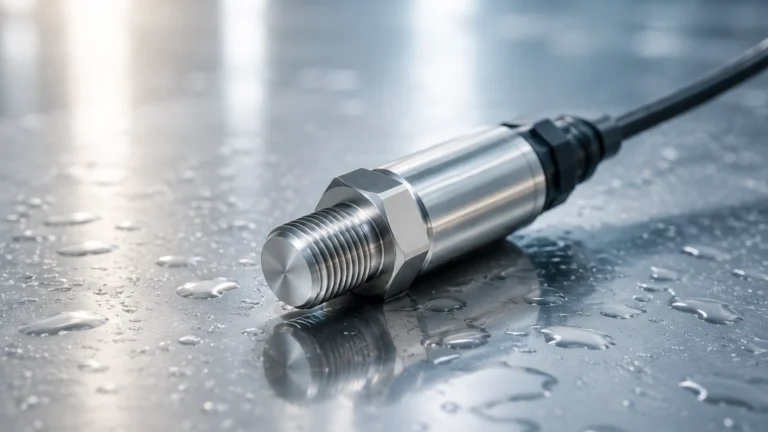
For submersible hydrostatic transmitters, the cable usually contains a small vent tube. This tube allows the sensor to compensate for changes in barometric pressure. It is vital to ensure this tube is not kinked, blocked, or exposed to moisture, as this would cause a measurement error equivalent to the atmospheric pressure change.

Limitations of Pressure-Based Measurement
While the pressure density equation is a reliable tool, it has inherent limitations in specific industrial scenarios:
1. Boiling Liquids: In applications where a liquid is at its boiling point, the density can become unstable due to gas bubbles within the liquid column. This effectively lowers the average density, leading to inaccurate hydrostatic readings.
2. Layered Liquids: If a tank contains two non-mixing liquids of different densities (e.g., oil and water), a single pressure sensor cannot determine the total level and the interface level simultaneously without additional data.
3. Vacuum Conditions: In vacuum distillation columns, the extremely low pressures require specialized differential pressure sensors with high sensitivity and chemical compatibility.
Frequently Asked Questions (FAQ)
Q: How do I calibrate a hydrostatic level sensor if I don't know the exact density?
A: The most accurate method is a "two-point calibration." Measure the pressure at a known low level and a known high level. The slope of the line between these two points will define the relationship between pressure and height for that specific fluid, effectively calculating the density for you.
Q: Can I use the pressure density equation for solids or powders?
A: Generally, no. Granular solids do not behave like fluids; they exert pressure unevenly and can "bridge" or "rathole" in a silo. For solids, radar or ultrasonic technologies are preferred.
Q: Does the shape of the tank affect the pressure reading?
A: No. The pressure at the bottom of a vessel depends only on the vertical height of the liquid, not the volume or the shape of the tank. A narrow pipe 10 meters high and a wide reservoir 10 meters deep will both exert the same hydrostatic pressure at the base.
Q: How often should density be re-verified in the equation?
A: This depends on the process. In water storage, density is stable and rarely needs re-verification. In chemical blending, density should be monitored continuously or sampled whenever the batch recipe changes.
Conclusion
The pressure density equation is an essential tool in the engineer's toolkit for liquid level measurement. By understanding the interplay between pressure, density, and gravity, industrial professionals can select the most appropriate instrumentation for their specific needs. While hydrostatic transmitters offer a cost-effective and reliable solution for many applications, understanding their dependence on density is key to maintaining system accuracy.
Whether you are managing a municipal water facility or a complex chemical refinery, Welk provides the technical expertise and high-quality instrumentation needed to master your level measurement challenges. For further technical specifications and to explore our full range of radar, ultrasonic, and hydrostatic solutions, please visit our Main Page.