Pressure Probe
Pressure Probe
In the landscape of industrial automation and process control, the pressure probe—specifically the hydrostatic level transmitter—remains one of the most reliable and widely utilized instruments for liquid level measurement. By leveraging the fundamental laws of physics, these devices provide a direct correlation between the pressure exerted by a liquid column and its height. For engineers and procurement specialists, understanding the nuances of pressure probe technology is essential for ensuring accuracy in applications ranging from municipal water treatment to complex chemical processing.
Fundamental Principles of Hydrostatic Level Measurement
The operation of a pressure probe is based on the principle of hydrostatic pressure. In a stationary liquid, the pressure at a specific depth is caused by the weight of the liquid column above it. This relationship is mathematically expressed by the formula:
P = ρ × g × h
Where:
* P is the hydrostatic pressure (typically measured in Pascals or bar).
* ρ (rho) is the density of the liquid (kg/m³).
* g is the acceleration due to gravity (approximately 9.81 m/s²).
* h is the height of the liquid column (meters).
Because gravity is constant and the density of many process liquids (such as water) remains relatively stable under controlled temperatures, the pressure measured by the probe is directly proportional to the level of the liquid. The pressure probe typically utilizes a flexible diaphragm connected to a sensing element (such as a piezoresistive or capacitive sensor). As the liquid level rises, the increasing pressure deflects the diaphragm, which the sensor converts into an electrical signal, usually 4-20mA or a digital protocol like HART or RS485.
Atmospheric Compensation
To ensure accuracy, a pressure probe must account for atmospheric pressure acting on the surface of the liquid. Most submersible probes utilize a "vented cable" design. This cable contains a small capillary tube that allows the internal side of the sensor diaphragm to be exposed to ambient atmospheric pressure. This effectively cancels out the atmospheric component, ensuring the sensor measures only the "gauge pressure" exerted by the liquid itself.
Key Components and Design of a Pressure Probe
An industrial-grade pressure probe is engineered to withstand harsh environments while maintaining high precision. The primary components include:
1. The Sensor Head: This housing contains the primary sensing element and the diaphragm. Common materials include 316L stainless steel for general use, or specialized materials like Tantalum or Hastelloy for corrosive media.
2. The Diaphragm: The interface between the liquid and the electronics. Ceramic diaphragms are often preferred for abrasive or sandy fluids due to their high hardness and resistance to wear, while metallic diaphragms offer excellent sensitivity for clean liquids.
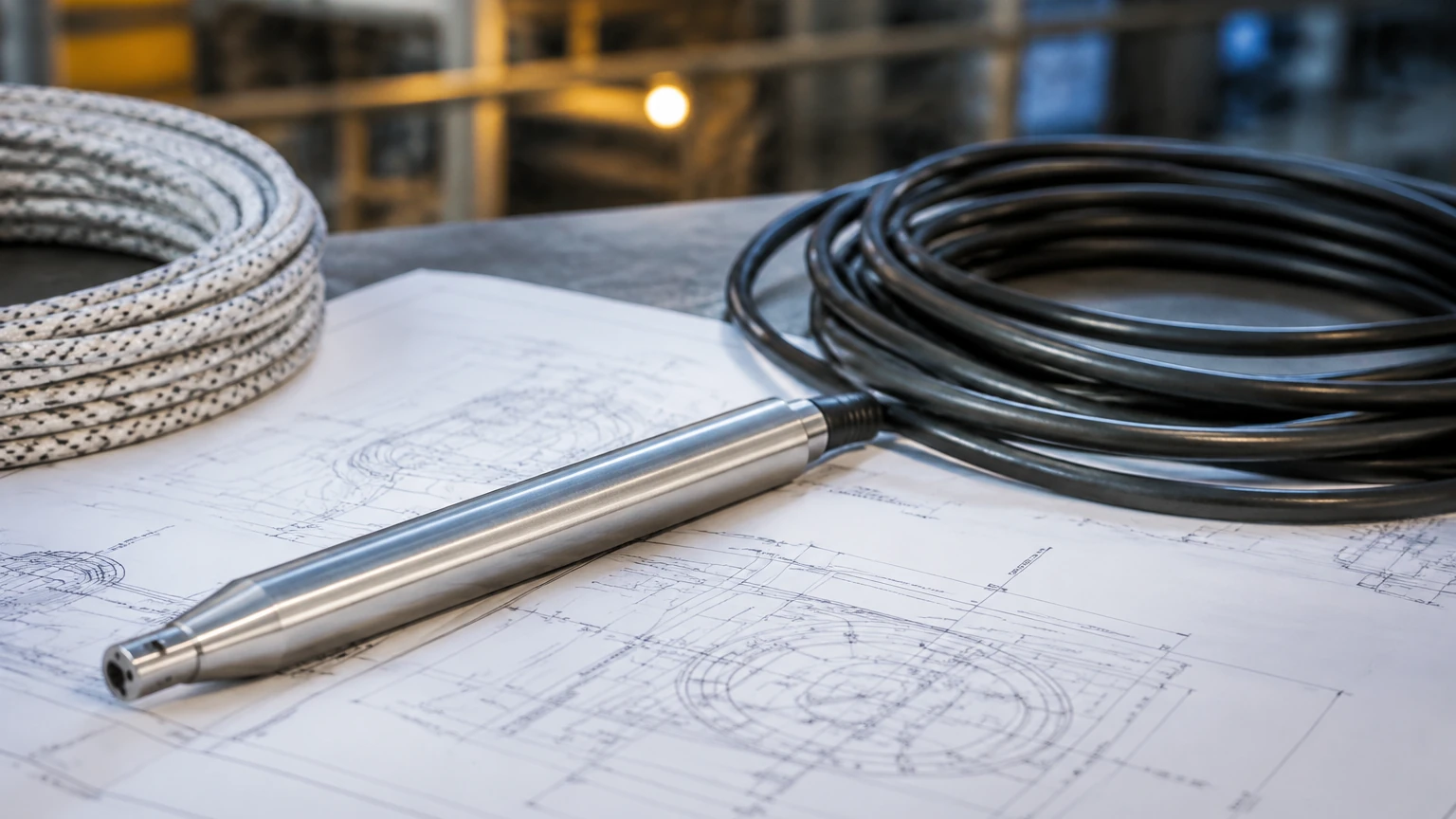
3. The Cable: For submersible applications, the cable provides both electrical connectivity and mechanical support. It is often reinforced with Kevlar to prevent stretching and sheathed in materials like PUR (Polyurethane), PE (Polyethylene), or FEP (Fluorinated Ethylene Propylene) depending on chemical compatibility.
4. Signal Processing Electronics: These convert the raw sensor output into a standardized industrial signal. Modern probes often include temperature compensation circuitry to correct for density changes caused by thermal fluctuations.
Selection Criteria for Industrial Applications
Choosing the correct pressure probe requires a detailed analysis of the process environment. Failure to account for chemical compatibility or pressure ranges can lead to premature sensor failure or inaccurate readings.
1. Measurement Range and Overpressure
The probe must be rated for the maximum depth of the tank or well. It is standard practice to select a sensor with a range slightly higher than the maximum expected level to avoid saturation. Furthermore, the "overpressure rating" is critical; this defines the maximum pressure the sensor can survive without permanent damage, which is vital in systems prone to pressure surges or water hammer.
2. Media Compatibility
The wetted materials (diaphragm, housing, and seals) must be chemically inert relative to the process fluid. For example:
* Water/Wastewater: 316L Stainless Steel with a PUR cable is standard.
* Strong Acids/Bases: PVDF or PTFE housings with FEP cables are required.
* Seawater: Titanium housings are often used to prevent chloride-induced pitting and galvanic corrosion.
3. Accuracy and Stability
Industrial applications typically require accuracy levels between 0.1% and 0.5% of the full scale. Long-term stability is also a factor, especially in remote locations where frequent recalibration is impractical.
4. Output Signal
While the 4-20mA analog signal is the industry standard for its noise immunity over long distances, many modern facilities are moving toward digital integration. Modbus RTU (RS485) allows for multiple probes to be networked on a single bus, reducing wiring costs and providing diagnostic data such as internal temperature and sensor health.
For a comprehensive overview of available technologies and detailed product specifications, engineers should consult the Main Page to review product options and application support.
Selection Table: Pressure Probe vs. Application
| Application Type | Recommended Housing | Diaphragm Material | Cable Material | Key Consideration |
| :— | :— | :— | :— | :— |
| Deep Groundwater Wells | Stainless Steel | Piezoresistive | PE/PUR | High tensile strength cable |
| Wastewater Treatment | Stainless Steel/PVC | Ceramic | PUR | Resistance to clogging/fats |
| Chemical Storage (Acid) | PVDF / Hastelloy | Tantalum / Ceramic | FEP | Chemical permeation resistance |
| Food & Beverage | 316L (Polished) | 316L (Flush) | Food-grade PE | Hygienic (CIP/SIP) compatibility |
| Fuel/Oil Tanks | Stainless Steel | Stainless Steel | FEP / Oil-resistant | Explosion-proof (ATEX/IECEx) |
Installation Best Practices and Considerations
Proper installation is as critical as sensor selection. Even the highest quality pressure probe will yield poor results if installed incorrectly.
Submersible Installation
When lowering a probe into a deep well or a large tank, the device should be suspended away from inflow pipes to avoid turbulence. In high-flow environments, a stilling well (a perforated pipe) should be used to protect the probe from mechanical stress and to dampen surface ripples. The cable should be secured with a proper cable clamp that supports the weight without pinching the internal vent tube.
Atmospheric Venting
The vented cable must terminate in a dry environment. If the vent tube is exposed to high humidity, moisture can condense inside, leading to sensor drift or internal short circuits. Most manufacturers provide a desiccant cartridge or a specialized bellows at the termination point to prevent moisture ingress while still allowing pressure equalization.
Tank Mounting
For non-submersible applications, the pressure probe is often mounted to the side of the tank via a flange or threaded connection. In these cases, the probe is located at the lowest point of the vessel (the "zero point"). If there is sediment or sludge at the bottom of the tank, the probe should be mounted slightly above the floor to prevent the diaphragm from being buried.
Limitations and Troubleshooting
While highly versatile, the pressure probe has specific limitations that engineers must manage:
* Density Sensitivity: Since the probe measures weight, any change in the liquid's density (caused by temperature changes or concentration shifts) will result in a level error. If the density is variable, a dual-sensor setup or integrated temperature compensation is necessary.
* Pressurized Vessels: A standard hydrostatic pressure probe cannot be used in a pressurized tank without a second sensor to measure the headspace pressure. In these scenarios, a differential pressure (DP) transmitter is typically used.
* Viscous and Clogging Media: In fluids with high solids content, such as thick sludge or paper pulp, the small pressure ports of a standard probe can clog. Flush-diaphragm designs are recommended here to ensure the sensing surface remains in contact with the media.
Common Troubleshooting Steps
* Erratic Readings: Often caused by moisture in the vent tube or electrical interference. Check the desiccant and ensure the cable shield is properly grounded.
* Fixed Output (e.g., 4mA or 20mA): This usually indicates a broken cable or a sensor that has been exposed to pressure far beyond its rated limit.
* Slow Response: This may indicate sediment buildup over the diaphragm, requiring careful cleaning with a soft cloth and non-corrosive solvent.
Comparison with Other Level Measurement Technologies
To provide a balanced engineering perspective, it is useful to compare the pressure probe with non-contact methods like Radar or Ultrasonic sensors.
| Feature | Pressure Probe (Hydrostatic) | Ultrasonic Level Sensor | Radar Level Meter |
| :— | :— | :— | :— |
| Cost | Low to Moderate | Moderate | Moderate to High |
| Contact | Contacting | Non-contact | Non-contact |
| Foam Influence | No effect | High interference | Minimal effect |
| Vapor/Dust | No effect | Significant interference | No effect |
| Installation | Simple (Submersible) | Requires clear LOS | Requires clear LOS |
| Accuracy | High (if density is constant) | Moderate | Very High |
Pressure probes excel in applications where foam, vapor, or internal tank obstructions make non-contact methods difficult. They are particularly favored for deep-well monitoring where mounting a radar unit at the top is impractical or cost-prohibitive.
Frequently Asked Questions (FAQ)
Q: Can a pressure probe be shortened in the field?
A: Standard electrical cables can be shortened, but for submersible pressure probes with vented cables, shortening requires specialized tools to ensure the vent tube is not blocked and the seal remains watertight. It is generally recommended to order the specific length required or use a junction box designed for vented cables.
Q: How often should a pressure probe be calibrated?
A: In stable environments like clean water storage, annual calibration is usually sufficient. In harsher chemical or wastewater applications, semi-annual checks are recommended to account for potential diaphragm scaling or drift.
Q: Is the pressure probe affected by the shape of the tank?
A: No. Hydrostatic pressure depends only on the height of the liquid column, not the volume or shape of the vessel. This makes it an excellent choice for irregularly shaped tanks or reservoirs.
Q: What is the maximum depth a pressure probe can measure?
A: Standard industrial probes can measure depths up to 200 meters (approx. 20 bar) or more. For extremely deep applications, such as deep-sea monitoring or ultra-deep boreholes, specialized high-pressure housings and reinforced cables are required.
For technical assistance in selecting the right instrumentation for your specific process, or to view detailed engineering drawings and data sheets, please visit the Main Page for professional-grade level measurement solutions.