Remote Water Tank Monitoring
Remote Water Tank Monitoring
In modern industrial operations, remote water tank monitoring has transitioned from a convenience to a critical operational necessity. Whether managing municipal water supplies, chemical storage in processing plants, or cooling towers in power generation, the ability to track liquid levels accurately and in real-time is essential for preventing overflows, ensuring supply continuity, and optimizing logistics. As a professional manufacturer, Welk provides a comprehensive suite of instruments designed to meet these diverse industrial needs through advanced sensing technologies.
Effective remote monitoring relies on the integration of high-precision level sensors with robust data transmission systems. This guide explores the engineering principles behind these technologies, selection criteria for different environments, and best practices for implementation in a B2B context.
Core Measurement Principles for Remote Monitoring
Before selecting a system for remote water tank monitoring, it is vital to understand the physics governing different measurement technologies. Each principle offers specific advantages depending on the physical properties of the liquid and the tank environment.
Radar Level Measurement (ToF)
Radar level meters utilize the Time of Flight (ToF) principle. The sensor emits high-frequency microwave pulses (typically in the 26GHz or 80GHz range) that travel at the speed of light. When these pulses hit the surface of the water, they are reflected back to the sensor. The distance is calculated based on the time interval between emission and reception.
* Non-contact: The sensor does not touch the liquid, reducing maintenance and wear.
* Accuracy: High-frequency 80GHz radar offers millimeter-level precision, even in the presence of steam or dust.
* Dielectric Constant: Radar performance depends on the reflectivity of the medium, though water (with a high dielectric constant) is an excellent reflective surface.
Ultrasonic Level Measurement
Ultrasonic sensors also use the ToF principle but utilize sound waves instead of electromagnetic waves. A piezoelectric transducer emits an ultrasonic pulse that reflects off the liquid surface. The sensor measures the time taken for the echo to return.
* Medium-Dependent: The speed of sound is affected by air temperature, requiring integrated temperature compensation for accuracy.
* Cost-Effective: Generally more affordable than radar for standard water applications.
* Limitations: Performance can be degraded by heavy foam, high pressure, or vacuum conditions, which attenuate sound waves.
Hydrostatic Pressure Measurement
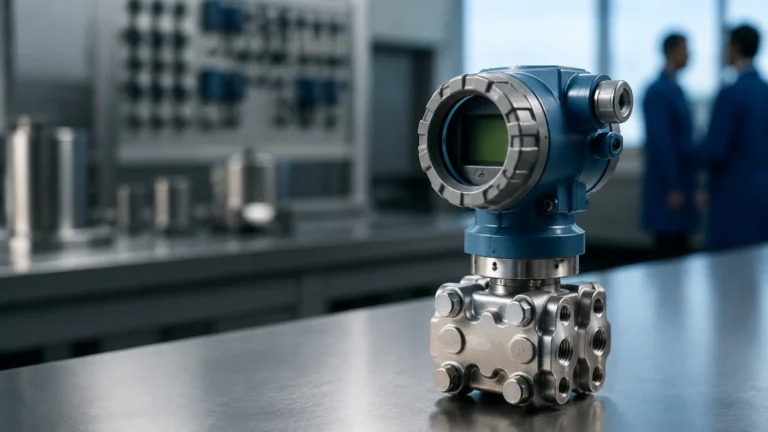
Hydrostatic transmitters are submersible or externally mounted sensors that measure the pressure exerted by the liquid column. The principle is based on the formula: $P = \rho \cdot g \cdot h$, where $P$ is pressure, $\rho$ is the liquid density, $g$ is gravity, and $h$ is the height of the liquid.
* Contact-based: The sensor is in direct contact with the water.
* Simplicity: Ideal for deep wells or vented tanks where surface turbulence might interfere with non-contact sensors.
* Density Sensitivity: Changes in liquid density (e.g., due to significant temperature shifts or chemical additives) will affect the level reading unless compensated.
Magnetic Level Gauges
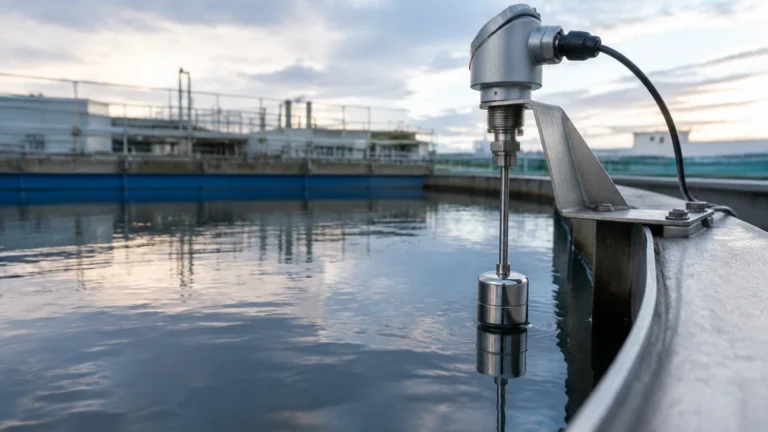
For applications requiring both local visual indication and remote transmission, magnetic level gauges are used. A float containing a permanent magnet moves with the liquid level inside a bypass chamber. This movement triggers external magnetic flaps for visual display and can be paired with a reed chain transmitter or magnetostrictive sensor for remote signal output.
Selecting the Right Sensor for Your Application
Choosing the correct technology for remote water tank monitoring depends on the tank geometry, the nature of the liquid, and the environmental conditions. The following table provides a comparison of common industrial solutions.
| Technology | Typical Range | Accuracy | Ideal Application | Limitations |
| :— | :— | :— | :— | :— |
| 80GHz Radar | 0.1m – 120m | ±1mm | Process tanks, agitated liquids | Higher initial cost |
| Ultrasonic | 0.3m – 20m | ±0.25% FS | Open channels, plastic tanks | Affected by foam and steam |
| Hydrostatic | 1m – 200m | ±0.5% FS | Deep wells, reservoirs | Sensitive to density changes |
| Magnetic Gauge | 0.5m – 6m | ±5mm | High-pressure boilers, chemical tanks | Mechanical wear over time |
For engineers evaluating these options, visiting the Main Page provides access to detailed technical datasheets and product configurations tailored to specific industrial requirements.
Remote Connectivity and Data Integration
The "remote" aspect of monitoring is achieved by converting the sensor's physical measurement into a digital or analog signal transmitted to a central control room or cloud platform. Common integration methods include:
1. 4-20mA Current Loop: The industry standard for wired transmission. It is highly resistant to electrical noise and can transmit signals over long distances (up to 1,000 meters) to a PLC or RTU.
2. Modbus RTU/RS485: A digital protocol allowing multiple sensors to be daisy-chained on a single cable, reducing wiring costs and providing more diagnostic data.
3. HART Protocol: Superimposes digital signals on the 4-20mA analog loop, allowing for remote configuration and advanced diagnostics of Welk instruments.
4. IoT and Wireless (NB-IoT/LoRaWAN): For remote water tank monitoring in geographically dispersed areas (like agricultural reservoirs or remote pump stations), wireless modules allow data to be sent directly to a cloud server via cellular or long-range radio networks.
Installation Guidelines for Reliable Data
Proper installation is as important as sensor selection. Even the most accurate radar or ultrasonic meter will fail if mounted incorrectly.
Mounting Position
* Avoid the Center: In cylindrical tanks, do not mount the sensor in the exact center, as this can lead to multiple reflections (parabolic effect) that confuse the signal processing.
* Clearance from Walls: Ensure the sensor is mounted at a distance from the tank wall (typically at least 200mm or 1/6th of the tank diameter) to avoid interference from wall welds or buildup.
* Obstruction Check: The signal beam (the "beam angle") must be clear of internal obstructions such as ladders, heating coils, or agitators. If obstructions are unavoidable, many Welk radar units feature "false echo suppression" to ignore these fixed objects.
Environmental Protection
* Stilling Wells: In tanks with high turbulence or surface foam, installing the sensor inside a stilling well (a vertical pipe) can provide a calm surface for more accurate measurement.
* Sun Shields: For outdoor remote monitoring, use a sun shield to prevent the sensor electronics from overheating and to minimize temperature-induced errors in ultrasonic transducers.
Dead Zones (Blocking Distance)
Every non-contact sensor has a "dead zone" directly beneath the transducer where measurement is impossible. For ultrasonic sensors, this might be 0.25m to 0.5m; for high-frequency radar, it is significantly smaller. Ensure the maximum expected water level does not enter this zone.

Technical Limitations and Operational Challenges
While modern instrumentation is highly robust, certain factors can challenge the reliability of remote water tank monitoring:
* Condensation: In closed water tanks, humidity can lead to condensation on the sensor face. While radar can typically see through thin films of moisture, heavy droplets can attenuate ultrasonic signals. Welk offers sensors with PTFE-enclosed antennas to shed moisture effectively.
* Foam: Heavy, thick foam absorbs ultrasonic waves and can scatter radar signals. In these instances, hydrostatic pressure sensors or magnetic level gauges are often more reliable as they measure the liquid mass or use a float that penetrates the foam.
* Signal Interference: In large-scale industrial sites, electromagnetic interference (EMI) from high-power motors can affect signal integrity. Using shielded twisted-pair cables and ensuring proper grounding is essential for wired 4-20mA or Modbus systems.
Frequently Asked Questions (FAQ)
Q: How often do remote level sensors need calibration?
A: Most digital radar and ultrasonic sensors are factory-calibrated and do not drift significantly. However, for regulatory compliance or high-precision applications, an annual verification against a manual dip-tape measurement is recommended. Hydrostatic sensors may require more frequent zero-point checks if the liquid density changes.
Q: Can one system monitor multiple tanks?
A: Yes. Using a multi-channel controller or a Modbus network, data from multiple tanks can be aggregated into a single gateway for remote viewing. This is a common setup for chemical tank farms.
Q: What is the maximum distance for remote monitoring?
A: With IoT and cellular-enabled sensors, there is effectively no limit to the distance. Data can be transmitted from a remote reservoir to a headquarters thousands of kilometers away via satellite or cellular networks.
Q: How does 80GHz radar differ from older 26GHz models?
A: 80GHz radar has a much narrower beam angle (as small as 3 degrees). This allows it to be used in narrow tanks or tanks with many internal obstructions without picking up false reflections from the walls or pipes.
Conclusion
Implementing a remote water tank monitoring system requires a balance of selecting the right physical measurement principle and the appropriate communication infrastructure. By understanding the strengths of radar, ultrasonic, and hydrostatic technologies, industrial operators can ensure long-term reliability and accuracy. For customized OEM/ODM services or to find a cost-effective solution for your specific application, consulting with a specialized manufacturer like Welk ensures that the hardware meets the rigorous demands of industrial automation. Detailed product options and technical support are available through the Main Page, providing the necessary foundation for any professional level measurement project.