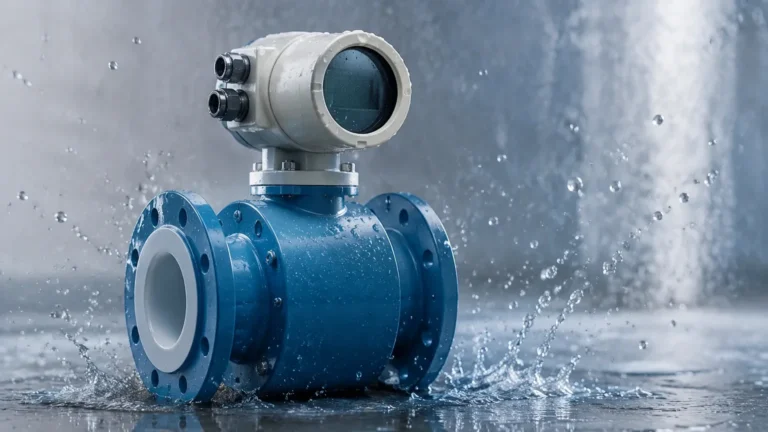
Rust Automation
Rust Automation
In the modern industrial landscape, the term "rust automation" has evolved into a dual-concept. On one hand, it represents the physical challenge of managing automation equipment in corrosive, high-moisture environments where oxidation (rust) is a constant threat to infrastructure. On the other hand, it refers to the burgeoning movement of using the Rust programming language to build safer, more reliable automation software for industrial Internet of Things (IIoT) and sensor networks.
For process engineers and system integrators, navigating both the physical and digital aspects of automation is essential. Achieving reliable level measurement in environments prone to corrosion requires a deep understanding of sensor physics, material science, and robust software architectures. This guide explores the principles of level measurement, the selection of hardware for corrosive service, and how modern software practices are transforming industrial control systems.
Principles of Level Measurement in Industrial Automation
Before selecting a solution for a rust-prone or automated environment, it is critical to understand the underlying measurement principles. Level measurement technologies are generally categorized into non-contact and contact methods, each with specific advantages in automated workflows.
Radar Level Measurement
Radar level meters utilize high-frequency electromagnetic waves, typically in the 26GHz or 80GHz range. The instrument emits a pulse that travels to the surface of the medium and reflects back to the sensor. The time-of-flight (ToF) is measured to calculate the distance.
In the context of automation, radar is highly valued because it is non-contact. Since the sensor does not touch the liquid, it is less susceptible to chemical corrosion or the buildup of rust particles. 80GHz radar, in particular, offers a narrow beam angle (as small as 3 degrees), which allows it to avoid internal tank obstructions like agitators or rusted support beams that might cause false echoes in lower-frequency systems.
Ultrasonic Level Measurement
Ultrasonic sensors function similarly to radar but use sound waves instead of electromagnetic pulses. The sensor transmits an ultrasonic pulse that reflects off the surface of the material. The duration of the return trip determines the level.
Ultrasonic sensors are cost-effective for water treatment and simple chemical storage. However, they are sensitive to air temperature, pressure changes, and heavy vapors. In automated systems, temperature compensation is required to maintain accuracy. From a physical "rust" perspective, ultrasonic transducers are often housed in plastic (PVDF or UPVC), making them naturally resistant to oxidation.
Hydrostatic Level Measurement
Hydrostatic transmitters measure the pressure exerted by a liquid column at a specific point. The relationship is defined by the formula $P = \rho gh$, where $P$ is pressure, $\rho$ is the density of the liquid, $g$ is gravity, and $h$ is the height of the liquid.
These sensors are often submerged (submersible type) or mounted to the side of a tank (flange type). Because they are in constant contact with the medium, the choice of diaphragm material—such as 316L stainless steel, tantalum, or ceramic—is vital to prevent corrosion and ensure long-term automation stability.
The Role of the Rust Programming Language in Automation
As industrial systems move toward Industry 4.0, the software driving the hardware has become as important as the sensors themselves. The "Rust Automation" movement involves the use of the Rust programming language to develop firmware for PLCs (Programmable Logic Controllers), gateways, and edge computing devices.
Memory Safety and Reliability
Traditional automation software often relies on C or C++, which are prone to memory leaks and buffer overflows. In a B2B industrial setting, a software crash can lead to tank overfills or system shutdowns. Rust provides memory safety without a garbage collector, ensuring that the software governing level switches and transmitters remains stable over years of continuous operation.
Concurrency in Sensor Networks
Modern automation requires handling multiple data streams simultaneously—reading Modbus data from a radar meter, processing Hart signals from a pressure transmitter, and uploading data via MQTT to the cloud. Rust’s "fearless concurrency" allows developers to write code that handles these tasks in parallel without the risk of data races, making it an ideal choice for high-performance industrial gateways.
Selecting Level Meters for Corrosive and Automated Environments
When designing a system for "rust automation," the hardware must be selected based on its ability to withstand the environment while providing the digital output necessary for automated control. For high-quality industrial instruments, engineers often consult the Main Page of specialized manufacturers to compare technical specifications.
Material Compatibility
In environments where rust is a primary concern (such as brine tanks, wastewater facilities, or chemical processing), the wetted parts of the sensor must be inert.
- 316L Stainless Steel: Standard for mild corrosion resistance.
- PTFE/PFV Coating: Essential for strong acids or bases that would quickly degrade standard metals.
- Ceramic Diaphragms: Highly resistant to abrasion and chemical attack in hydrostatic applications.
Signal Output and Integration
Automation requires seamless communication between the field instrument and the control room. Most modern level meters provide:
- 4-20mA with HART: The industry standard for transmitting analog signals with superimposed digital data.
- RS485/Modbus RTU: Ideal for daisy-chaining multiple sensors to a single PLC or Rust-based gateway.
- Profibus/Foundation Fieldbus: Used in complex plant-wide automation architectures.
Practical Selection Table for Level Measurement
| Technology | Best For | Rust/Corrosion Resistance | Automation Integration | Max Range |
| :— | :— | :— | :— | :— |
| 80GHz Radar | Precise chemical/oil measurement | Excellent (Non-contact/PTFE) | High (HART/Modbus) | Up to 120m |
| Ultrasonic | Water treatment/Open channels | Good (Plastic housings) | Moderate (4-20mA) | Up to 30m |
| Hydrostatic | Deep wells/Vented tanks | Variable (Depends on Diaphragm) | High (Analog/Digital) | Up to 500m |
| Magnetic Gauge | High-pressure boilers | Moderate (Stainless Steel) | Moderate (Via Transmitters) | Custom |

Installation Considerations for Corrosive Service
Proper installation is the bridge between a high-quality instrument and a functional automated system. In rust-prone environments, physical installation must account for both the sensor's performance and its protection.
1. Avoiding Obstructions: In tanks with rusted internal supports, radar sensors should be positioned to avoid "false echoes." Using a mapping function in the software can help the system "learn" to ignore these static reflections.
2. Standoff Pipes and Nozzles: If a nozzle is used to mount a radar or ultrasonic sensor, the height of the nozzle should not interfere with the signal beam. For 80GHz radar, shorter nozzles are preferred to minimize signal loss.
3. Cable Protection: Often, the sensor survives the environment, but the cabling fails due to corrosion. Use PVC or stainless steel conduits and ensure cable glands are tightened to IP67 or IP68 standards to prevent moisture ingress.
4. Venting: For hydrostatic sensors in vented tanks, ensure the breather tube in the cable is protected by a desiccant filter to prevent internal moisture buildup, which can lead to sensor drift and eventual failure.
Limitations and Maintenance in Rust-Prone Applications
While automation reduces the need for manual intervention, it does not eliminate the need for maintenance.
- Build-up and Scaling: In wastewater or chemical applications, material can build up on the sensor face. While radar can penetrate some buildup, excessive crusting will eventually attenuate the signal. Automated systems should include "signal strength" monitoring to alert operators when a sensor needs cleaning.
- Atmospheric Effects: Ultrasonic sensors are limited by heavy foam or vacuum conditions. In these instances, radar is the superior choice for automation.
- Sacrificial Anodes: In massive metal tank structures, the use of sacrificial anodes can help reduce the rate of rust, protecting both the tank and the mounted level instrumentation.
Frequently Asked Questions (FAQs)
Q: Can Rust-based software directly control Welk level meters?
A: Yes. If the level meter supports Modbus RTU or TCP, a Rust-based automation controller can read the registers directly, providing high-speed, memory-safe data acquisition.
Q: Is radar always better than ultrasonic for corrosive environments?
A: Generally, yes. Radar is less affected by the vapors and gases often present in corrosive chemical tanks. However, for simple water-based applications where rust is the only concern, ultrasonic sensors with plastic transducers are a cost-effective alternative.
Q: How do I handle rust particles affecting hydrostatic sensors?
A: Use a flush diaphragm or a ceramic sensor. Traditional small-bore pressure ports can become clogged with rust flakes or sediment. A flush design prevents this accumulation.
Q: What is the benefit of 80GHz over 26GHz in automated tanks?
A: The primary benefit is the focus. A tighter beam allows the sensor to be installed in smaller nozzles and closer to tank walls without picking up interference from rust or structural ribs, leading to more reliable automated data.
By integrating robust hardware designed for corrosive service with modern software practices like Rust-based automation, industrial facilities can achieve unprecedented levels of reliability and safety. Choosing the right measurement principle and material is the first step toward a maintenance-free level control system.