Side Mounted Level Switch
Side Mounted Level Switch
In the landscape of industrial process control, the side mounted level switch serves as a critical component for point-level detection. Unlike continuous level transmitters that provide a constant stream of data regarding the volume or height of a medium, a level switch is designed to trigger a specific action—such as starting a pump, opening a valve, or sounding an alarm—when the material reaches a predetermined height.
For engineers and procurement specialists, selecting the correct side mounted level switch requires a deep understanding of the underlying measurement principles, the physical properties of the media, and the mechanical constraints of the vessel. This guide provides a technical overview of these instruments to assist in the selection and implementation of reliable level control solutions.
Measurement Principles of Side Mounted Level Switches
Before selecting a device, it is essential to understand how different technologies detect the presence of a liquid or solid. Side-mounted units are typically installed through the wall of a tank or vessel, meaning they interact directly with the process environment at a specific horizontal plane.
1. Magnetic Float Principle
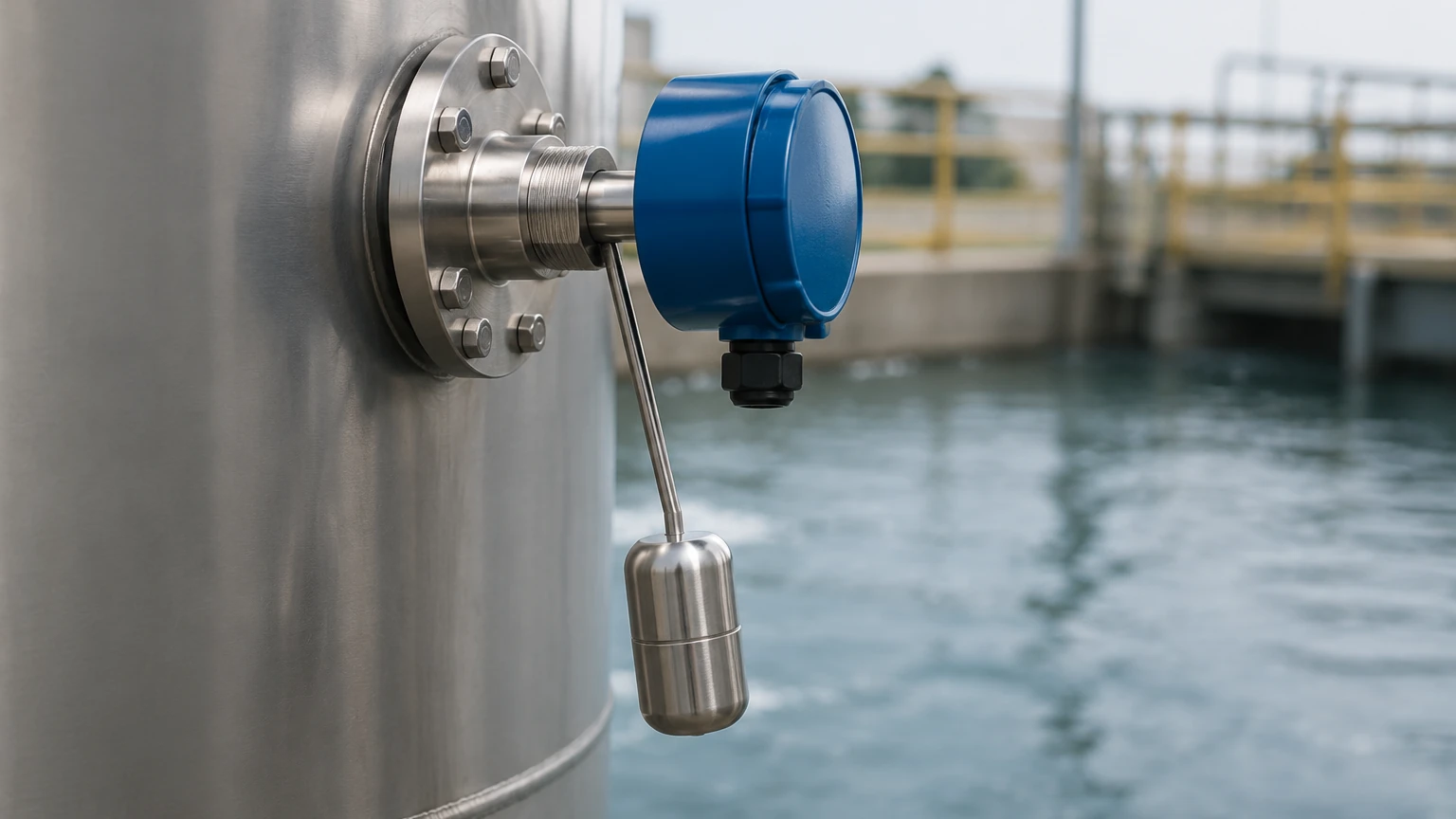
The most common form of side-mounted detection is the magnetic float switch. This operates on the principle of buoyancy (Archimedes' Principle). A float containing an internal magnet is attached to a hinged lever or a sliding mechanism. As the liquid level rises, the float moves upward. When it reaches the horizontal position, the internal magnet actuates a reed switch or a microswitch located within the housing (isolated from the process).
* Advantages: Simple, requires no power to operate the switch contact, and is highly cost-effective.
* Limitations: Susceptible to mechanical jamming if the liquid contains debris or high viscosity.
2. Vibrating Tuning Fork Principle
Vibrating level switches utilize piezoelectric crystals to vibrate a metal fork at its natural resonance frequency (typically around 1200 Hz to 1400 Hz). When the fork is submerged in a liquid or covered by a solid, the frequency of vibration shifts or the amplitude is dampened. An internal electronic circuit detects this change and converts it into a switching signal.
* Advantages: Not affected by bubbles, turbulence, or small amounts of coating on the forks. Highly reliable for both liquids and fine-grained solids.
* Limitations: Generally more expensive than basic float switches and requires an external power supply.
3. Capacitance Principle
Capacitance switches measure the change in electrical capacitance between the sensing probe and the tank wall (or a reference electrode). Every material has a dielectric constant. When the air around the probe is replaced by the process medium, the capacitance increases. Once this change crosses a calibrated threshold, the switch changes state.
* Advantages: No moving parts; suitable for high-temperature and high-pressure applications.
* Limitations: Can be sensitive to material build-up on the probe, requiring "active shield" technology to ignore coatings.
Technical Selection Criteria
Choosing the right side mounted level switch involves balancing the physical requirements of the application with the performance characteristics of the sensor. For a broader look at various measurement technologies, you can visit the Main Page of our industrial instrument catalog.
Media Characteristics
* Density (Specific Gravity): For float switches, the float must be less dense than the liquid. Most standard floats require a minimum density of 0.7 g/cm³ (700 kg/m³).
* Viscosity: High-viscosity liquids can impede the movement of mechanical floats. In such cases, tuning forks or non-contact sensors are preferred.
* Chemical Compatibility: The wetted parts (the parts touching the liquid) must resist corrosion. Common materials include 316L Stainless Steel, Polypropylene (PP), and PTFE (Teflon).
Process Conditions
* Pressure: Standard plastic switches may only handle 1–2 bar (14–29 psi), while heavy-duty stainless steel flanged units can withstand up to 40 bar (580 psi) or more.
* Temperature: High-temperature applications (above 120°C) often require specialized cooling fins or high-temp electronic components to prevent damage to the switch housing.
Selection Table: Technology Comparison
| Feature | Magnetic Float | Vibrating Tuning Fork | Capacitance |
| :— | :— | :— | :— |
| Moving Parts | Yes | No (Micro-vibration) | No |
| Media Type | Clean Liquids | Liquids & Powders | Liquids & Solids |
| Build-up Sensitivity| High | Low | Medium/High |
| Max Temperature | Up to 200°C | Up to 150°C | Up to 250°C+ |
| Max Pressure | Up to 40 bar | Up to 64 bar | Up to 100 bar |
| Power Required | No (Passive) | Yes | Yes |
Installation Considerations
Proper installation is the most significant factor in ensuring the longevity of a side mounted level switch. Because these units penetrate the side of the vessel, the seal and orientation are paramount.
1. Mounting Position: Ensure the switch is not placed directly under a fill stream. The force of falling liquid can damage floats or cause false triggers in tuning forks. If placement under an inlet is unavoidable, a protective baffle should be installed.
2. Orientation: Most side-mounted float switches must be installed perfectly horizontal to ensure the hinge operates correctly. A deviation of even 5 degrees can lead to increased friction and eventual failure.
3. Nozzle Length: For tuning fork switches, ensure the "dead length" of the nozzle does not allow material to bridge or pack inside the pipe, which would prevent the fork from vibrating freely.
4. Wiring and Sealing: Always use the correct cable glands to maintain the IP65 or IP67 rating of the enclosure. In outdoor installations, a "drip loop" in the conduit should be used to prevent moisture from traveling down the cable and into the switch housing.
Potential Risks and Limitations
While side-mounted switches are robust, they are not universal solutions. Engineers should be aware of the following risks:
* Mechanical Fatigue: In applications with high vibration (such as near large pumps), mechanical float arms can suffer from metal fatigue over time. Tuning forks are generally more resistant to external vibration.
* Coating and Scaling: In wastewater or chemical mixing tanks, material can build up on the sensor. If a float becomes too heavy due to scaling, it will fail to rise. If a tuning fork is completely encased in a hard shell of dried material, it will signal a "full" state regardless of the actual level.
* Turbulence: Rapidly swirling or sloshing liquids can cause "chatter" in the switch contacts. This can be mitigated by using switches with a built-in time delay (e.g., 1–3 seconds) or by installing the switch inside a stilling well.
Frequently Asked Questions (FAQ)
Q: Can a side mounted level switch be used for both high and low-level alarms?
A: Yes, but they are typically dedicated to one point. To have both a high and a low alarm, you would usually install two separate switches at different heights on the side of the tank. Some float switches can be inverted (flipped 180°) to change the contact logic from Normally Open (NO) to Normally Closed (NC).
Q: What is the difference between SPDT and DPDT contacts in these switches?
A: SPDT (Single Pole Double Throw) allows you to control one circuit (e.g., a light OR a pump). DPDT (Double Pole Double Throw) essentially acts as two separate switches triggered at the same time, allowing you to control two independent circuits (e.g., a PLC input AND a local emergency siren) simultaneously.
Q: Are these switches suitable for hazardous (Explosive) areas?
A: Many side-mounted switches are available with ATEX, IECEx, or UL explosion-proof certifications. For these environments, the switch housing is designed to contain any internal spark, or the device is designed to operate as "Intrinsically Safe" when used with a safety barrier.
Q: How do I maintain a side-mounted switch?
A: Maintenance involves periodic functional tests (manually lifting the float or dampening the fork) and checking the wetted parts for corrosion or build-up. In clean liquid applications, these devices can often operate for several years without intervention.
Conclusion
The side mounted level switch remains a staple of industrial automation due to its reliability and straightforward integration. Whether utilizing the mechanical simplicity of a float or the advanced electronics of a vibrating fork, these instruments provide the essential "eyes" for tank safety and process efficiency. When specifying a switch, always prioritize the chemical compatibility of the materials and the physical dynamics of the tank environment to ensure long-term operational success.
For more detailed specifications on radar, ultrasonic, and hydrostatic measurement technologies that complement point-level switching, please Review product options and application support to find the optimal configuration for your specific industrial requirements.