Streamline Distributors
Streamline Distributors
In the complex landscape of industrial automation, the role of streamline distributors is pivotal in bridging the gap between advanced manufacturing and end-user application. For industries ranging from water treatment to chemical processing, the efficiency of the supply chain depends on the distributor's ability to provide not just hardware, but integrated technical expertise and reliable logistics. Level measurement instruments, including radar, ultrasonic, and hydrostatic sensors, require a high degree of precision and application-specific configuration. By partnering with professional manufacturers like Welk, streamline distributors can optimize their inventory, reduce technical support overhead, and ensure that end-users receive the most cost-effective and accurate solutions for their specific process environments.
To effectively serve the market, it is essential to understand the underlying physics of level measurement. This knowledge allows distributors to guide customers toward the correct technology, minimizing returns and installation failures. For a detailed look at the full range of industrial sensors, professionals can visit the Main Page to review product options and application support.
Fundamental Measurement Principles and Technologies
Selecting the right level meter begins with an understanding of how different sensors interact with the media and the environment. There is no "one-size-fits-all" solution; rather, each technology offers specific advantages based on the physical properties of the substance being measured.
Radar Level Measurement (ToF and FMCW)
Radar level meters operate on the principle of electromagnetic wave propagation. There are two primary methods: Time of Flight (ToF) and Frequency Modulated Continuous Wave (FMCW).
In ToF systems, the sensor emits a short microwave pulse that travels at the speed of light, reflects off the surface of the medium, and returns to the receiver. The distance is calculated based on the time interval. FMCW radar, often operating at higher frequencies like 80GHz, emits a continuous signal with a varying frequency. The distance is determined by the frequency difference between the transmitted and received signals. High-frequency radar is particularly effective for streamline distributors to recommend because its narrow beam angle minimizes interference from tank internals like agitators or ladders.
Ultrasonic Level Sensors
Ultrasonic sensors utilize sound waves rather than electromagnetic waves. The transducer emits a pulse of ultrasonic sound (typically between 20 kHz and 200 kHz), which reflects off the liquid or solid surface. The sensor measures the time taken for the echo to return. Because sound speed is affected by air temperature, these sensors usually include an internal temperature probe to compensate for variations. This technology is non-contact and highly cost-effective for standard water and wastewater applications, though it is sensitive to foam, heavy vapors, and vacuum conditions.
Hydrostatic Level Transmitters
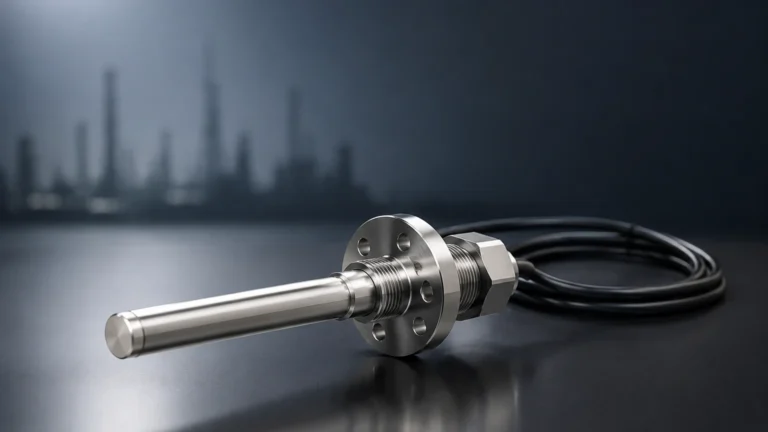
Hydrostatic measurement is a contact-based method that relies on the relationship between liquid height and pressure. The pressure at the bottom of a vessel is proportional to the liquid's density and the height of the liquid column (P = ρgh). A submersible pressure transducer or a flange-mounted transmitter measures this head pressure. This method is exceptionally reliable for vented tanks and deep wells, provided the liquid density remains relatively constant.
Magnetic Level Gauges
Magnetic level gauges provide a visual indication and can be paired with reed switches or transmitters for remote monitoring. They operate on the principle of buoyancy and magnetic coupling. A float containing a permanent magnet moves with the liquid level inside a bypass chamber. Outside the chamber, a series of magnetic flaps or a follower indicates the level. This is a robust, mechanical solution ideal for high-pressure or high-temperature applications where electronic components might be at risk.
Technical Criteria for Selecting Level Instruments
For streamline distributors, the goal is to provide a solution that balances performance with total cost of ownership. The following table provides a technical comparison to assist in the selection process:
| Technology | Accuracy | Typical Range | Temperature Range | Pressure Range | Common Media |
| :— | :— | :— | :— | :— | :— |
| 80GHz Radar | ±2 mm | Up to 120m (393 ft) | -40°C to +200°C | Vacuum to 40 bar | Corrosives, Solids, Liquids |
| Ultrasonic | ±0.25% of range | 0.3m to 15m (49 ft) | -40°C to +80°C | Atmospheric | Water, Wastewater, Slurries |
| Hydrostatic | ±0.1% to 0.5% | 1m to 200m (656 ft) | -20°C to +80°C | Depth dependent | Oils, Water, Chemicals |
| Magnetic Gauge | ±5 mm to 10 mm | 0.5m to 6m (20 ft) | Up to +400°C | Up to 160 bar | Acids, Fuels, High-temp liquids |
When evaluating these options, streamline distributors should confirm the dielectric constant (DK) of the medium for radar applications, the presence of foam for ultrasonic applications, and the specific gravity for hydrostatic and magnetic solutions.
Installation Considerations and Best Practices
Correct installation is as critical as selecting the right technology. Even the most advanced radar level meter will fail if placed incorrectly. Streamline distributors should provide the following guidance to their engineering clients:
1. Nozzle Positioning: For radar and ultrasonic sensors, the sensor should not be mounted in the center of a tank (to avoid multiple reflections) or too close to the wall (to avoid signal attenuation). Ideally, the sensor should be placed at 1/3 of the tank diameter from the wall.
2. Dead Zones (Blocking Distance): Every non-contact sensor has a "dead zone" directly beneath the transducer where measurements cannot be taken. For an ultrasonic sensor with a 10m (32.8 ft) range, the dead zone might be 0.3m (1 ft). The sensor must be mounted high enough to ensure the maximum liquid level does not enter this zone.
3. Atmospheric Venting: Hydrostatic sensors in vented tanks require a vent tube in the cable to compensate for changes in barometric pressure. If this tube is blocked or crimped, the level reading will drift as weather patterns change.
4. Stillwells and Bypass Chambers: In applications with heavy turbulence or foam, installing the sensor inside a stillwell (a vertical pipe) can provide a calm surface for measurement. This is particularly useful for radar and magnetic gauges in process vessels with high-speed agitators.

Operational Limitations and Environmental Constraints
Understanding the limitations of each technology helps streamline distributors avoid application failures.
* Vapor and Dust: High concentrations of dust (in silos) or heavy steam (in boiling tanks) can attenuate ultrasonic signals. In these environments, high-frequency radar (80GHz) is the preferred choice as microwaves penetrate dust and steam more effectively.
* Vacuum Conditions: Ultrasonic waves require a medium (air or gas) to travel. Therefore, they cannot function in a vacuum. Radar, being electromagnetic, works perfectly in vacuum conditions.
* Density Variations: Hydrostatic transmitters are sensitive to changes in fluid density. If a tank is used for different chemicals with varying specific gravities, the transmitter must be recalibrated for each substance, or a different technology (like radar) should be used.
* Foam: Thick, dense foam can absorb both ultrasonic and radar signals. While low-frequency radar or guided wave radar can sometimes penetrate foam, it is often a significant challenge for non-contact sensors.
Streamlining the Supply Chain with OEM/ODM Services
For streamline distributors, the ability to offer customized solutions is a significant competitive advantage. Manufacturers like Welk provide OEM (Original Equipment Manufacturer) and ODM (Original Design Manufacturer) services that allow distributors to brand instruments or request specific technical modifications. This might include custom probe lengths for magnetic gauges, specialized flange connections, or specific communication protocols like HART, Modbus, or Profibus.
By leveraging these services, distributors can reduce the number of individual SKUs they need to stock while still meeting a broad range of customer requirements. Standardizing on a versatile platform—such as a high-frequency radar that handles both solids and liquids—allows for leaner inventory management and faster response times to customer inquiries.
Frequently Asked Questions (FAQs)
Q: Can an ultrasonic sensor be used to measure the level of solids?
A: Yes, but with limitations. Solids like grain or plastic pellets do not reflect sound waves as uniformly as liquids. The range is typically reduced by 50%, and the sensor must be aimed at the angle of repose of the material.
Q: What is the advantage of 80GHz radar over 26GHz radar?
A: 80GHz radar has a much narrower beam angle (as small as 3 degrees). This allows it to be installed in smaller nozzles and avoids interference from internal tank structures, making it much easier for streamline distributors to specify for complex tanks.
Q: How often do hydrostatic level transmitters need calibration?
A: In stable environments with non-corrosive liquids, annual calibration is standard. However, if the liquid is prone to coating or contains solids that might clog the diaphragm, more frequent inspection and cleaning are required.
Q: Do magnetic level gauges require power?
A: The basic visual indication is purely mechanical and requires no power. However, if a transmitter or switch is added for remote monitoring, a standard 24V DC loop power is typically required.
By adhering to these engineering principles and selection criteria, streamline distributors can ensure they provide high-quality, reliable level measurement solutions that meet the rigorous demands of modern industrial automation. For further technical specifications and product catalogs, visiting the Main Page is the recommended next step for procurement and engineering teams.