Swan Oxytrace
Swan Oxytrace
In the demanding environment of high-pressure steam generation and high-purity water treatment, the measurement of dissolved oxygen at the parts-per-billion (ppb) level is a critical requirement for asset protection. The Swan Oxytrace system represents a specialized class of analytical instrumentation designed to monitor these trace levels with high precision. While industrial facilities rely on robust level measurement solutions from providers like Welk to manage tank inventories and process stability, analytical monitors like the Swan Oxytrace ensure the chemical integrity of the fluid itself.
This guide examines the technical principles, application criteria, and installation requirements for trace oxygen monitoring, providing a comprehensive reference for process engineers and instrumentation specialists.
Measurement Principles of Trace Oxygen
To understand the function of the Swan Oxytrace, one must first distinguish between standard dissolved oxygen (DO) measurement and trace oxygen measurement. Standard DO sensors often operate in the parts-per-million (ppm) range, suitable for wastewater or environmental monitoring. However, in power plant boiler feed water or semiconductor ultrapure water, oxygen levels must be kept below 5 ppb to prevent catastrophic corrosion.
Amperometric Sensing Technology
The Swan Oxytrace utilizes an amperometric measurement principle, specifically a three-electrode polarographic system. This method involves a gold cathode, a silver anode, and a reference electrode immersed in an electrolyte solution, separated from the process sample by a gas-permeable membrane.
1. Diffusion: Oxygen molecules from the water sample diffuse through the membrane into the electrolyte.
2. Reduction: A constant polarization voltage is applied to the cathode. When oxygen molecules reach the cathode, they are electrochemically reduced.
3. Current Generation: The reduction process generates an electrical current directly proportional to the partial pressure of oxygen in the sample.
4. Temperature Compensation: Because membrane permeability and oxygen solubility are highly temperature-dependent, an integrated thermistor (typically a Pt1000) measures the sample temperature to allow the transmitter to calculate the precise concentration in ppb or µg/L.
Unlike two-electrode systems, the three-electrode design used in the Swan Oxytrace provides superior stability by utilizing a reference electrode that does not carry current, ensuring the polarization potential remains constant even as the anode consumes silver over time.
Technical Specifications and Evaluation Criteria
When evaluating trace oxygen analyzers, engineers must look beyond the basic measurement range. The stability of the baseline (zero point) and the response time to process upsets are the true indicators of performance.
Performance Metrics
| Feature | Specification (Typical) |
| :— | :— |
| Measurement Range | 0 to 20,000 ppb (µg/L) |
| Detection Limit | 0.1 ppb |
| Accuracy | ± 0.5 ppb or ± 1% of reading |
| Response Time (t90) | < 30 seconds (from air to < 5 ppb) |
| Sample Temperature | 5°C to 45°C (41°F to 113°F) |
| Sample Pressure | 0.2 to 2 bar (2.9 to 29 psi) |
| Flow Rate | 5 to 20 L/h |
The Role of Atmospheric Compensation
A unique challenge in trace oxygen measurement is calibration. The Swan Oxytrace often incorporates an automated air calibration feature. Since the oxygen concentration in the atmosphere is constant and well-known, the sensor can be exposed to air to verify its slope. The transmitter then compensates for current barometric pressure to ensure the calibration is absolute. This eliminates the need for expensive and cumbersome calibration gases.
Comparison: Analytical vs. Physical Process Monitoring
In a complex industrial system, such as a thermal power plant, different types of instrumentation work in tandem to ensure efficiency. While the Swan Oxytrace monitors the chemical risk (oxygen-induced corrosion), level measurement instruments are responsible for the physical management of the water-steam cycle.
For instance, in a deaerator—the vessel designed specifically to remove dissolved gases—the Oxytrace monitors the efficiency of oxygen removal at the outlet. Simultaneously, a high-precision guided wave radar or a hydrostatic level transmitter from the Main Page of a specialized manufacturer is required to maintain the water level within the deaerator storage tank. If the level is too low, the feed pumps may cavitate; if it is too high, the deaeration zone may be flooded, rendering the Swan Oxytrace's readings irrelevant as the system fails to remove oxygen effectively.
Installation Considerations and Sample Conditioning
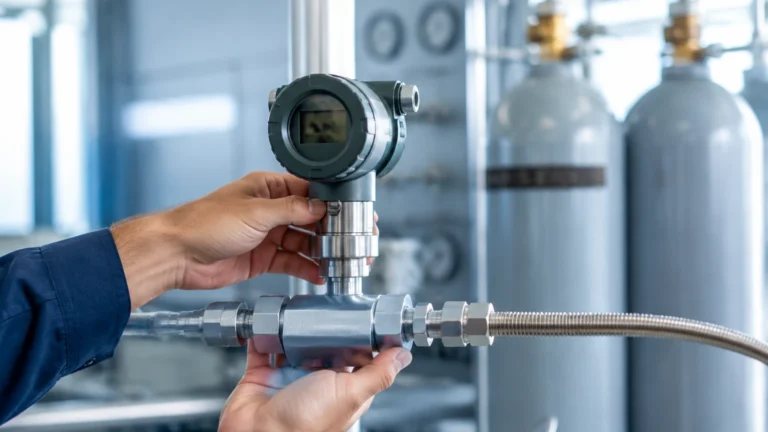
The accuracy of a trace oxygen measurement is only as good as the sample delivery system. Because the sensor is measuring concentrations as low as 0.1 ppb, even a microscopic leak in the sample line can introduce enough atmospheric oxygen to invalidate the data.
Sample Line Integrity
1. Material Selection: Stainless steel tubing (316L) is mandatory. Plastic or rubber tubing is permeable to oxygen and will result in artificially high readings.
2. Minimize Connections: Every fitting is a potential leak point. Use orbital welds where possible and high-quality compression fittings elsewhere.
3. Flow Regulation: The Swan Oxytrace requires a stable, low-velocity flow. A needle valve and a flow meter (rotameter) should be installed upstream of the sensor cell to maintain a constant flow of approximately 10 L/h.
Temperature and Pressure Control
Process water in steam cycles is often at high temperatures and pressures. A sample conditioning skin or rack is usually required to:
* Cool the sample: Use a heat exchanger to bring the sample down to approximately 25°C (77°F).
* Reduce pressure: Use a pressure-reducing valve to stabilize the sample pressure between 0.5 and 1 bar before it enters the flow cell.
Maintenance and Operational Best Practices
To maintain the high sensitivity of the swan oxytrace, a routine maintenance schedule is essential. Unlike level meters, which are often "set and forget," analytical sensors interact chemically with the sample.
Membrane and Electrolyte Service
The sensor membrane is a delicate Teflon-based film. Over time, it can become fouled by iron oxides (magnetite) common in power plant water or coated with organic films.
* Monthly: Inspect the flow rate and check for visual fouling in the flow cell.
* Quarterly/Bi-annually: Replace the electrolyte solution and the membrane cap. After replacing the membrane, the sensor requires a "burn-in" or polarization period of several hours before it reaches maximum stability.
* Calibration: Perform an air calibration after every membrane change or if the process readings show an unexplained drift.
Troubleshooting Common Issues
* High Readings: Usually caused by a leak in the sample line or a depleted electrolyte. Check all upstream fittings using a leak detection fluid.
* Slow Response: Often indicates a fouled membrane or insufficient flow rate. Ensure the rotameter indicates at least 5 L/h.
* Negative Readings/Zero Drift: This can occur if the reference electrode is contaminated. A thorough cleaning and electrolyte change are typically required.

Practical Selection Table for Industrial Applications
Choosing the right configuration of a trace oxygen system depends on the specific process environment.
| Application | Primary Concern | Recommended Feature |
| :— | :— | :— |
| Boiler Feed Water | Corrosion of carbon steel | High sensitivity (< 1 ppb), integrated flow alarm. |
| Semiconductor UPW | Wafer oxidation | Fast response time, ultra-clean flow cell materials. |
| Stator Cooling Water | Hollow conductor plugging | High pressure capability, pH compensation if applicable. |
| Closed Loop Cooling | Anaerobic bacteria/Corrosion | Portable Oxytrace units for spot-checking multiple loops. |
Limitations and Prohibitions
While the Swan Oxytrace is a leader in trace oxygen detection, it is not a universal solution for all gas measurements.
* Non-Aqueous Samples: The sensor is designed for water-based samples. It cannot be used directly in oils or aggressive solvents that would dissolve the membrane or the sensor body.
* High Solids Content: Samples with high turbidity or suspended solids will quickly plug the membrane. Pre-filtration is required for "dirty" industrial water.
* Extreme pH: Very high or very low pH levels can affect the longevity of the electrolyte. Standard boiler water (pH 9.0-9.6) is ideal, but extreme chemical cleaning cycles should bypass the sensor.
Frequently Asked Questions (FAQ)
Q: How often should I calibrate the swan oxytrace?
A: For most high-purity water applications, an air calibration every 3 to 6 months is sufficient, provided the membrane is clean. However, if the system is used for safety-critical asset protection, monthly verification is recommended.
Q: Can the sensor be used in seawater?
A: While the principle works, the high chloride content of seawater can be aggressive toward the silver anode and may require more frequent maintenance and specialized electrolyte formulations.
Q: What is the difference between the Oxytrace and a standard DO sensor?
A: The main difference lies in the electrode design and the thickness of the membrane. The Oxytrace is optimized for the 0-20 ppb range with a detection limit of 0.1 ppb, whereas a standard sensor may have a detection limit of only 10-50 ppb.
Q: Does the swan oxytrace require a constant power supply?
A: Yes, the sensor must remain polarized to provide an immediate and accurate reading. If the transmitter is powered down for an extended period, the sensor will require several hours to re-polarize before the readings are valid.
Conclusion
Effective process control in modern industry requires a dual approach: monitoring the physical state of the process and the chemical purity of the media. The Swan Oxytrace provides the necessary resolution to manage dissolved oxygen at the trace level, preventing long-term structural damage to high-value assets like turbines and boilers. When integrated with reliable physical monitoring tools—such as those found on the Main Page for level and pressure—the Swan Oxytrace forms the backbone of a comprehensive industrial instrumentation strategy. By adhering to strict installation guidelines and maintaining a consistent calibration schedule, engineers can ensure their systems operate at peak efficiency with minimal risk of oxygen-induced failure.