Tank Level Tracker
Tank Level Tracker
In industrial process automation, a tank level tracker is not a single device but an integrated system consisting of a level sensor, a signal transmitter, and often a localized or remote monitoring interface. These systems are critical for inventory management, overfill prevention, and process efficiency across sectors such as water treatment, chemical processing, and oil and gas production. Selecting the appropriate tracking technology requires a deep understanding of the physical properties of the media being measured and the environmental conditions of the vessel.
Measurement Principles of Tank Level Trackers
Before selecting a specific tank level tracker, engineers must evaluate the underlying measurement principle that best suits the application. Industrial level measurement generally falls into two categories: contact and non-contact.
Radar Level Measurement (Non-Contact)
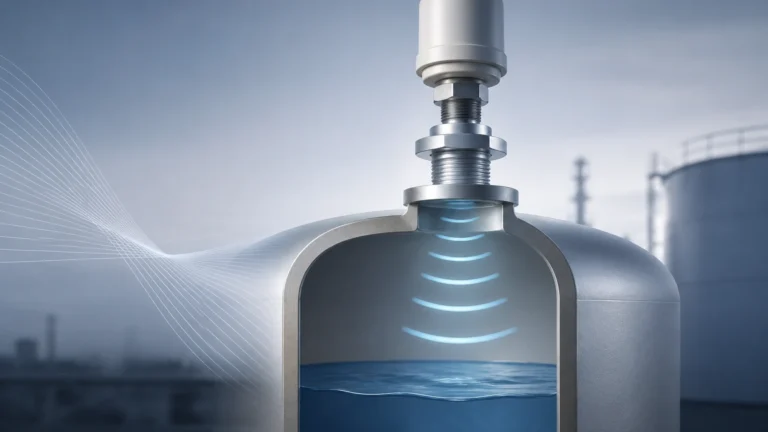
Radar level trackers utilize high-frequency electromagnetic waves, typically in the 26GHz or 80GHz range. The device emits a radar pulse toward the material surface, which reflects back to the sensor. The system calculates the distance based on the Time of Flight (ToF).
* Advantages: It is unaffected by temperature fluctuations, vacuum, or high pressure. Modern 80GHz radar trackers offer a narrow beam angle, which minimizes interference from internal tank structures like agitators or ladders.
* Limitations: The accuracy depends on the dielectric constant (εr) of the media. Materials with a very low dielectric constant (e.g., certain hydrocarbons) may require guided wave radar (GWR) to ensure signal return.
Ultrasonic Level Measurement (Non-Contact)
Ultrasonic trackers use sound waves rather than electromagnetic waves. The sensor emits an ultrasonic pulse that bounces off the liquid surface. The time taken for the echo to return is proportional to the distance.
* Advantages: Highly cost-effective for water-based applications and open-air sumps.
* Limitations: Sound speed is affected by air temperature and gas composition. Furthermore, heavy foam, steam, or dust can absorb the sound energy, leading to signal loss.
Hydrostatic Level Measurement (Contact)
This method relies on the principle that the pressure at the bottom of a liquid column is directly proportional to the height of that column (P = ρgh). A pressure transmitter is mounted at the bottom or submerged in the tank.
* Advantages: Simple to install and highly reliable for vented tanks with consistent liquid density.
* Limitations: Changes in the liquid's specific gravity will result in measurement errors unless the system is recalibrated or compensated.
Magnetic Level Gauges (Contact/Visual)
These trackers use a float containing a permanent magnet that moves with the liquid level. This float acts upon an external bypass chamber equipped with magnetic flaps or a continuous transmitter.
* Advantages: Provides a clear visual indication without requiring power, making it ideal for high-pressure boilers and toxic chemical storage where a physical sight glass would be a safety risk.
Technical Selection Criteria
Choosing the right tank level tracker requires a systematic comparison of technical specifications against the process environment. To explore a complete range of industrial instrumentation and detailed technical data sheets, visit our Main Page.
Selection Table: Technology Comparison
| Technology | Typical Accuracy | Measuring Range | Media Compatibility | Operating Temperature |
| :— | :— | :— | :— | :— |
| Radar (80GHz) | ±2 mm | Up to 120 m | Liquids, Solids, Slurries | -40°C to +250°C |
| Ultrasonic | ±0.25% of range | 0.3 m to 15 m | Water, Wastewater | -40°C to +80°C |
| Hydrostatic | ±0.1% to ±0.5% | 1 m to 200 m | Clear liquids, Oils | -20°C to +100°C |
| Magnetic Gauge | ±5 mm | 0.3 m to 6 m | Corrosive chemicals | -40°C to +400°C |
Industrial Applications and Environmental Factors
Water and Wastewater Treatment
In water treatment, tank level trackers are used in chemical dosing tanks, equalization basins, and sludge thickeners. Ultrasonic sensors are the standard choice for open channels and sumps due to their non-contact nature and resistance to moisture. However, in anaerobic digesters where methane gas and foam are present, radar trackers are preferred because electromagnetic waves penetrate gas layers more effectively than sound waves.
Chemical and Petrochemical Processing
Corrosive environments require materials like PTFE or PVDF for wetted parts. For highly volatile liquids, explosion-proof (ATEX/IECEx) certifications are mandatory. Radar trackers are often the primary choice here because they can be isolated from the process via a plastic window or flange, preventing the electronics from coming into contact with aggressive vapors.
Oil and Gas Storage
Large-scale storage tanks require high-precision tracking for custody transfer. In these scenarios, radar trackers with high repeatability (±1 mm) are deployed. For heavy crude oil, which may have a layer of paraffin or sludge at the bottom, hydrostatic sensors or guided wave radar are often used to ensure the sensor can "see" through the buildup.
Installation Guidelines for Optimal Performance
A tank level tracker's accuracy is heavily influenced by its installation position. Engineers should follow these standard practices:
1. Avoid the Center: In cylindrical tanks with domed or conical bottoms, do not install the sensor in the exact center. This can cause multiple reflections (parabolic effect) that confuse the signal processing unit.
2. The 1/6th Rule: For radar and ultrasonic sensors, the ideal mounting position is usually 1/6th of the tank diameter away from the tank wall. This provides enough distance to avoid wall interference while staying clear of the center.
3. Nozzle Height: Ensure the sensor face extends slightly below the mounting nozzle. If the sensor is recessed too far into a narrow nozzle, the signal may reflect off the nozzle walls (ringing effect), creating a "dead zone" at the top of the tank.
4. Inlet Interference: Never install a tracker directly above the liquid inlet. The turbulence and splashing from the incoming flow will cause erratic readings and may damage contact-based sensors.
5. Obstruction Clearance: Identify internal structures such as heating coils, agitator blades, and support beams. If these cannot be avoided, use a tracker with "False Echo Suppression" capabilities to map out and ignore these static reflections.

Limitations and Common Risks
Despite advancements in technology, certain conditions remain challenging for tank level trackers:
* Dielectric Sensitivity: Non-contact radar relies on the reflection of energy. If a liquid has a dielectric constant below 1.4, the signal may pass through the liquid and reflect off the tank bottom instead. In these cases, a stilling well or guided wave radar must be used.
* Vapor and Condensation: While radar is generally immune to vapor, heavy condensation on the sensor face can attenuate the signal. Sensors with a convex lens or PTFE drip shield are recommended for high-humidity environments.
* Surface Turbulence: Rapidly moving or boiling surfaces can scatter the signal of ultrasonic and radar trackers. Signal damping and averaging algorithms in the transmitter can help, but a stilling well is the most effective mechanical solution for stabilizing the surface.
Frequently Asked Questions (FAQ)
Q: How do I track the level of a tank containing heavy foam?
A: Foam is a significant challenge. Ultrasonic waves are usually absorbed by foam. Radar waves may also be attenuated depending on the foam's density and moisture content. For heavy foam, a hydrostatic pressure transmitter or a magnetic level gauge is often the most reliable solution as they are unaffected by surface conditions.
Q: Can a tank level tracker measure volume instead of just height?
A: Yes. Most modern transmitters allow the user to input a linearization table or select a tank shape (e.g., horizontal cylinder, sphere). The device then calculates the volume based on the measured level and the tank's geometry.
Q: What is the "Dead Zone" in level measurement?
A: The dead zone (or blocking distance) is the area directly below the sensor where it cannot accurately measure. For ultrasonic sensors, this is the time required for the transducer to stop vibrating and start listening. For radar, it is related to the pulse width. Always ensure the maximum liquid level does not enter the sensor's dead zone.
Q: How often should a tank level tracker be calibrated?
A: This depends on the industry and the technology. Hydrostatic sensors may drift over time and usually require annual checks. Radar and ultrasonic sensors are generally more stable but should be verified every 12 to 24 months, especially in safety-critical applications.
Conclusion
Effective tank level tracking is foundational to industrial safety and operational efficiency. By understanding the physics of radar, ultrasonic, and hydrostatic measurement, and by strictly adhering to installation best practices, engineers can ensure long-term reliability. When selecting a system, always prioritize the chemical compatibility of wetted materials and the specific physical challenges of the media, such as dielectric constant, viscosity, and potential for foaming.