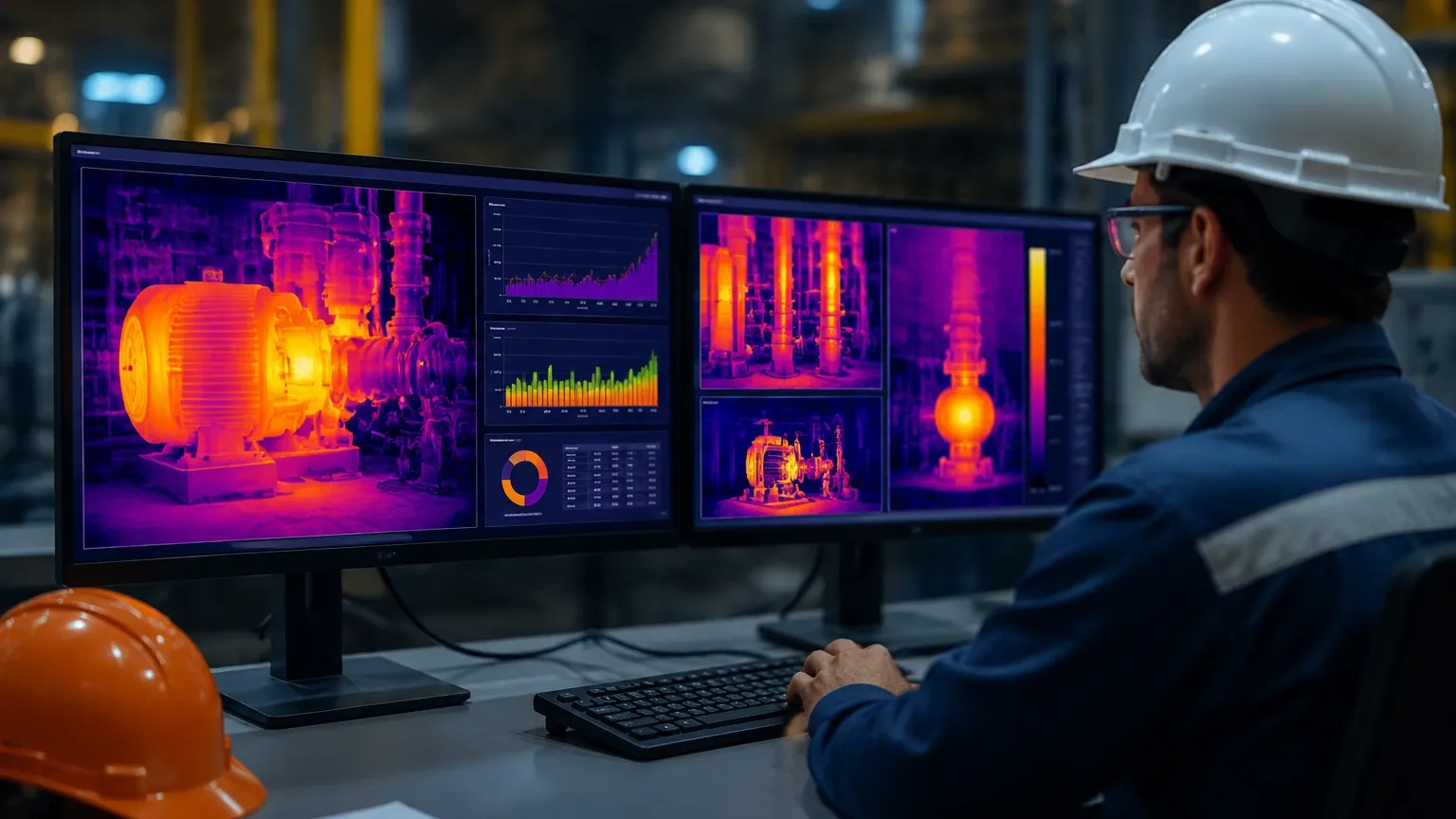
Thermal Monitoring for Industrial Systems
Thermal Monitoring for Industrial Systems
In the modern industrial landscape, the ability to accurately track and manage temperature fluctuations is not merely a matter of operational preference but a fundamental requirement for safety, efficiency, and asset longevity. Thermal monitoring for industrial systems encompasses a broad range of technologies designed to detect, measure, and analyze heat distribution across machinery, storage vessels, and process lines. Whether it is preventing the overheating of a high-speed turbine or ensuring the volumetric accuracy of a chemical storage tank, thermal data provides the critical insights necessary for predictive maintenance and process optimization.
Measurement Principles of Thermal Monitoring
To implement effective thermal monitoring for industrial systems, engineers must first understand the physical principles that govern temperature measurement. Industrial sensors generally fall into two categories: contact and non-contact.
1. Resistance Temperature Detectors (RTDs)
RTDs operate on the principle that the electrical resistance of a metal increases as its temperature rises. The most common type is the PT100, which uses platinum and has a resistance of 100 ohms at 0°C. RTDs are prized for their exceptional accuracy and stability over time. They are typically used in applications where precise temperature control is required, such as in pharmaceutical or food processing environments.
2. Thermocouples
Thermocouples function based on the Seebeck effect, where a voltage is generated at the junction of two dissimilar metals when they are exposed to a temperature gradient. Unlike RTDs, thermocouples are active sensors that do not require an external power source for the sensing element itself. They are highly rugged and can measure extreme temperatures (up to 2,300°C in some configurations), making them ideal for furnaces and heavy manufacturing.
3. Infrared (IR) Thermometry
Non-contact thermal monitoring relies on detecting the infrared energy emitted by an object. Every object with a temperature above absolute zero emits infrared radiation. IR sensors and thermal imaging cameras capture this radiation to determine surface temperatures without physical contact. This is essential for monitoring moving parts or high-voltage electrical components where contact sensors would be impractical or dangerous.
4. Fiber Optic Temperature Sensing
In environments with high electromagnetic interference (EMI) or explosive atmospheres, fiber optic sensors offer a unique solution. Using Raman scattering or Bragg gratings, these systems can provide distributed temperature sensing (DTS) along the entire length of a cable, allowing for the monitoring of kilometers of pipeline or large-scale power cables.
The Integration of Thermal Monitoring and Level Measurement
In many B2B industrial applications, thermal monitoring is inextricably linked to level measurement. Temperature changes directly influence the physical properties of the media being measured, which can lead to significant errors if not properly compensated.
Density and Hydrostatic Pressure
For hydrostatic level transmitters, which calculate liquid level based on the pressure exerted by a liquid column, temperature is a critical variable. As a liquid heats up, its density typically decreases. Without integrated thermal monitoring, a hydrostatic sensor might report a stable pressure even as the physical volume of the liquid expands, leading to an inaccurate level reading. Advanced systems use temperature data to perform real-time density compensation.
Speed of Sound in Ultrasonic Systems
Ultrasonic level sensors measure the time it takes for a sound pulse to travel to the liquid surface and back. However, the speed of sound is highly dependent on the temperature of the air or gas through which it travels. A change of just 1°C can result in a measurement error of approximately 0.17%. Therefore, high-quality ultrasonic sensors must include an integrated temperature probe to adjust the calculation of the distance based on the current ambient conditions.
Dielectric Constants in Radar Measurement
While radar level meters are generally more resistant to temperature fluctuations than ultrasonic sensors, extreme thermal shifts can still affect the dielectric constant of certain vapors in the tank headspace. In high-pressure and high-temperature steam applications, thermal monitoring ensures that the radar signal processing algorithms account for changes in the propagation speed of the electromagnetic waves.
Practical Selection Table for Thermal Sensors
Choosing the right technology for thermal monitoring for industrial systems requires balancing accuracy, range, and environmental resilience. The following table provides a comparison of common industrial sensor types.
| Sensor Type | Temperature Range | Accuracy | Durability | Typical Application |
| :— | :— | :— | :— | :— |
| RTD (PT100/1000) | -200°C to +850°C | Excellent | Moderate | Laboratory, Food & Beverage |
| Thermocouple (Type K/J) | -270°C to +1260°C | Moderate | High | Steel Mills, Exhaust Gas |
| Infrared Sensor | -50°C to +3000°C | Variable | Low (Lens sensitive) | Moving Belts, Electrical Panels |
| Thermistor | -90°C to +130°C | High | Moderate | HVAC, Battery Monitoring |
Installation Considerations for Industrial Systems
Proper installation is as important as sensor selection. Inaccurate placement can lead to "thermal lag" or readings that do not represent the true state of the process.
1. Thermowell Selection: In high-pressure or corrosive environments, sensors should be housed in a thermowell. This protective sleeve allows for the removal of the sensor without breaking the process seal. However, the material and thickness of the thermowell must be chosen carefully to minimize the impact on response time.
2. Immersion Depth: To avoid errors caused by heat conduction along the sensor shaft (stem conduction), a contact sensor must be immersed to a sufficient depth. A general rule of thumb is an immersion depth equal to at least ten times the diameter of the sensor protective sheath.
3. Shielding and Grounding: In environments with heavy machinery, electrical noise can interfere with the small millivolt signals produced by thermocouples. Using shielded cables and ensuring proper grounding is vital for maintaining signal integrity.
4. Lagging and Insulation: If a sensor is mounted on the outside of a pipe, the area must be well-insulated to ensure the sensor reaches the actual process temperature rather than being cooled by the surrounding air.
Limitations and Operational Risks
While thermal monitoring for industrial systems is highly effective, it is not without limitations. Engineers must be aware of the following risks:
* Sensor Drift: Over time, the accuracy of RTDs and thermocouples can degrade due to mechanical shock, vibration, or chemical contamination of the sensing element. Regular calibration is necessary to maintain system reliability.
* Emissivity Challenges: For infrared monitoring, the "emissivity" of a surface (its ability to emit thermal radiation) must be known. Shiny metals have low emissivity and can reflect the temperature of surrounding objects, leading to false readings if the sensor is not correctly calibrated for the specific material.
* Thermal Inertia: In large-scale systems, there is often a delay between a heat-generating event and the sensor's detection of that heat. This lag must be accounted for in the control logic to prevent overshoot in heating or cooling cycles.
Frequently Asked Questions (FAQs)
Q: How often should industrial thermal sensors be calibrated?
A: Calibration frequency depends on the criticality of the process and the environment. Most industrial standards recommend an annual calibration, though high-vibration or high-temperature applications may require quarterly checks.
Q: Can I use a thermocouple and an RTD interchangeably?
A: Generally, no. They require different signal conditioning and input modules on a PLC (Programmable Logic Controller). Furthermore, their response times and accuracy levels differ significantly.
Q: What is the benefit of a 4-wire RTD over a 2-wire RTD?
A: A 4-wire configuration eliminates the effect of lead wire resistance, which is crucial for high-accuracy measurements over long distances. 2-wire RTDs are usually only acceptable for short distances where high precision is not required.
Q: How does ambient temperature affect level measurement accuracy?
A: Ambient temperature affects the density of the liquid and the electronics of the sensor. In ultrasonic systems, it also changes the speed of the measurement signal. Integrated thermal monitoring is the standard method for correcting these variables.
Conclusion
Effective thermal monitoring for industrial systems is a multi-layered discipline that requires a deep understanding of both physics and process engineering. By selecting the appropriate sensing technology and accounting for the environmental factors that influence measurement, facilities can significantly reduce downtime and improve safety. For those looking to integrate these technologies into broader automation frameworks, it is recommended to Review product options and application support to find the most compatible solutions for specific industrial needs. Whether the goal is protecting a single motor or managing a complex chemical refinery, the data provided by robust thermal monitoring remains an indispensable asset in the industrial toolkit.