Thermostat Calibration Services
Thermostat Calibration Services
In industrial process control, the accuracy of temperature regulation is as critical as the measurement of pressure or liquid levels. Thermostat calibration services provide the technical verification necessary to ensure that thermal switches and controllers actuate at the precise setpoints required for safety and efficiency. For facilities utilizing complex automation systems, maintaining the integrity of temperature-sensitive operations requires a rigorous approach to instrument validation.
While often overshadowed by continuous sensors, thermostats serve as vital primary or redundant control elements in heating, ventilation, and process cooling. When these devices drift, the consequences range from increased energy consumption to catastrophic equipment failure. This guide examines the technical foundations of thermostat operation, the methodologies used by professional calibration services, and the criteria for selecting a service provider within a B2B framework.
Understanding Thermostat Measurement Principles
Before engaging with thermostat calibration services, it is essential to understand the underlying physical principles of the devices being tested. Industrial thermostats generally fall into three categories, each requiring a specific calibration approach.
Bimetallic Mechanical Principles
Mechanical thermostats often rely on the differential thermal expansion of two bonded metals. As temperature changes, the bimetallic strip bends, eventually making or breaking an electrical contact. Calibration for these units focuses on the mechanical tension and the physical distance the strip must travel to trigger the switch. Over time, metal fatigue can alter the spring constant, necessitating periodic recalibration.
Capillary and Bulb Systems
These systems utilize a fluid-filled bulb connected to a bellows or diaphragm via a capillary tube. As the temperature at the bulb increases, the fluid expands, increasing pressure within the system and actuating a switch. Calibration involves verifying the pressure-to-temperature relationship. These are common in hazardous areas where electrical components must be isolated from the process.
Electronic and Thermistor-Based Systems
Modern industrial thermostats use thermistors or Resistance Temperature Detectors (RTDs) coupled with a microprocessor. These devices measure changes in electrical resistance. Calibration for electronic units is often performed through software offsets or by adjusting the 4-20mA loop output if the thermostat is integrated into a wider control architecture.
The Technical Process of Professional Calibration
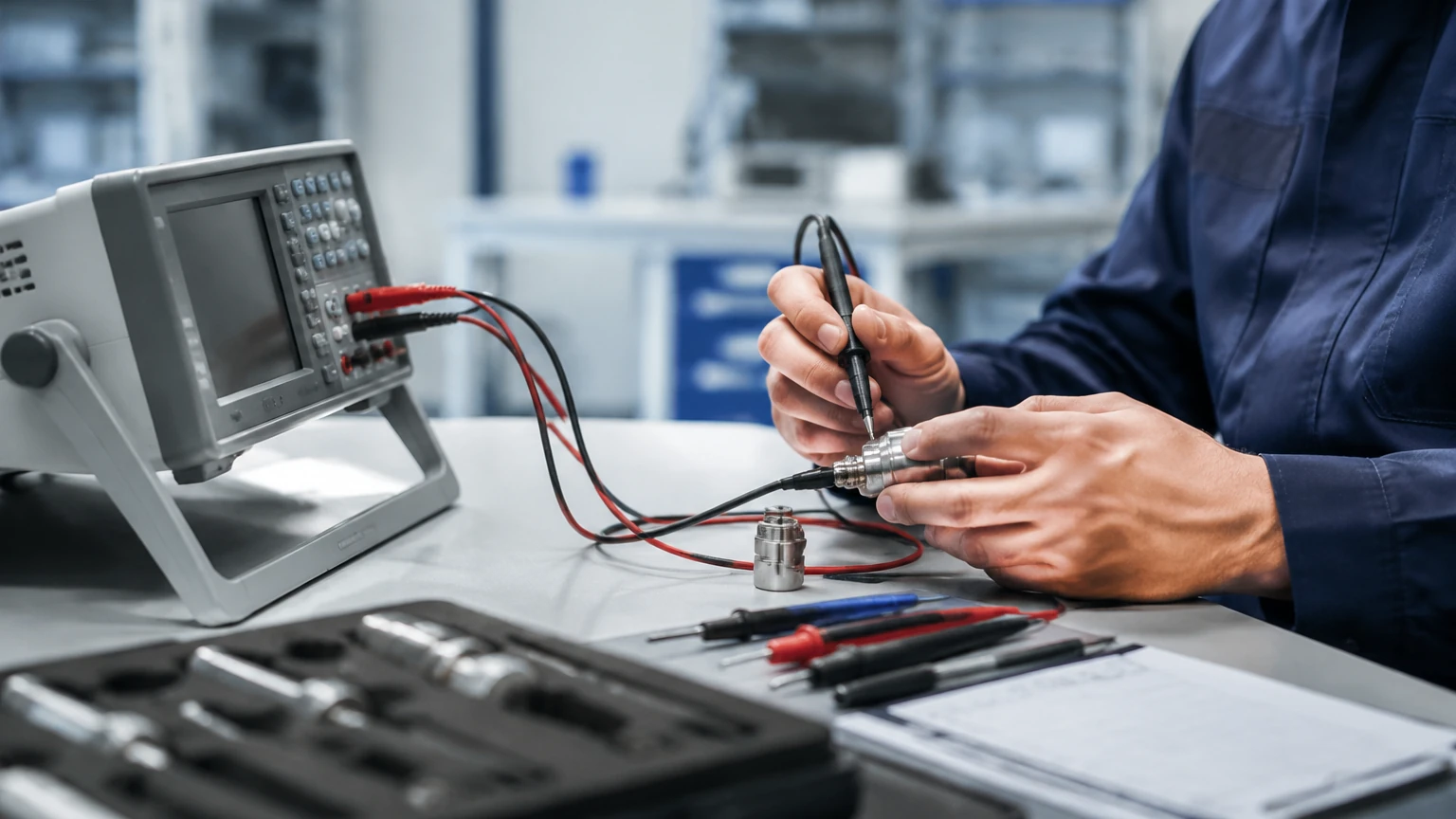
Professional thermostat calibration services utilize controlled thermal environments to compare the Device Under Test (DUT) against a traceable reference standard. The goal is to determine the "deadband" or hysteresis—the difference between the setpoint where the switch closes and the point where it opens.
Dry-Block Calibrators vs. Stirred Liquid Baths
Service providers typically use one of two primary methods for generating stable temperatures:
1. Dry-Block Calibrators: These are portable units that use a metal block with bored holes to house the sensors. They are ideal for on-site thermostat calibration services due to their speed and lack of fluids. However, they may have higher thermal gradients than liquid baths.
2. Stirred Liquid Baths: These provide the highest level of thermal stability and uniformity. By immersing the thermostat bulb or sensor in a circulating fluid (water, oil, or ethanol), the service provider ensures that the entire sensing element is at a uniform temperature. This is the preferred method for laboratory-grade calibration.
Traceability and Uncertainty
A key component of B2B calibration is the provision of a certificate that demonstrates traceability to national standards, such as NIST (National Institute of Standards and Technology) or equivalent international bodies. Calibration services must also provide an "uncertainty budget," which quantifies the potential error introduced by the reference equipment and environmental conditions during the test.
Why Industrial Facilities Require Regular Calibration
In many process industries, temperature accuracy directly impacts the physical properties of the media being handled. For instance, in level measurement applications, the density of a liquid changes with temperature. If a thermostat controlling a tank heater is inaccurate, it can lead to errors in volume calculations or even cause the media to reach its flash point.
Companies often consult the Main Page of instrumentation specialists like Welk to understand how temperature integration affects overall system accuracy. Ensuring that thermostats are calibrated allows for more precise synchronization between thermal management and level control systems.
Practical Selection Table for Calibration Services
When evaluating thermostat calibration services, engineers should match the service capability with the specific requirements of their hardware.
| Feature | Field Calibration (On-Site) | Laboratory Calibration |
| :— | :— | :— |
| Accuracy | Moderate (±0.5°C to ±1.0°C) | High (±0.01°C to ±0.1°C) |
| Equipment Used | Portable Dry-Blocks | Stirred Liquid Baths / Fixed Points |
| Best For | Routine maintenance, HVAC, safety cut-offs | Master sensors, R&D, high-precision process |
| Turnaround | Immediate | 5–10 Business Days |
| Traceability | NIST/ISO 17025 | NIST/ISO 17025 (Full Documentation) |
Installation and Maintenance Considerations
Calibration is only effective if the thermostat is installed correctly. Even a perfectly calibrated device will provide false readings if it is subject to "thermal shunting" or poor placement.
* Immersion Depth: For capillary and bulb thermostats, the bulb must be fully immersed in the process media. Insufficient immersion leads to heat loss through the stem, causing the thermostat to read lower than the actual process temperature.
* Shielding: In air-sensing applications, thermostats should be shielded from direct radiant heat sources and drafts, which can cause premature cycling.
* Wiring Integrity: For electronic thermostats, electromagnetic interference (EMI) can induce noise in the signal. Shielded cabling and proper grounding are essential to maintain the calibration accuracy in a factory environment.
Limitations and Common Risks
While thermostat calibration services can correct for drift, they cannot fix fundamental hardware failures. It is important to recognize when a device should be replaced rather than recalibrated.
1. Contact Pitting: In mechanical thermostats, the electrical contacts can pit or weld over time due to arcing. Calibration will not resolve the intermittent connectivity caused by physical wear.
2. Hysteresis Expansion: If the deadband of a thermostat has widened significantly beyond its factory specifications, it usually indicates a loss of tension in the internal springs or a leak in the capillary system.
3. Environmental Degradation: Corrosive atmospheres can degrade the sensing element. If the protective sheath of a probe is compromised, the internal sensor will eventually fail, regardless of calibration frequency.
Integrating Temperature and Level Control
In B2B industrial environments, instrumentation is rarely isolated. A thermostat controlling a cooling jacket on a chemical reactor must work in tandem with level sensors to ensure the vessel does not overflow or run dry while at high temperatures. High-quality level measurement instruments, such as those provided by Welk, often feature integrated temperature compensation. However, for secondary safety loops, independent thermostat calibration services remain a necessity to provide a redundant layer of protection.
By maintaining a regular calibration schedule, facilities can reduce the risk of "nuisance tripping," where a thermostat shuts down a process unnecessarily, or worse, fails to trip during a genuine over-temperature event.
Frequently Asked Questions (FAQ)
Q: How often should industrial thermostats be calibrated?
A: Most industrial standards recommend an annual calibration cycle. However, in high-vibration environments or critical safety applications (such as SIL-rated loops), a six-month interval may be required.
Q: Can I calibrate a thermostat myself using a bucket of ice water?
A: While a 0°C (32°F) ice bath can serve as a functional check, it is not a substitute for professional thermostat calibration services. Professional services use multi-point verification across the device's entire operating range and provide the documentation required for regulatory compliance.
Q: What is the difference between a thermostat and a temperature transmitter?
A: A thermostat is a switch that triggers at a specific setpoint. A temperature transmitter provides a continuous signal (like 4-20mA) representing the current temperature. Both require calibration, but the methods and equipment differ.
Q: Does calibration include repair?
A: Generally, no. Calibration is the process of comparing and documenting performance. If a device is found to be out of tolerance, a "service" might include adjustment, but physical repairs often require separate component replacement.
Conclusion
Thermostat calibration services are a cornerstone of industrial maintenance, ensuring that temperature-dependent processes remain within defined safety and quality parameters. By understanding the measurement principles of bimetallic, capillary, and electronic systems, and by selecting the appropriate calibration environment—whether on-site dry-blocks or laboratory liquid baths—engineers can significantly extend the reliable life of their instrumentation. For those managing broader process control systems, integrating these services with high-precision level and pressure measurement ensures a holistic approach to plant automation and safety. For more information on professional-grade measurement solutions, visiting the Main Page can provide further technical insights into the hardware that supports these critical industrial functions.