Thermowell Probe
Thermowell Probe
In industrial process control, the accuracy of temperature measurement is as critical as level or pressure monitoring. A thermowell probe is not a single component but an assembly consisting of a temperature-sensing element—typically a Resistance Temperature Detector (RTD) or a thermocouple—and a thermowell, which acts as a protective pressure-tight receptacle. This assembly allows for the measurement of process temperatures while protecting the delicate sensor from high pressures, corrosive chemicals, and high-velocity fluid flows.
For engineers and plant managers, understanding the synergy between the sensor and its protective housing is essential for maintaining system integrity. Whether used in water treatment, chemical processing, or oil and gas applications, the thermowell probe ensures that temperature data remains reliable without compromising the containment of the process media.
Understanding the Thermowell Probe Assembly
The fundamental purpose of a thermowell probe is to provide a barrier between the process environment and the temperature sensor. In many industrial settings, the process media can be highly aggressive. Without a thermowell, a sensor would be directly exposed to mechanical stresses and chemical erosion, leading to rapid failure.
A complete assembly typically includes:
1. The Sensor (Probe): The active element (RTD or Thermocouple) that converts thermal energy into an electrical signal.
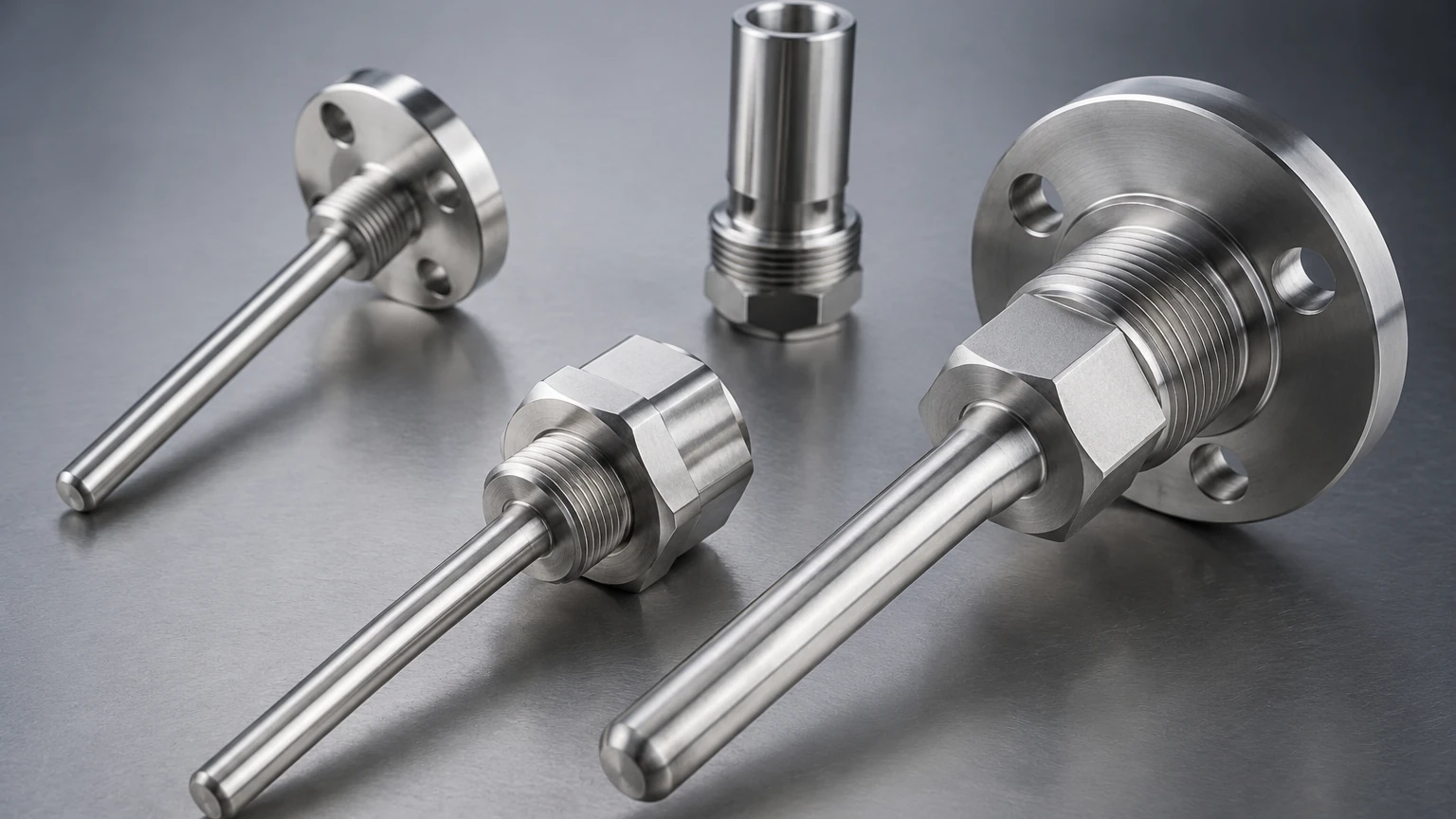
2. The Thermowell: A solid-drilled or fabricated tube closed at one end and mounted into the process vessel or piping.
3. The Connection Head: An enclosure that protects the electrical terminals and may house a transmitter.
4. Extension Hardware: Nipples, unions, or couplings that connect the thermowell to the connection head, often used to move the electronics away from high-temperature zones.
By utilizing this modular design, the sensor can be removed for calibration or replacement without depressurizing the system or draining the tank. This is a significant advantage in continuous process industries where downtime is costly.
Core Measurement Principles and Heat Transfer
The thermowell probe operates on the principle of thermal conduction. For an accurate reading, the heat from the process fluid must pass through the wall of the thermowell and reach the sensor tip.
Thermal Lag
Because the thermowell adds mass and a physical barrier between the fluid and the sensor, there is an inherent delay in temperature response, known as thermal lag. To minimize this, the internal diameter of the thermowell must be precisely matched to the outer diameter of the probe. A tight fit ensures better conduction. In many high-precision applications, the probe is "spring-loaded," forcing the sensor tip into direct contact with the bottom of the thermowell to eliminate air gaps that act as insulators.
Conduction Error
Conduction error occurs when heat travels along the length of the thermowell toward the cooler (or hotter) ambient environment outside the pipe. To prevent this, the "U-length" or insertion length of the thermowell must be sufficient. A general engineering rule is that the probe should extend into the fluid at least ten times its diameter to ensure the sensing tip is fully immersed in the process temperature zone.
Evaluation Criteria for Industrial Applications
Selecting the correct thermowell probe requires a balance between mechanical strength and measurement sensitivity. Engineers must evaluate several factors before specifying a model.
Material Compatibility
The material of the thermowell must be compatible with the process medium. While Stainless Steel 316 (SS316) is the industry standard for its balance of cost and corrosion resistance, more aggressive environments may require specialized alloys. For example, Hastelloy or Monel are preferred in highly acidic chemical processes, while Tantalum jackets may be used for extreme chemical resistance.
Pressure and Temperature Ratings
The thermowell is a pressure vessel component. It must be rated to withstand the maximum operating pressure of the system at the maximum operating temperature. As temperature increases, the structural strength of the metal decreases, meaning the pressure rating of the thermowell is temperature-dependent.
Connection Types
* Threaded: Common for smaller pipes and lower pressures. Easy to install but prone to leaks if not properly sealed.
* Flanged: The standard for high-pressure and critical applications. They provide a robust seal and are easier to inspect.
* Weld-in: Used where a permanent, leak-proof seal is required, such as in high-pressure steam lines.
Selection Table: Matching Probe Types to Process Conditions
| Process Condition | Recommended Thermowell Material | Connection Type | Probe Type |
| :— | :— | :— | :— |
| General Water Treatment | SS304 / SS316 | Threaded (NPT/G) | RTD (Pt100) |
| High-Pressure Steam | Chrome-Moly Steel | Weld-in | Type K Thermocouple |
| Corrosive Chemicals | Hastelloy C-276 / PTFE Coated | Flanged | RTD (Pt100) |
| High-Velocity Gas | Tapered SS316 | Flanged | Type J/K Thermocouple |
| Food & Beverage | SS316L (Polished) | Tri-Clamp (Sanitary) | RTD (Pt100) |
Engineering Considerations: Wake Frequency and Stress
One of the most overlooked risks in thermowell probe installation is the phenomenon of vortex shedding. When a fluid flows past a cylindrical object like a thermowell, it creates alternating low-pressure vortices. If the frequency of these vortices (the wake frequency) matches the natural frequency of the thermowell, resonance occurs.
Resonance can cause the thermowell to vibrate violently, leading to fatigue failure and eventually snapping the probe off inside the pipe. To prevent this, engineers perform a Wake Frequency Calculation according to the ASME PTC 19.3 TW standard. To mitigate high wake frequencies, a designer might:
* Reduce the insertion length (U-length).
* Increase the root and tip diameter of the thermowell.
* Switch from a straight shank to a tapered shank design, which has a higher natural frequency.
Installation and Maintenance Guidelines
Proper installation is paramount for both safety and accuracy. For comprehensive technical specifications and product options, professionals often consult the Main Page of specialized instrument manufacturers like Welk to ensure the hardware meets international standards.
Insertion Depth
In piping, the probe should ideally be positioned so the tip is in the center third of the pipe. If the pipe diameter is too small to allow for the required 10x diameter immersion, the thermowell should be installed at an elbow or at an angle (45 degrees) against the flow to increase the effective immersion length.
Orientation
In liquid applications, the thermowell should ideally point upwards or horizontally to prevent the accumulation of sediment around the probe. In gas applications, orientation is less critical, but moisture drainage should be considered.
Maintenance
Routine maintenance involves checking for:
* Corrosion/Erosion: Inspecting the outer surface of the thermowell for thinning.
* Sensor Drift: Periodically removing the probe for dry-block or oil-bath calibration.
* Integrity of Seals: Ensuring threaded or flanged connections show no signs of process leakage.
Common Risks and Limitations
While the thermowell probe is a robust solution, it is not without limitations:
* Response Time: As mentioned, the extra mass of the thermowell slows down the measurement. In processes with rapid temperature fluctuations (e.g., safety shut-off loops), a thermowell might be too slow unless a high-response tapered design is used.
* Cost and Complexity: For non-critical, low-pressure applications, the cost of a heavy-duty flanged thermowell may be unnecessary. In such cases, a simple compression fitting and a direct-immersion probe might suffice.
* Material Fatigue: In high-vibration environments, even if wake frequency is managed, the mechanical stress on the mounting threads or flange can lead to cracks over several years of operation.
Relationship to Level Measurement
In many industrial contexts, temperature and level measurement are intrinsically linked. For instance, hydrostatic level transmitters rely on the density of the liquid to calculate the height of the column. Since density changes with temperature, a thermowell probe is often installed alongside the level sensor to provide real-time temperature compensation. This ensures that the level reading remains accurate even as the ambient or process temperature fluctuates.
Frequently Asked Questions
Q: Can I use a thermowell probe in a vacuum system?
Yes, but the connection (usually flanged or specialized threaded) must be rated for vacuum service to prevent air ingress. The thermal conduction in a vacuum is also different, so ensure the probe has good mechanical contact with the thermowell tip.
Q: What is the difference between a fabricated and a solid-drilled thermowell?
Fabricated thermowells are made by welding a tube to a tip. They are cost-effective for low-pressure applications. Solid-drilled thermowells are machined from a single bar of hexagonal or round stock. They are much stronger and are required for high-pressure or high-velocity services.
Q: How do I know if my thermowell is too long?
A thermowell that is too long can interfere with internal tank components (like agitators) or cause excessive pressure drop in a pipe. It is also more susceptible to wake frequency failure. Always cross-reference the insertion length with the vessel's internal drawings.
Q: Why use an RTD instead of a Thermocouple in a thermowell?
RTDs (like the Pt100) offer higher accuracy and stability over time, making them ideal for temperature ranges between -200°C and +600°C. Thermocouples are generally used for much higher temperatures or in applications where extreme vibration might damage an RTD element.
By carefully selecting the thermowell probe based on the mechanical, chemical, and thermal requirements of the process, industrial operators can ensure long-term reliability and safety. For those seeking specific hardware configurations or customized OEM/ODM services, reviewing the latest advancements in sensor technology is the recommended next step.