Ultrasonic Steam Flow Meter
Ultrasonic Steam Flow Meter
In modern industrial processing, steam serves as a primary medium for heat transfer, sterilization, and power generation. Accurate measurement of steam flow is essential for energy management, process optimization, and cost accounting. While traditional technologies like vortex shedders and orifice plates have long dominated the market, the ultrasonic steam flow meter has emerged as a high-precision, low-maintenance alternative. This article explores the engineering principles, selection criteria, and installation best practices for implementing ultrasonic technology in steam applications.
Understanding the Measurement Principle
Ultrasonic flow measurement for steam typically utilizes the transit-time (or time-of-flight) principle. Unlike Doppler methods, which require particles or bubbles to reflect signals, transit-time technology relies on the difference in the travel time of ultrasonic pulses moving with and against the flow of the medium.
The Transit-Time Method
Two transducers are mounted on the pipe, functioning as both transmitters and receivers. They emit ultrasonic signals diagonally across the pipe.
1. Downstream Transmission: The signal traveling in the same direction as the steam flow moves faster.
2. Upstream Transmission: The signal traveling against the flow is slowed down by the velocity of the steam.
The flow velocity ($v$) is calculated using the time difference ($Δt$) between these two signals. The relationship can be simplified as:
$$v = K \cdot \frac{L}{2 \cdot \cos(\theta)} \cdot \frac{\Delta t}{t_{up} \cdot t_{down}}$$
Where:
* L is the distance between transducers.
* θ is the angle of the signal path relative to the flow.
* t represents the travel times.
Because steam is a gaseous medium with high sound velocity—often exceeding 400 m/s to 500 m/s depending on temperature—the electronic processing unit must be capable of resolving extremely small time differences, often in the nanosecond range. Advanced signal processing is required to distinguish the ultrasonic pulse from the background noise generated by high-velocity steam flow.
Why Choose Ultrasonic Technology for Steam?
Selecting an ultrasonic steam flow meter offers several distinct advantages over mechanical or differential pressure-based systems. As a professional manufacturer, Welk emphasizes these benefits for facilities looking to modernize their Main Page of instrumentation.
1. No Pressure Drop
Unlike orifice plates or venturi meters, which create a restriction in the pipe to generate a pressure differential, ultrasonic meters are typically full-bore or even clamp-on. This eliminates permanent pressure loss, reducing the energy required by the boiler to maintain system pressure. Over a year of operation, this energy saving can significantly offset the initial investment cost.
2. High Turndown Ratio
Traditional steam meters often struggle with low-flow conditions (the "low-end cutoff"). Ultrasonic meters provide a wide turndown ratio, often exceeding 100:1. This allows the meter to accurately measure steam flow during peak production periods as well as during low-demand standby modes, which is critical for accurate leak detection and energy balancing.
3. Maintenance and Longevity
With no moving parts and no components protruding into the high-velocity steam path, ultrasonic sensors are not subject to the wear and tear associated with vortex sensors or the erosion seen in orifice plates. This leads to longer calibration intervals and a lower total cost of ownership (TCO).
Technical Selection Criteria for Steam Applications
When evaluating an ultrasonic steam flow meter, engineers must consider the specific state of the steam and the environmental conditions of the plant.
Saturated vs. Superheated Steam
* Superheated Steam: This is the ideal medium for ultrasonic measurement. It behaves like a dry gas, allowing the ultrasonic signal to pass through with minimal attenuation.
* Saturated Steam: This presents more challenges. If the steam quality is low (high moisture content), water droplets can scatter the ultrasonic signal. Modern meters use digital signal processing (DSP) to filter out this noise, but it is essential to ensure the steam is as dry as possible at the point of measurement.
Temperature and Pressure Ratings
Steam applications often involve temperatures ranging from 150°C (302°F) to over 400°C (752°F). Transducers must be constructed from high-grade stainless steel or specialized alloys and may require cooling fins or thermal spacers to protect the piezoelectric elements from extreme heat.
Pipe Material and Size
While clamp-on ultrasonic meters are popular for liquids, steam applications often require "inline" or "wetted" transducers. This is because the acoustic impedance mismatch between the pipe wall and the steam gas is so high that very little signal energy enters the steam. Inline meters, where the transducers are in direct contact with the steam or recessed in ports, provide a much stronger signal-to-noise ratio.
Installation Guidelines and Best Practices
Proper installation is the most critical factor in ensuring the accuracy of an ultrasonic steam flow meter. Even the most advanced meter will fail if the flow profile is distorted.
Straight Pipe Requirements
To ensure a fully developed laminar flow profile, the meter requires specific lengths of straight pipe upstream and downstream of the installation point:
* Upstream: Minimum 10D to 20D (where D is the pipe diameter), depending on whether there are elbows, valves, or reducers.
* Downstream: Minimum 5D.
If these distances cannot be met, a flow conditioner may be necessary to eliminate swirl and turbulence.
Transducer Orientation
For horizontal pipes, transducers should generally be mounted in the 3 o'clock and 9 o'clock positions. Mounting them at the top (12 o'clock) can lead to issues if air or non-condensable gases collect there, while mounting at the bottom (6 o'clock) exposes the sensors to condensate and sediment, which can block the signal.
Insulation
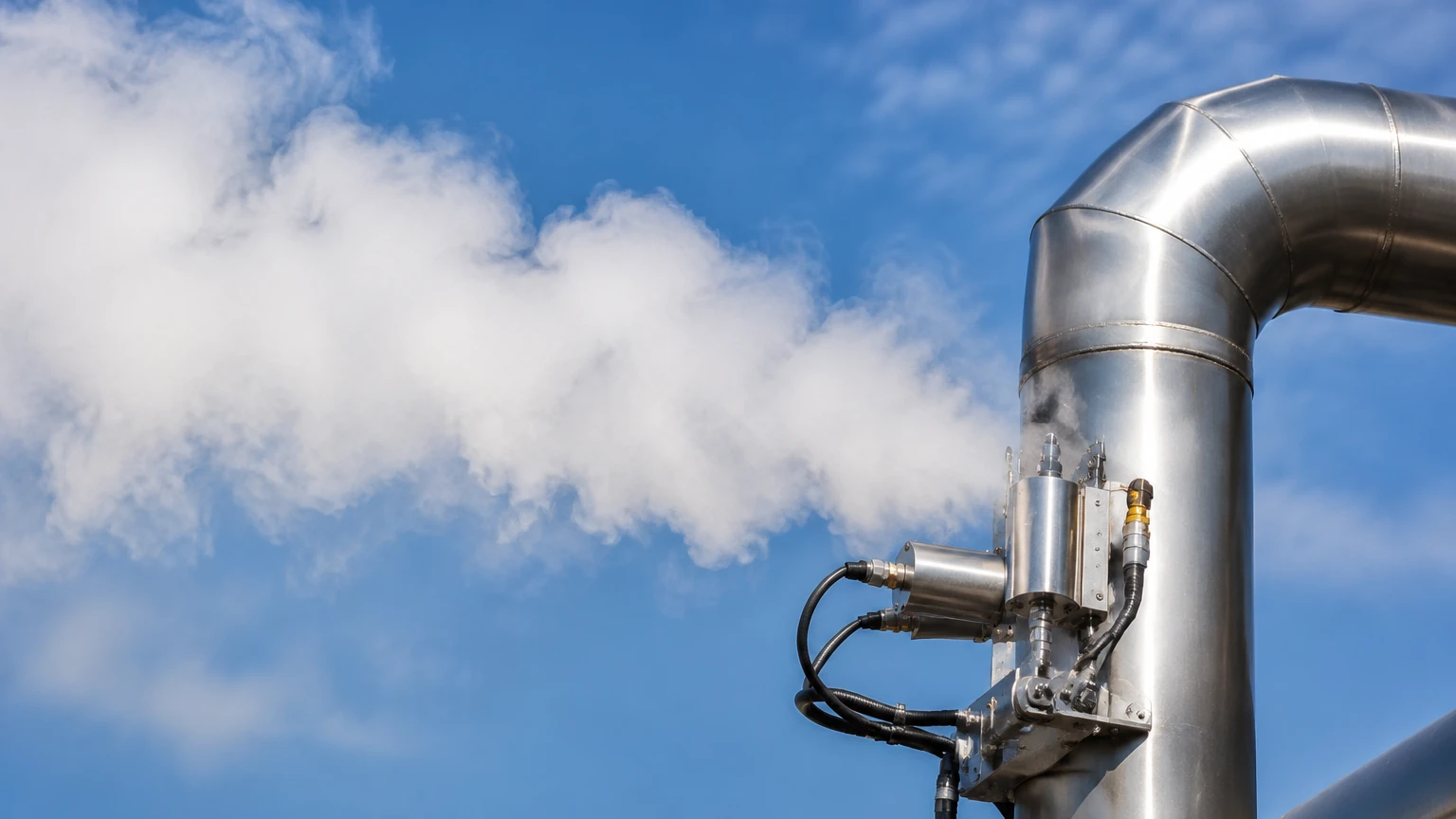
In steam systems, the pipe must be heavily insulated to prevent heat loss and the formation of condensate. However, the transducer housings themselves may need to remain uninsulated or be equipped with specific thermal barriers to allow heat dissipation, preventing the electronics from overheating.
Comparison Table: Ultrasonic vs. Traditional Steam Flow Meters
| Feature | Ultrasonic (Transit-Time) | Vortex Shedding | Orifice Plate (DP) |
| :— | :— | :— | :— |
| Accuracy | ±0.5% to ±1.0% | ±1.0% to ±1.5% | ±2.0% to ±3.0% |
| Pressure Drop | Negligible | Moderate | High |
| Turndown Ratio | 100:1 | 20:1 | 4:1 |
| Moving Parts | None | None | None (but erodes) |
| Installation | Inline or Clamp-on | Inline | Inline (Flanged) |
| Initial Cost | High | Moderate | Low |
| Maintenance | Very Low | Low | High |
Common Risks and Limitations
While the ultrasonic steam flow meter is a robust tool, engineers should be aware of potential pitfalls:
1. Condensate Interference: Excessive condensate in the bottom of the pipe or a film of water on the transducer face can attenuate the signal. Steam traps should be installed upstream of the meter to ensure high-quality steam.
2. Acoustic Noise: High-pressure drop valves located too close to the meter can generate ultrasonic noise that interferes with the meter's frequency. Maintaining the recommended upstream straight run helps mitigate this.
3. Signal Attenuation in Low Pressure: At very low pressures (e.g., below 1 bar or 14.5 psi), the density of steam is low, making it harder for ultrasonic waves to propagate. Most ultrasonic steam meters have a minimum operating pressure requirement.
Frequently Asked Questions (FAQ)
Q: Can an ultrasonic steam flow meter measure mass flow?
A: Yes, but it requires integrated temperature and pressure sensors. Since the density of steam changes significantly with temperature and pressure, the flow computer uses these inputs to calculate the mass flow rate from the measured volume flow.
Q: Is a clamp-on version available for steam?
A: While clamp-on technology exists for steam, it is technically demanding due to the high temperatures and the acoustic properties of gas. Inline meters are generally preferred for permanent, high-accuracy billing or control applications.
Q: How does steam velocity affect the meter?
A: Ultrasonic meters are excellent at measuring high-velocity steam (up to 60-100 m/s), which might cause cavitation or damage in other meter types. However, at extremely high velocities, the signal "drift" can be significant, requiring advanced compensation algorithms.
Q: What maintenance is required?
A: Maintenance is minimal. Periodic checks of the signal strength and diagnostic parameters via the transmitter's interface are usually sufficient. Unlike mechanical meters, there are no bearings to replace or plates to inspect for erosion.
Conclusion
The implementation of an ultrasonic steam flow meter represents a significant step toward industrial efficiency. By providing high accuracy across a wide range of flow rates without introducing pressure drops, these instruments allow for precise energy monitoring and process control. When selecting a solution, it is vital to partner with a manufacturer like Welk that understands the complexities of steam dynamics and provides the necessary technical support for installation and calibration. For more information on our full range of industrial measurement solutions, visit our Main Page.
By adhering to strict installation standards and carefully considering the steam conditions (temperature, pressure, and quality), facility managers can ensure reliable, long-term performance from their ultrasonic flow measurement systems.