Vega Grieshaber
Vega Grieshaber
In the landscape of industrial automation and process control, Vega Grieshaber KG stands as a prominent manufacturer specializing in sensors for measuring level, point level, and pressure. Based in Schiltach, Germany, the company has significantly influenced the evolution of radar and pressure measurement technologies over several decades. For process engineers and procurement specialists, understanding the technical nuances of these instruments is essential for optimizing plant efficiency and safety.
This guide provides a technical overview of the measurement principles employed by Vega Grieshaber, selection criteria for various industrial applications, and practical installation considerations. By comparing different sensing technologies, engineers can make informed decisions when consulting a Main Page for industrial instrumentation or evaluating specific sensor models for their facilities.
Core Measurement Principles
Before selecting a specific instrument, it is vital to understand the physics behind the measurement. Industrial level sensing generally falls into two categories: continuous measurement and point level detection.
Radar (Non-Contact)
Non-contact radar technology utilizes high-frequency electromagnetic waves, typically in the 80 GHz range. The sensor emits a signal toward the medium, which reflects the signal back to the antenna. The instrument measures the time of flight (ToF) between emission and reception.
$$d = \frac{c \cdot t}{2}$$
Where *d* is the distance, *c* is the speed of light, and *t* is the travel time. The 80 GHz frequency is particularly advantageous because it allows for smaller antenna sizes and narrower beam angles. A narrower beam minimizes reflections from tank internals like agitators or heating coils, providing a cleaner signal in complex geometries.
Guided Wave Radar (GWR)
Guided Wave Radar, also known as Time Domain Reflectometry (TDR), uses a physical probe (cable or rod) to guide the microwave pulses to the product surface. When the pulse reaches the surface of the medium, the change in the dielectric constant ($ε_r$) causes a reflection. GWR is highly effective in applications with heavy steam, dust, or foam, as the probe ensures the signal reaches the liquid even when the headspace is cluttered.
Ultrasonic Measurement
Ultrasonic sensors emit mechanical sound pulses. The time taken for the echo to return is proportional to the distance. While cost-effective, ultrasonic sensors are sensitive to air temperature variations, heavy dust, and vacuum conditions, as sound requires a medium (air) to travel. They are best suited for simple water and wastewater applications where the environment is relatively stable.
Hydrostatic Pressure
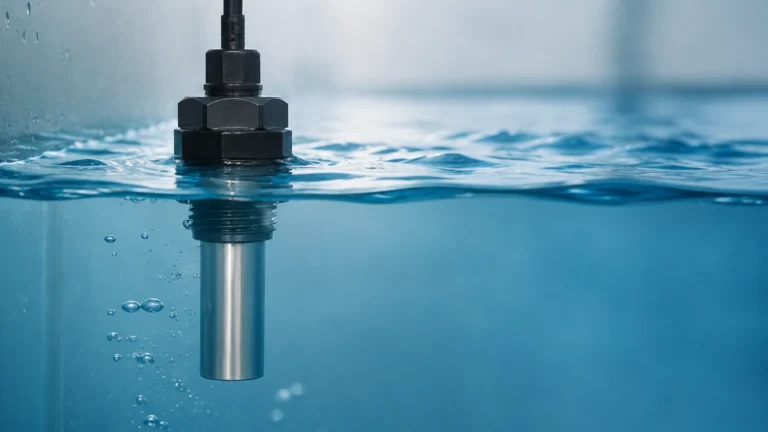
Hydrostatic level measurement relies on the principle that the pressure at the bottom of a vessel is proportional to the height of the liquid column and its density.
$$P = \rho \cdot g \cdot h$$
Vega Grieshaber utilizes both metallic and ceramic measuring cells for this purpose. Ceramic cells (such as the CERTEC® series) are highly resistant to abrasion and chemical attack, making them ideal for slurries or corrosive acids.
Technical Selection Criteria for Process Industries
Choosing the right technology requires an analysis of the medium's properties and the environmental conditions. The following table provides a comparison of common technologies used in B2B industrial environments.
Selection Comparison Table
| Technology | Media Type | Temp. Range | Pressure Range | Accuracy | Typical Application |
| :— | :— | :— | :— | :— | :— |
| 80 GHz Radar | Liquids & Solids | -196 to +450°C | Vacuum to 160 bar | ±1 mm | Chemical reactors, silos |
| Guided Wave Radar | Liquids & Interface | -196 to +450°C | Vacuum to 400 bar | ±2 mm | Oil/Water interface, steam drums |
| Ultrasonic | Liquids | -40 to +80°C | 0.3 to 3 bar | ±0.2% | Open channels, water tanks |
| Hydrostatic | Liquids | -40 to +150°C | Up to 1000 bar | ±0.1% | Deep wells, pressurized vessels |
| Vibrating Level Switch| Liquids/Solids | -50 to +250°C | Up to 64 bar | N/A (Point) | Overfill protection |
Dielectric Constant (εr) Considerations
For radar and GWR, the dielectric constant of the medium is the most critical factor. Materials with low εr (e.g., hydrocarbons, oils) reflect less energy than materials with high εr (e.g., water). If the εr is below 1.4, a coaxial probe or a high-sensitivity radar sensor is usually required to ensure a reliable signal return.
Installation Considerations and Best Practices
Correct installation is as important as selecting the right sensor. Even the most advanced vega grieshaber instrument can fail if poorly positioned.
1. Nozzle Dimensions: For non-contact radar, the nozzle height should be kept to a minimum. If the nozzle is too long or narrow, it can create internal reflections (ringing) that mask the true level signal.
2. Obstructions: Sensors should be mounted away from inflow streams, ladders, and agitators. While modern software can perform "false signal suppression," it is always better to have a clear line of sight to the product.
3. Vessel Geometry: In tanks with conical bottoms, the sensor should be positioned such that it can track the level down to the lowest point. For horizontal cylindrical tanks, mounting the sensor at 1/3 of the diameter from the end wall is often recommended to avoid the strongest curvature reflections.
4. Foam and Turbulence: If heavy foam is present, non-contact radar may suffer signal attenuation. In these cases, GWR or hydrostatic transmitters are preferred. For turbulent surfaces, damping settings in the sensor's electronics can be adjusted to provide a stable reading.
Limitations and Application Risks
While vega grieshaber instruments are robust, certain conditions present risks to measurement accuracy:
* Condensation and Buildup: In applications with high humidity, condensation can form on the antenna. While 80 GHz radar handles this better than older 26 GHz models, extreme buildup of sticky or conductive media can eventually cause signal loss.
* Vacuum Conditions: Ultrasonic sensors cannot function in a vacuum. Radar or pressure transmitters must be used instead.
* Gas Stratification: In large tanks containing different gases (e.g., Nitrogen blanketing over chemicals), the speed of light for radar remains constant, but the speed of sound for ultrasonic sensors changes significantly, leading to errors.
* High Pressure/High Temperature (HPHT): Extreme conditions require specialized seals, such as second line of defense (glass seals), to prevent process media from escaping into the sensor housing.

Maintenance and Calibration
Modern digital sensors require significantly less maintenance than older mechanical systems (like float switches or displacers). However, a routine verification schedule is recommended:
* Visual Inspection: Check for physical damage to the probe or antenna and ensure the cable glands are tight to prevent moisture ingress.
* Diagnostic Logs: Many vega grieshaber sensors feature internal data logging. Reviewing the echo curve (the visual representation of the signal) can identify potential issues before they cause a process shutdown.
* Proof Testing: For sensors used in Safety Instrumented Systems (SIS), periodic proof testing is mandatory to ensure the Probability of Failure on Demand (PFD) remains within the required SIL (Safety Integrity Level) rating.
For those looking to explore a wide range of industrial level measurement solutions, including radar and ultrasonic options, visiting the Main Page of a specialized manufacturer like Welk provides access to technical specifications and application support tailored to global industrial standards.
Future Trends: IIoT and Bluetooth Integration
The industry is moving toward greater connectivity. Many newer instruments now include Bluetooth communication, allowing technicians to configure and troubleshoot sensors from a safe distance using a smartphone or tablet. This is particularly useful for sensors mounted on tall silos or in hazardous areas where opening the housing is restricted. Furthermore, integration with cloud-based monitoring systems allows for predictive maintenance, where the sensor can alert operators if it detects increasing signal attenuation due to buildup.
Frequently Asked Questions (FAQs)
Q1: What is the difference between 26 GHz and 80 GHz radar?
A: 26 GHz radar has a wider beam angle and is more susceptible to interference from tank internals. 80 GHz radar offers a much narrower beam, better focusing, and higher resolution, making it suitable for smaller vessels and more complex environments.
Q2: Can radar sensors measure the level of solids?
A: Yes. Radar is excellent for solids like grain, plastic pellets, or ores. However, the angle of repose (the slope of the material) must be considered, as it can reflect the signal away from the antenna. High-sensitivity sensors are usually required for solids.
Q3: Is a stilling well necessary for radar?
A: A stilling well is used to protect the measurement from turbulence and foam or to increase the signal strength of low-dielectric liquids. While 80 GHz radar often eliminates the need for stilling wells, they are still used in specific LPG or high-accuracy custody transfer applications.
Q4: How does temperature affect hydrostatic level sensors?
A: Temperature changes affect the density of the liquid. Since hydrostatic pressure is density-dependent, a change in temperature can lead to a level error unless the system includes temperature compensation (either via a secondary sensor or integrated electronics).
Q5: What is the "Dead Zone" in level measurement?
A: The dead zone (or blocking distance) is the area directly below the sensor where it cannot accurately measure. For radar and ultrasonic sensors, this is usually between 50 mm and 500 mm, depending on the frequency and antenna design. The process level should never enter this zone.
By following these engineering principles and selection guidelines, process professionals can ensure that their vega grieshaber instrumentation provides the reliability and accuracy required for modern industrial operations. For further information on product ranges and technical support, refer to the Main Page for comprehensive level measurement resources.